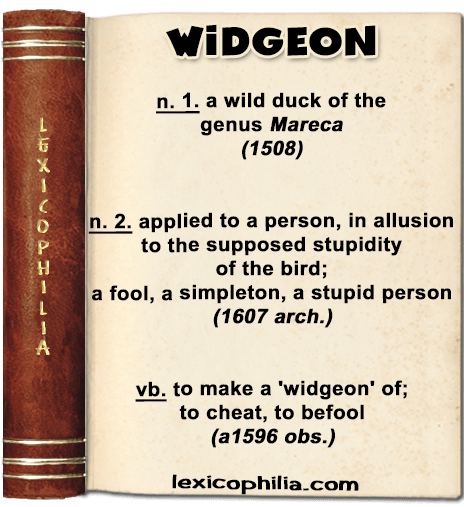
ETYMOLOGY
of uncertain origin
From the Oxford English Dictionary:
The form appears to suggest a French origin (compare pigeon n.), but French forms are first attested significantly later than the English word: compare †vigeon kind of West Indian duck (1667), †vingeon kind of duck observed in Madagascar (1690), kind of West Indian duck (1767 or earlier), Eurasian wigeon (Buffon 1783, also as †gingeon), American wigeon (J. Latham 1785), and it is even possible that the French word was borrowed < English.
PRONUNCIATION
WIJ-uhn
EXAMPLE (for n. 2)
“…Such as you shall like too: what say you to this young Gent. He is the widgen that wee must feed vpon…”
From: The Miseries of Inforst Mariage
By George Wilkins, 1607
 Lexicophilia