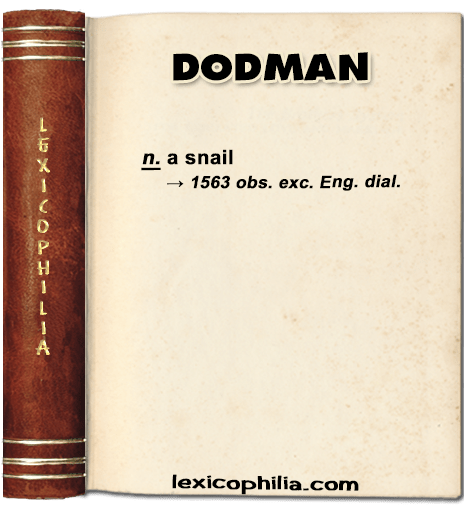
Word of the Day: DODMAN

ETYMOLOGY
origin unknown;
a connection with dod (a rounded summit or eminence (dialect)), has been suggested

EXAMPLE
“… KYNGE JOHAN. God hathe me ordeynned in this same princely estate
For that I shuld helpe such as be desolate.

SEDWSYON. Yt is as great pyte to se a woman wepe
As yt is to se a sely
dodman crepe,
Or, as ye wold say, a sely goose go barefote.

KYNGE JOHAN. Thou semyste by thy wordes to have no more wytt than a coote.
I mervell them arte to Englond so unnaturall,
Beyng her owne chyld: thou art worse than a best brutall.
…”

From: Kynge Johann,
By John Bale, a1563

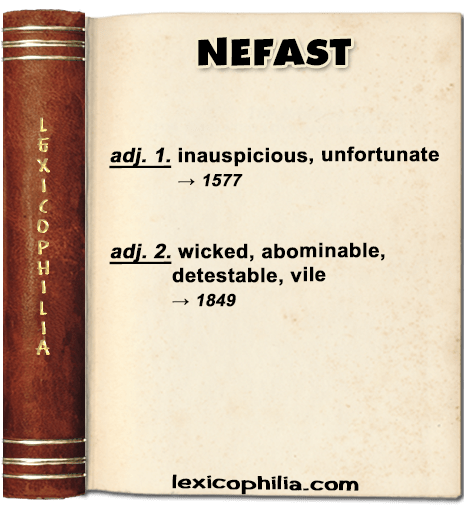
Word of the Day: NEFAST

ETYMOLOGY
from Latin nefastus (contrary to, or forbidden by divine law), 
from ne- (not) + fastus (lawful for the transaction of business) (from fas – wicked act, moral offense)

EXAMPLE (for adj. 1.)
“… The day of the moneth wherein he was borne, should be adiudged and accounted for an vnluckie, dismall, and nefast day, wherevpon it shoulde not be lawfull for any iudge to sit. …”

From: Beautifull Blossomes
By John Bishop, 1577

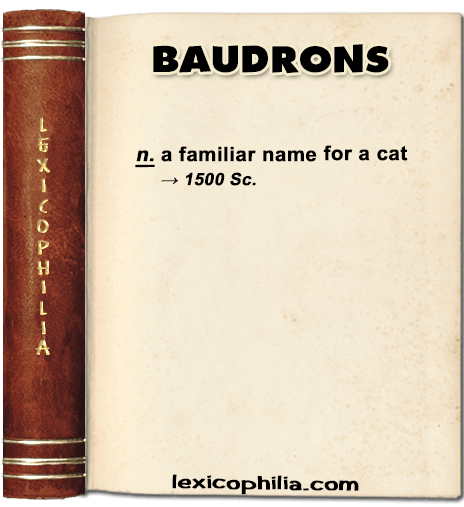
Word of the Day: BAUDRONS

ETYMOLOGY
of uncertain origin; perhaps Celtic

EXAMPLE
“… With fair tretie ʒit scho gart hir vpryse,
And to the burde thay went and togidder sat,
And scantlie had thay drunkin anis or twyse,
Quhen in come Gib hunter our Iolie Cat,
And bad God speid, the Burges vp with that,
And till the hole scho went as fyre on flint,
Bawdronis the vther be the bak hes hint. ….”

From: The Morall Babillis of Esope the Phrygian
By Robert Henryson, a1500

PRONUNCIATION
BAW-druhnz

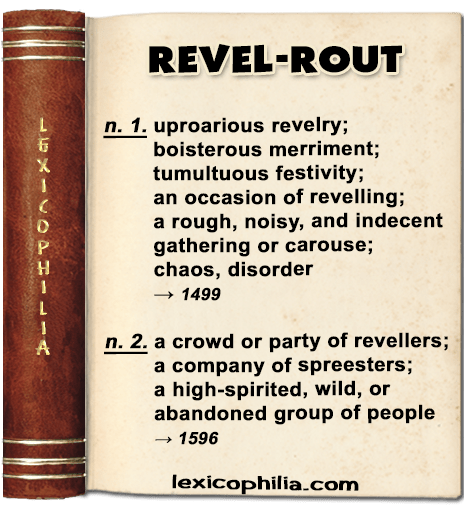
Word of the Day: REVEL-ROUT

ETYMOLOGY
from revel (exuberant merrymaking) + rout (a company or assemblage of persons)

EXAMPLE (for n. 1.)
“… Counter he coude (Olux) vpon a potte
An estryche fedder of a capons tayle
He set vp fresshely vpon his hat a lofte
What
reuell route quod he and gan to rayle
How ofte he hadde hit Ienet on the tayle
Of felyce fetewse dnd lytell prety cate
How ofte he knocked at her klycked gate
…”

From: Here begynneth a lytell treatyse named The Bowge of Courte
By John Skelton, 1499

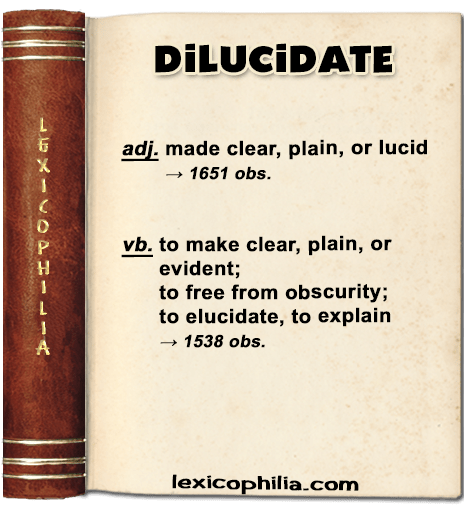
Word of the Day: DILUCIDATE

ETYMOLOGY
adj.:  from Latin dilucidatus, past participle of dilucidare (to make clear, to explain), from dilūcidus (clear, bright)
vb:  from Latin dilucidat- participial stem of dilucidare (to make clear, to explain)

EXAMPLE (for vb.)
“… .For we folowe not only a standynge text of the Hebrue, with the interpretacion of the Caldee, and the Greke, but we set, also, in a pryvate table, the dyversite of redinges of all textes, with suche annotacions, in another table, as shall douteles delucidate and cleare the same; as well without any singularyte of opinions, as all checkinges and reprofes. The prynt, no doubt, shall please your good Lordship. …”

From: State papers, published under the authority of His Majesty’s Commission. King Henry the Eighth
Coverdale and Grafton to Crumwell, 1538

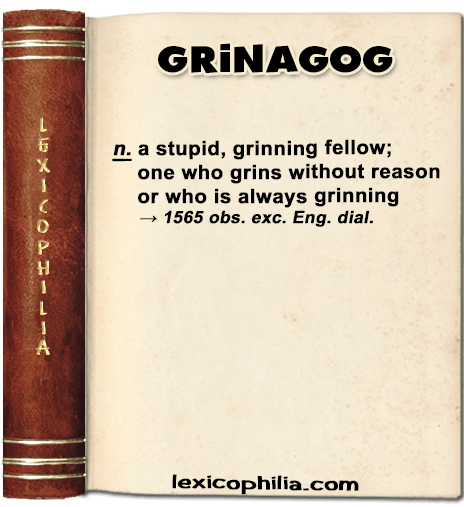
Word of the Day: GRINAGOG

ETYMOLOGY
from grin (vb.)

EXAMPLE
“… Fyrst, bycause none haue ye Prophets marke but such as be godly & lament wickednesse. But many of the diuels children, grinagods and such other, be crossed, and cursed to. Then also the proportion is so farre different, that there is no likenesse betwixt them. But for the likenesse of the effect, they may be well compared together. …”

From: An Aunsvvere to the Treatise of the Crosse wherin ye shal see by the plaine and vndoubted word of God, the vanities of men disproued
By James Calfhill, 1565

Word of the Day: PERICLITATE

ETYMOLOGY
adj.:  from Latin periclitatus (tried, tested, endangered) past participle of periclitari
vb:  from Latin periclitat-, past participial stem of periclitari (to expose to risk, danger, or peril), from periculumpericlum (trial, risk, danger)

EXAMPLE (for adj.
“… He alone be not noted to be the occasion of longer division werre and hostilite in Cristendome, wherby the hole state of the same may be periclitate and put in extreme daunger, but that by deliverance of the Frenche King, upon a convenient rawnsom, ther may ensue, God willing, generall peax bitwene al Cristen Princes, wherin He shal, besides the thanke of God, adquire more honour, than though by extreme force and violence He had attayned suche an other realme as Fraunce is. …”

From: State papers, published under the authority of His Majesty’s Commission. King Henry the Eighth, 1830
King Henry VIII. to Tunstall, &c., 1525

Word of the Day: HASKARD

ETYMOLOGY
of uncertain derivation; the suffix as in bast-ard, etc

EXAMPLE (for n.)
“… one daye as in a mornyng that he came out of the hous of a comyn woman He mette wyth a lewde haskarde, whyche for to doo the sayd synne of lechery went to the hous there as the holy man fro…”

From: Vitas Patrum
Translated by William Caxton, 1495

Word of the Day: FATIGATE

ETYMOLOGY
adj.:  from Latin fatigatus, past participle of fatigare (to fatigue)
vb.:  from Latin fatigat- participial stem of fatigare (to fatigue)

EXAMPLE (for adj.)
“… Oyle of Lune and water wyth labour grett,
I made Calcynyng yt with salt precipytate,
And by hyt selfe with vyolent hett
Gryndyng with Vynegar tyll I was
fatygate:
And also with a quantyte of Spyces acuate;
Uppon a Marble whych stode me oft in cost,
And Oyles with Corrosyves I made; but all was lost.
…”

From: Theatrum Chemicum Britannicum, Containing Severall Poeticall Pieces of our Famous English Philosophers, who have written the hermetique mysteries in their owne ancient language. Faithfully collected into one volume, with annotations;
By Elias Ashmole, 1652

Word of the Day: CHARGEFUL

ETYMOLOGY
from charge (n.) + -ful

EXAMPLE (for adj. 1.)
“… For so it is that whan the Kyng coude nat fynde with the seid Lowes bi alle the forseid costeley and chargefull ambassades but fraude, deceipte, and illusion, his Highnesse, of a grete prudence and foresight, purchased alliaunces and amyties with two the myghtyest princes of Fraunce, the Dukes of Burgoigne and Britaigne, …”

From: Literae Cantuarienses: The Letter Books of the Monastery of Christ Church, Canterbury, 1474
Edited by Joseph Brigstocke Sheppard, 1887