Word of the Day: GRINAGOG

ETYMOLOGY
from grin (vb.)

EXAMPLE
“… Fyrst, bycause none haue ye Prophets marke but such as be godly & lament wickednesse. But many of the diuels children, grinagods and such other, be crossed, and cursed to. Then also the proportion is so farre different, that there is no likenesse betwixt them. But for the likenesse of the effect, they may be well compared together. …”

From: An Aunsvvere to the Treatise of the Crosse wherin ye shal see by the plaine and vndoubted word of God, the vanities of men disproued
By James Calfhill, 1565

Word of the Day: GRIMALKIN

ETYMOLOGY
? Shakespeare’s Gray-Malkin, in “Macbeth,” 1605 = Gray cat

EXAMPLE
“… Your Muses, th’one a Youth, and one an Infant,
Gaue me two Panegericks at one Instant:
The first Pen, the first line it pleas’d to walke in,
Did make my Art a Rat, and like
Grimalkin,
Or a kinde needfull Vermin-coursing Cat.
By Art I play, but will not care your Rat.
I thanke you that you did so soone determine,
To Anagram my Art into a Vermine,
For which I vow, if e’re you keeps a Dayrie,
Of (now and then) a Cheese I will impaire yee.
…”

From: All the vvorkes of Iohn Taylor the water-poet
By John Taylor, 1630

PRONUNCIATION
grim-AL-kin

Word of the Day: GLIDDERY

ETYMOLOGY
from glidder (to glaze over; to cover with ice) + -y

EXAMPLE
“… Two men led my mother down a steep and gliddery stair-way, like the ladder of a hay-mow; and thence, from the break of the falling water, as far as the house of the captain. And there at the door, they left her trembling, strung as she was, to speak her mind. …”

From: Lorna Doone: a Romance of Exmoor
By Richard Doddridge Blackmore, 1869

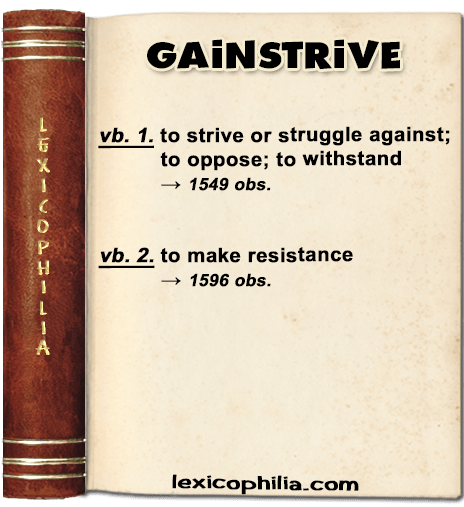
Word of the Day: GAINSTRIVE

ETYMOLOGY
from gain- (against, in opposition to) + strive (to endeavour vigorously)

EXAMPLE (for vb. 1.)
“… Giue vs that peace, which we doo lacke,
Through misbelief and ill lyfe:
Thy Word to offer thou dost not slacke,
Which we unkindly
gainstriue.
With fire and swoord,
This healthfull woord:
Some persecute and oppres:
Some with the mouth,
Confess the truth,
Wythout sincere godlynes.
…”

From: The Whole book of Psalms: collected into English metre, by Thomas Sternhold, John Hopkins, and others, 1569
Da Pacem, Domine

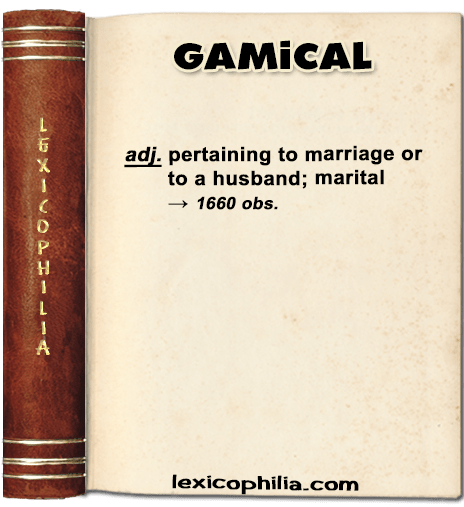
Word of the Day: GAMICAL

ETYMOLOGY
from Latin gamicus or from Greek γαµικός (of or for marriage) + -al

EXAMPLE
“… Humane Laws are threefold, viz. Secular, Temporal, or Civil, such are the Laws of every Country; or Gamacal , viz. the Laws of the Husband; or Paternal, viz. the Laws of Parents to their Children. …”

From: Justice vindicated from the false fucus put upon it, by Thomas White gent. Mr. Thomas Hobbs, and Hugo Grotius: As also elements of power & subjection;
By Roger Coke, 1660

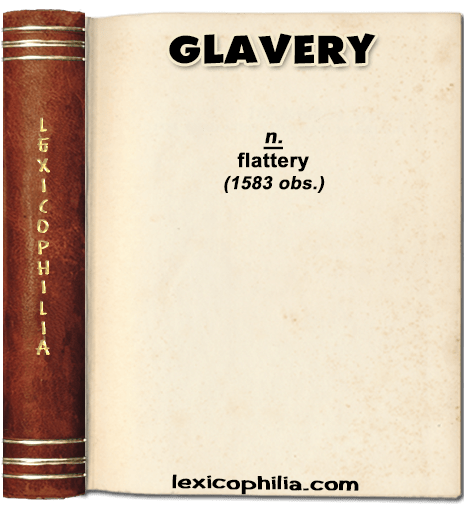
Word of the Day: GLAVERY

ETYMOLOGY
from glaver (to flatter, to deceive with flattery) + -y;
glaver is of obscure origin

EXAMPLE
“… But I staie my selfe and assure you of this, that in al crations and speeches, in all pleas, and actions, for and against any man amongst them, honest plainenesse was euer an argument of fauour and succour, and holowe smoothing glauerie a note of reprooch and an argument to perswade the contrarie. Nowe therefore let vs gather vppe all these againe together, and if heathens hate it, Christians loath it, and the God of life and death abhor it, what strength should anie cause in the earth haue to tempt you vnto it? …”

From: A Briefe Conference betwixt Mans Frailtie and Faith
By Gervase Babington, 1584

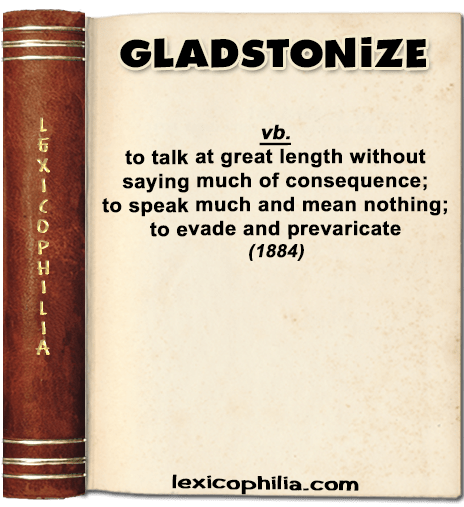
Word of the Day: GLADSTONIZE

ETYMOLOGY
from the alleged characteristics of British Prime Minister, William Ewart Gladstone, 1809-1898

EXAMPLE
“… Before the capitalist proprietors woke up to our game and cleared us out, the competition of the Star, which was immensely popular under what I may call the Fabian regime, had encouraged a morning daily, the Chronicle, to take up the run¬ nings and the Star, when it tried to go back, found that it could not do so further than to Gladstonize its party politics. …”

From: Fabian Tract No. 41
The Fabian Society: It’s Early History
By G. Bernard Shaw, 1892

Word of the Day: GLOAMING

ETYMOLOGY
representing Old English glomung strong feminine, from (on the analogy of ǽfning evening) glom (twilight), probably from the Germanic root glo-;
the etymological sense would thus seem to be the ‘glow’ of sunset or sunrise

EXAMPLE
“… There’s some exceptions, man an’ woman;
But this is Gentry’s life in common.
By this, the sun was out o’ sight,
An’ darker
gloamin brought the night;
The bum-clock humm’d wi’ lazy drone;
The kye stood rowtin’ i’ the loan;
When up they gat, an’ shook their lugs,
Rejoic’d they were na men, but dogs;
An’ each took aff his several way,
Resolv’d to meet some ither day.
…”

From: The Twa Dogs. A Tale
By Robert Burns, 1786