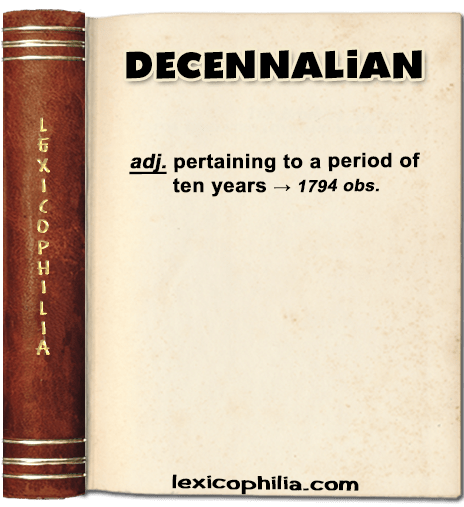
Word of the Day: DECENNALIAN

ETYMOLOGY
from Latin decennalis (of ten years) + -an

EXAMPLE
“… But the war was finished in the first year of the fourteenth Olympiad, in which the Corinthian Damon conquered in the stadium, and when, among the Athenians, the Medontidae still held the decennalian government, and the fourth year of the reign of Hippomenes was expired. …”

From: The Description of Greece
By: Pausanias
Translated by: Thomas Taylor
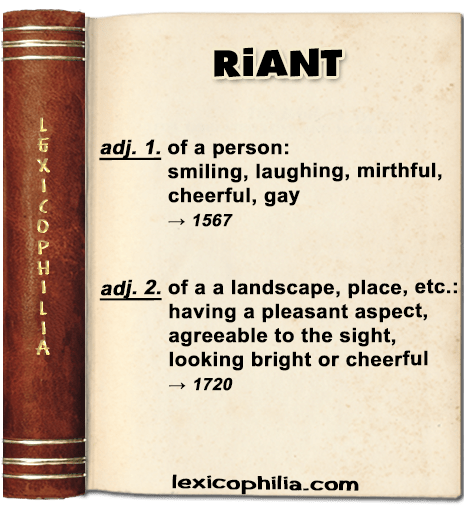
Word of the Day: RIANT

ETYMOLOGY
from French riant (smiling, laughing, cheerful, pleasant to look at), use as adjective of present participle of rire (to laugh), from Latin ridere (to laugh)

EXAMPLE (for adj. 1.)
“… Whatever was austere or earnest, still more, whatever bordered upon awe or horror, his riant fancy rejected with aversion; the rigorous moral sometimes hid in these traditions, the grim lines of primeval feeling and imagination to be traced in them, had no charms for him …”

From: German Romance: Specimens of its Chief Authors
By Thomas Carlyle, 1827
Johann August Musaeus

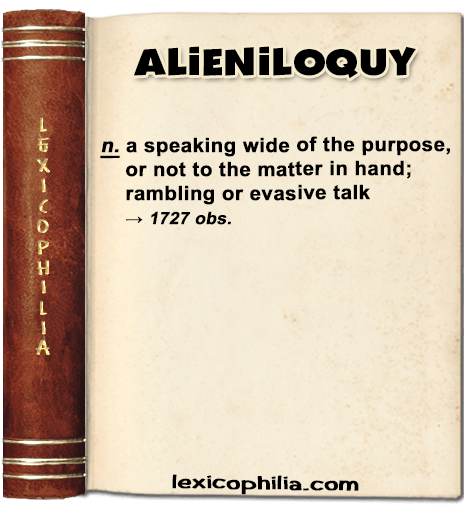
Word of the Day: ALIENILOQUY

ETYMOLOGY
from Latin alieniloquium, from alienus (foreign) + -loquium (from loqui (to speak))

EXAMPLE
“… In my dream she lived only to magnify my existence. Like an intravenous poison I kept topping her up. And then rain interrupted my alieniloquy. …”

From: Fastyngange
By Tim Wynne-Jones, 1988

PRONUNCIATION
ay-lee-uh-NIL-uh-kwee

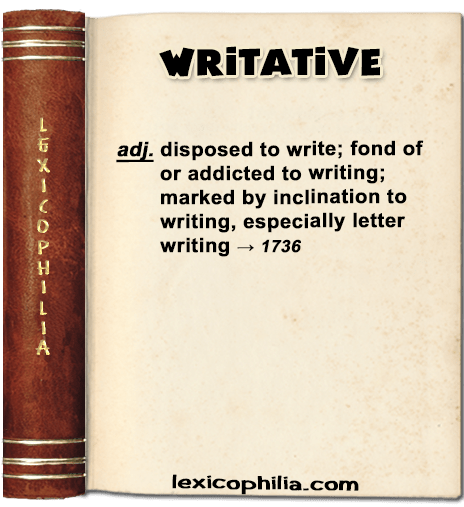
Word of the Day: WRITATIVE

ETYMOLOGY
from write (vb.) + -ative; after talkative

EXAMPLE
“… I find, tho’ I have less experience than you, the truth of what you told me some time ago, that increase of years makes men more talkative but less writative: to that degree, that I now write no letters but of plain business, or plain how-d’ye’s, to those few I am forced to correspond with, either out of necessity, or love …”

From: The Works of Alexander Pope, 1741
Letters to and from Dr. Swift, &c.
Letter LXXXI, August, 17, 1736

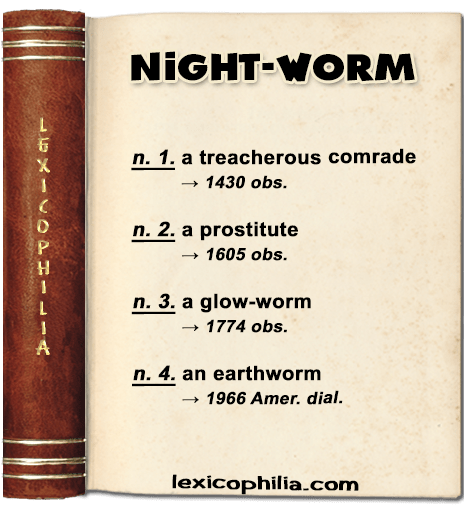
Word of the Day: NIGHT-WORM

ETYMOLOGY
from night + worm

EXAMPLE (for n. 1.)
“… Ye noble Pryncis, conceyueth the sentence
Off this story, remembrid in scripture,
How that Sampson off wilful necligence
Was shaue & shorn, diffacid his figure;
Keep your conceitis vnder couerture,
Suffre no 
nyhtwerm  withynne your counsail kreepe,
Thouh Dalida compleyne, crie and weepe!
…”

From: The Fall of Princes
Translated by John Lydgate, a1439
Edited by Dr. Henry Bergen
The Early English Text Society, 1924

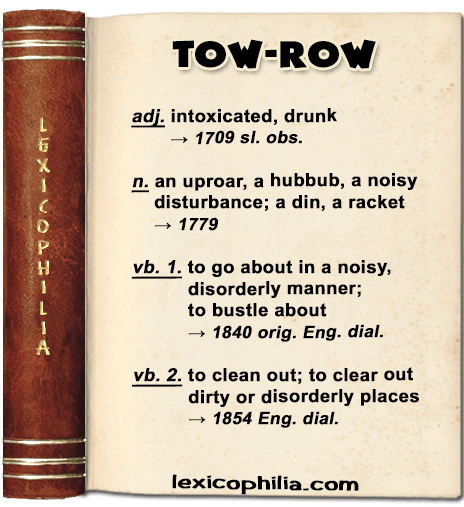
Word of the Day: TOW-ROW

ETYMOLOGY
reduplicated or extended form of row (a violent disturbance); orig. dialect

EXAMPLE (for adj.)
“… If a Virgin blushes, we no longer cry the Blues. He that Drinks till he stares, is no more Tow-Row, but Honest. A Youngster in a Scrape, is a Word out of Date; and what bright Man says , I was Joab’d by the Dean …”

From: The Tatlers
By Isaac Bickerstaff. 1710