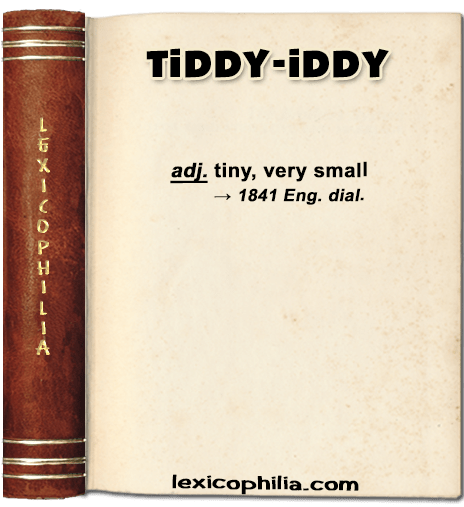
Word of the Day: TIDDY-IDDY

ETYMOLOGY
replication of tiddy (tiny, small)

EXAMPLE
“… In time came those maternal joys
Which take the form of girls or boys,
And strange to say of each they’d one –
A
tiddy iddy daughter, and a tiddy iddy son!…”

From: The “Bab” Ballads:
Much Sound and Little Sense
By W. S. Gilbert, 1869
Thomas Green and Harriet Hale.
To be Sung to the Air of “An ‘Orrible Tale”

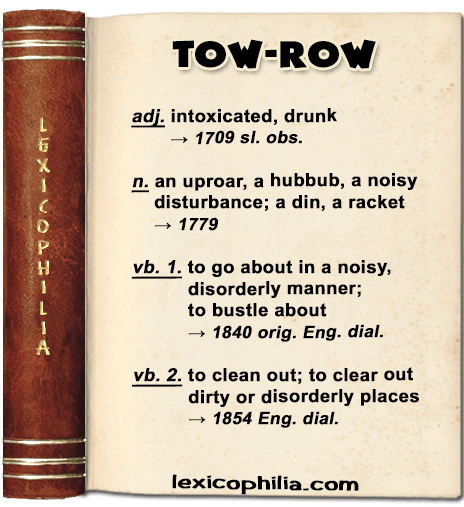
Word of the Day: TOW-ROW

ETYMOLOGY
reduplicated or extended form of row (a violent disturbance); orig. dialect

EXAMPLE (for adj.)
“… If a Virgin blushes, we no longer cry the Blues. He that Drinks till he stares, is no more Tow-Row, but Honest. A Youngster in a Scrape, is a Word out of Date; and what bright Man says , I was Joab’d by the Dean …”

From: The Tatlers
By Isaac Bickerstaff. 1710

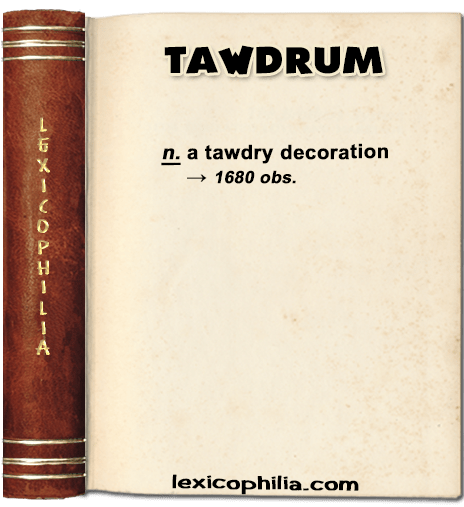
Word of the Day: TAWDRUM

ETYMOLOGY
from tawdry, with Latin ending -um 

EXAMPLE
“… Young Woman, young Woman, this is no time to think of Trifles, and gew gaws; the best dress is that of Repentance, let your Conscience be clean and neat within, and no matter for Lace and Tawdrums; dress up your Soul I say. …”

From: The Revenge, or, A Match in Newgate a Comedy
Usually attributed to writer, Aphra Behn, 1680

Word of the Day: THUMPATORY

ETYMOLOGY
from thump + –atory (a thing relating to)

EXAMPLE
“… Then scrubbing and swindging a little with his left Hand alongst, and upon the uppermost in the very bought of the Elbow of the said dexter Arm, the whole Cubit thereof by leisure fair, and softly, at these thumpatory warnings, did raise and elevate it self even to the Elbow, and above it, on a suddain did he then let it fall down as low as before: and after that, at certain intervals and such spaces of time, raising and abasing it, he made a shew thereof to Panurge …”

From: The Third Book of the Works of Mr. Francis Rabelais, Containing the Heroick Deeds of Pantagruel the Son of Gargantua,
By François Rabelais
Translated by Thomas Urquhart and Peter Anthony Motteux, 1693

Word of the Day: TAUTOLOGIZE

ETYMOLOGY
from tautology (unnecessary repetition of the same word, phrase, idea, argument, etc.; the saying of the same thing twice in different words), (from late Latin tautologia, from Greek ταὐτολογία, from ταὐτολόγος) + -ize

EXAMPLE
“… Although I am not ignorant that there be some which make two kindes of these Serpents, because of the two names rehearsed in the title, yet when they haue laboured to describe them seuerally, they can bring nothing or very little wherein their story doth not agree, so as to make twaine of them, or to handle them asunder, were but to take occasion to tautologize , or to speake one thing twice. …”

From: The Historie of Serpents. Or, The Second Booke of Liuing Creatures
By Edward Topsell, 1608

Word of the Day: TWIGGER

ETYMOLOGY
apparently from twig (to do anything strenuously or vigorously, obs.) + -er

EXAMPLE
“… Eaws yerely by twining, rich masters do make the lamb of such twynners, for breeders go take.
For twinlings be
twiggers, encrease for to bring:
though some for their twigging, peccantem may sing
Calues likely, yt come betwene Christmas & Lent,
take huswife to rere, or else after repent.
…”

From: Fiue Hundreth Points of Good Husbandry vnited to as many of good huswiferie first deuised,
By Thomas Tusser, 1573

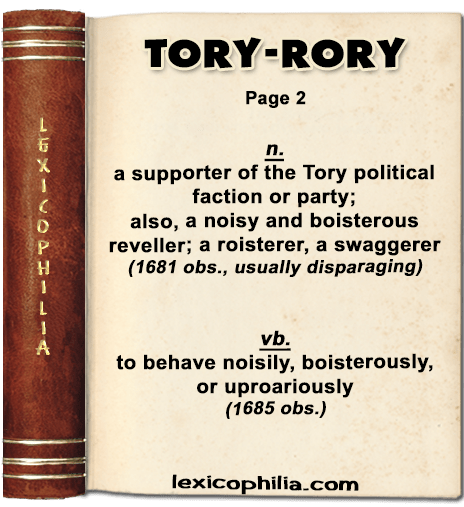
Word of the Day: TORY-RORY

ETYMOLOGY
Probably a reduplication (with consonant variation) of Tory (n.), perhaps after roary (loud, noisy, roaring)

EXAMPLE (for adj. 2.)
“… ‘Tis strange two of such different Tempers should so well agree: Methinks you look like two as roaring, ranting, tory rory Sparks as one would wish to meet withall. …”

From: Friendship in Fashion A Comedy
By Thomas Otway, 1678

Word of the Day: TIRELING

ETYMOLOGY
apparently from tire (to diminish, give out, come to an end, obs.) + -ling

EXAMPLE
“… So as they gazed after her a while,
Lo where a griesly Foster forth did rush,
Breathing out beastly lust her to defile:
His
tyreling iade he fiercely forth did push,
Through thicke and thin, both ouer banke and bush
In hope her to attaine by hooke or crooke,
That from his gorie sides the bloud did gush:
Large were his limbes, and terrible his looke,
And in his clownish hand a sharp bore speare he shooke.
…”

From: The Faerie Queene
By Edmund Spenser, 1590