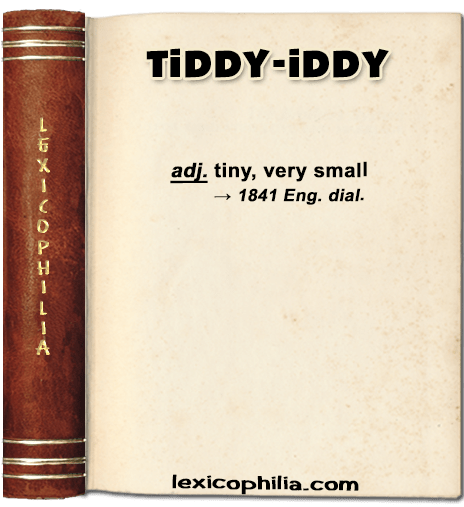
Word of the Day: TIDDY-IDDY

ETYMOLOGY
replication of tiddy (tiny, small)

EXAMPLE
“… In time came those maternal joys
Which take the form of girls or boys,
And strange to say of each they’d one –
A
tiddy iddy daughter, and a tiddy iddy son!…”

From: The “Bab” Ballads:
Much Sound and Little Sense
By W. S. Gilbert, 1869
Thomas Green and Harriet Hale.
To be Sung to the Air of “An ‘Orrible Tale”
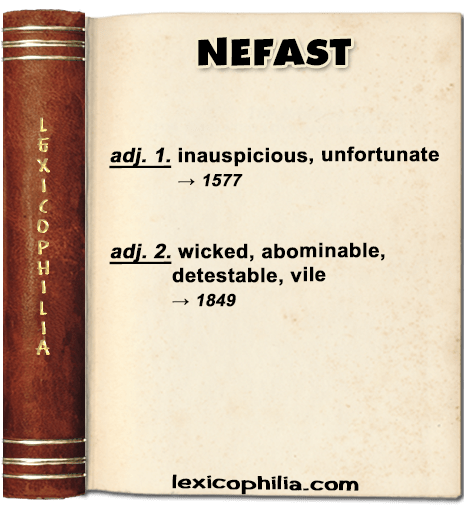
Word of the Day: NEFAST

ETYMOLOGY
from Latin nefastus (contrary to, or forbidden by divine law), 
from ne- (not) + fastus (lawful for the transaction of business) (from fas – wicked act, moral offense)

EXAMPLE (for adj. 1.)
“… The day of the moneth wherein he was borne, should be adiudged and accounted for an vnluckie, dismall, and nefast day, wherevpon it shoulde not be lawfull for any iudge to sit. …”

From: Beautifull Blossomes
By John Bishop, 1577

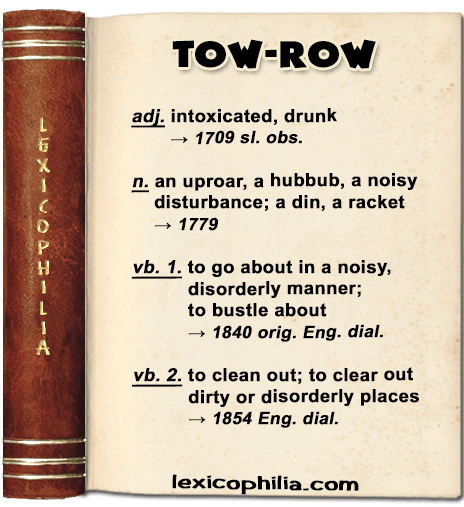
Word of the Day: TOW-ROW

ETYMOLOGY
reduplicated or extended form of row (a violent disturbance); orig. dialect

EXAMPLE (for adj.)
“… If a Virgin blushes, we no longer cry the Blues. He that Drinks till he stares, is no more Tow-Row, but Honest. A Youngster in a Scrape, is a Word out of Date; and what bright Man says , I was Joab’d by the Dean …”

From: The Tatlers
By Isaac Bickerstaff. 1710

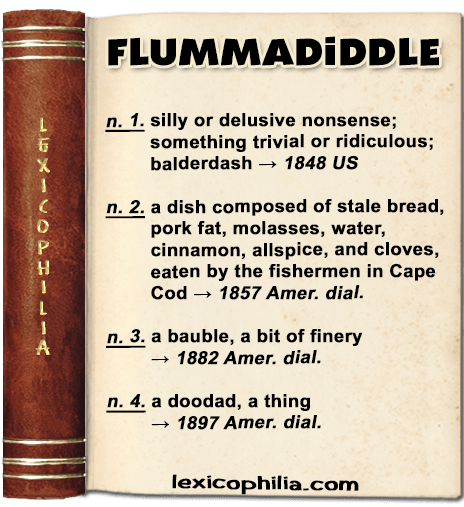
Word of the Day: FLUMMADIDDLE

ETYMOLOGY
probably from flummery (nonsense, humbug, empty trifling)

EXAMPLE (for n. 1.)
“… When Mr. Middleton was spoken to on the subject of sending Julia to Frankfort, he at first refused outright. ” No,” said he, ” indeed she shan’t go ! What does she want of any more flummerdiddle notions ? What she does know is a damage to her ! “
“But do you not wish to give your daughters every possible advantage ? ” said Mr. Wilmot.
…”

From: Tempest and Sunshine; or, Life in Kentucky
By Mary Jane Holmes, 1854

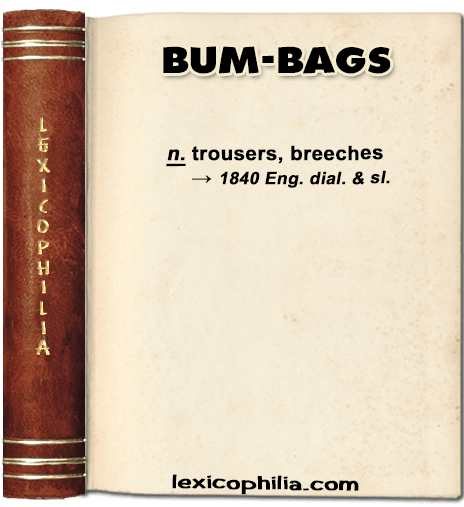
Word of the Day: BUM-BAGS

ETYMOLOGY
from bum + bags (trousers, sl.)

EXAMPLE
“… Hodgson in a bit of pink!
Shade of Stultz, shade of Brummell,
Who of such a sight could think,
Having seen him in the pommel?

Hodgson in white leathers, tights,
Braces, bumbags, brogues, or breeches
Made to fit like very Flight’s,
Till the pressure starts the stitches.
…”

From: The Annals of the Warwickshire Hunt, 1896
Costume of the New Master of the Quorn (Mr. Hodgson)
By Lord Rosslyn in Blackwood’s Magazine, February Ist, 1840

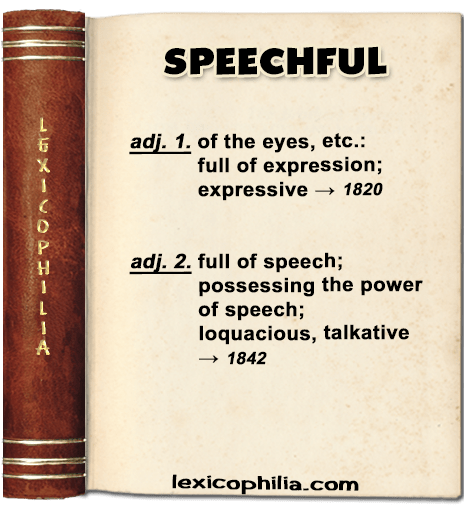
Word of the Day: SPEECHFUL

ETYMOLOGY
from speech + -ful

EXAMPLE (for adj. 2.)
“… John Mauropus, of Euchaita, Euchania, Theodoropolis — one living man among many dead, as the Arabian tale goes of the city of enchantment — one speechful voice among the silent, sole survivor of the breath which maketh words effluence of the soul replacing the bittern’s cry — speak to us! …”

From: Some Account of the Greek Christian Poets
By Elizabeth Barrett Browning, 1842 (1863)

Word of the Day: PHILOFELIST

ETYMOLOGY
from philo, combining form (loving, having an affection for) + Latin feles (cat) + -ist

EXAMPLE
“… An extract from the Register of Cat’s Eden has got abroad, whereby it appears that the Laureate, Dr. Southey, who is known to be a philofelist, and confers honours upon his Cats according to their services, has raised one to the highest rank in peerage, promoting him through all its degrees by the following titles, His Serene Highness the Arch-Duke Rumpelstilzchen, Marquis Macbum, Earl Tomlemagne, Baron Raticide, Waowlher and Skaratchi. …”

From: The Doctor, &c.
By Robert Southey, 1847

Word of the Day: PECKSNIFF

ETYMOLOGY
from the name of Mr. Pecksniff, a hypocritical character in Charles Dickens’s novel “The Life and Adventures of Martin Chuzzlewit

EXAMPLE
“… Should Welby Pugin ever favour us with a Supplement to his Contrasts, he will uo doubt bring forward as one most egregious instance of architectural bathos the unlucky structure commented upon in the preceding paragraph. He might also hold up for reprehension a good many Pecksniff specimens of Gothic and Tudor of very recent date – certainly more recent than would be imagined, for some of them seem to be almost twin-brothers to Strawberry Hill, or else to the front of Guildhall …”

From: The Civil Engineer and Architect’s Journal, Scientific and Railway Gazette
Volume 7, 1844

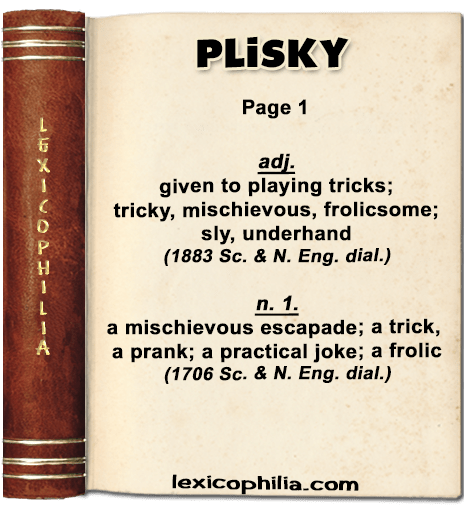
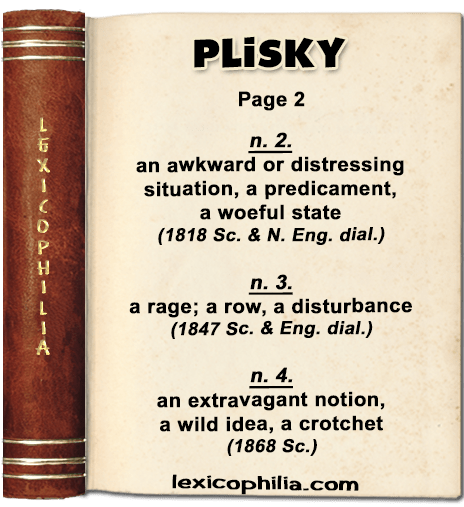
Word of the Day: PLISKY

ETYMOLOGY
of obscure origin

EXAMPLE (for n. 1.)
“… They ‘re fly’d at the heart, it’l be a black Bargain for poor Scotland: for the Engleses are owr auld farren for us, and there’s little Ground to think, they ‘ll gee
us a seen Vantage wee their will, they neer liked us sae well; and its naе forgotten yet, the foul
Plisk they play’d us about our Caledonia Business; …”

From: The Scottish Antiquary Or Northern Notes and Queries
Volume XII, January 1898
A Copy of a Letter from a Country Farmer To His Laird, a Member of Parliament, 1706

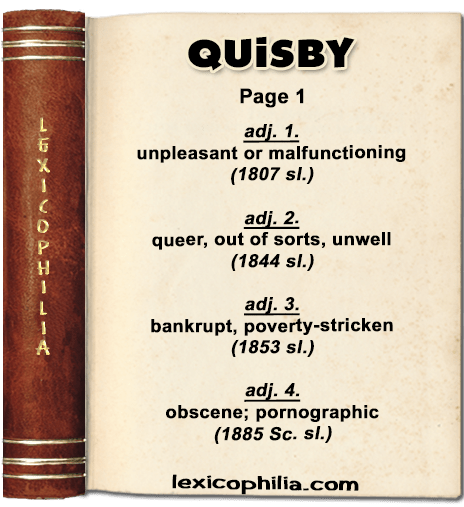
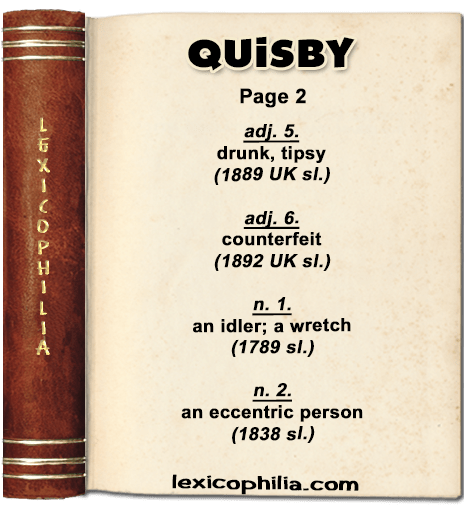
Word of the Day: QUISBY

ETYMOLOGY
of uncertain origin;
possibly from quiz (n.) + -by

EXAMPLE
“… Alibi. What wou’d I do then?
Air. Aye, Sir, what wou’d you do then?
Soph. Cou’dn’t he push a little feeble old quisby like you down into a chair?
Alibi, How, pray?
Soph. Shew him how, Robin?
Air. Why there – (puts him into a chair) Just that way
Alibi. Well, now Old Quisby’s down in the chair – what wou’d he do then?…”

From: The Toy
By John O’Keeffe, 1789