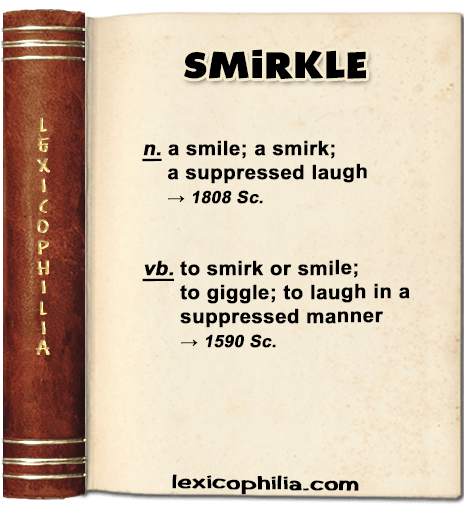
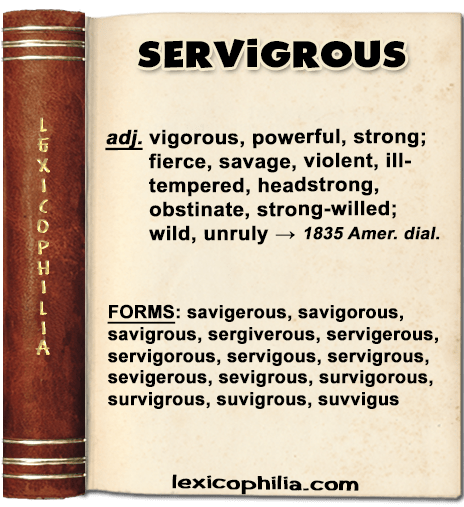
Word of the Day: SMIRKLE

ETYMOLOGY
from smirk (vb.) + -le

EXAMPLE
“… Blinks waggish glances now and then,
And flytes upon his priests sae jolly
For heaviness and melancholy;
The friskier for the flytin’ they
Gaffaw and
smirkle in their play
‘Mid sic like daffery and glaikin’,
Baith god and priest were merry-makin’,
Whan, hark! upon the gowden door,
Tirl! comes a rap, as seld before
…”

From: Papistry Storm’d; or, The Dingin’ Down o’ the Cathedral
By William Tennant, 1827

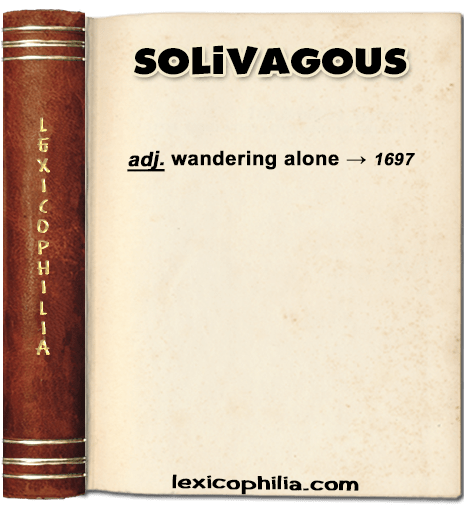
Word of the Day: SOLIVAGOUS

ETYMOLOGY
from Latin solivagus, from solus + vagari (to wander)

EXAMPLE
“… Other creatures live free and independent upon one another, except the young ones of some Creatures, while they can seek their Food and Preservation; and are either Solivagous and Hurtful, as Foxes, Wolves and Tigers, &c. or live promiscuously in Herds and Flocks, and are innocent Creatures as Sheep, Goats, &c. whereas Men live in Dependency one upon another, so as no Man can subsist of himself; …”

From: A Detection Of The Court and State Of England During The Four Last Reigns 
and the Inter-Regnum.
By Roger Coke, 1697
The Reign of King Charles II. A. D. 1661

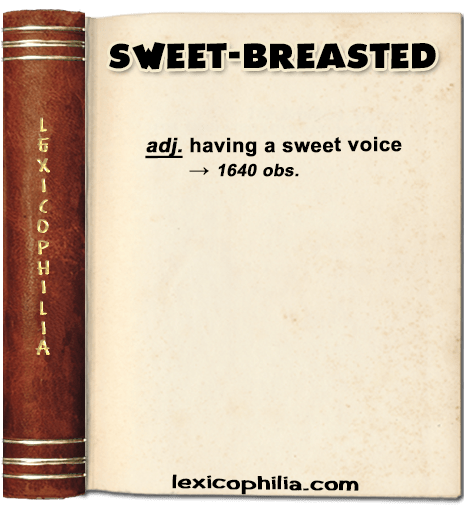
Word of the Day: SWEET-BREASTED

ETYMOLOGY
from sweet + breasted (breast = a person’s singing voice, obs.)

EXAMPLE
“… I like his feather well: a proper man,
Of good discourse, fine conversation,
Valiant, and a great carrier of the businesse,
Sweet breasted, as the Nightingale, or Thrush:
Yet I must tell you; you forget your selfe,
My Lord Vitellies love, and maintenance
Deserves no other Jack ith’ box, but he:
What though he gather’d first the golden fruit,
And blew your pigges-coat up into a blister,
When you did wait at Court upon his mother;
Has he not wel provided for the barne?
Beside, what profit reap I by the other?
If you wil have me serve your pleasure, Lady,
Your pleasure must accommodate my service; …”

From: Comedies and Tragedies written by Francis Beaumont and John Fletcher, 1647
Love’s Cure, or The Martial Maid“, a1640

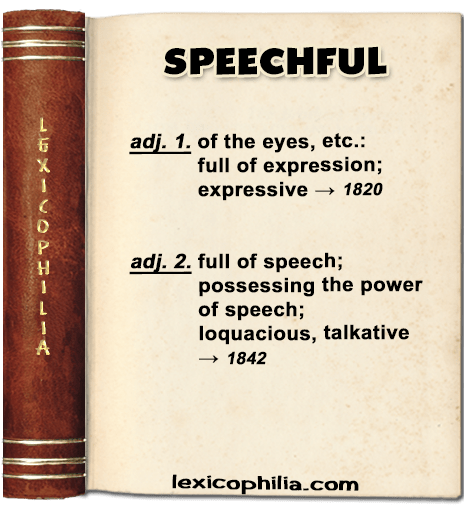
Word of the Day: SPEECHFUL

ETYMOLOGY
from speech + -ful

EXAMPLE (for adj. 2.)
“… John Mauropus, of Euchaita, Euchania, Theodoropolis — one living man among many dead, as the Arabian tale goes of the city of enchantment — one speechful voice among the silent, sole survivor of the breath which maketh words effluence of the soul replacing the bittern’s cry — speak to us! …”

From: Some Account of the Greek Christian Poets
By Elizabeth Barrett Browning, 1842 (1863)

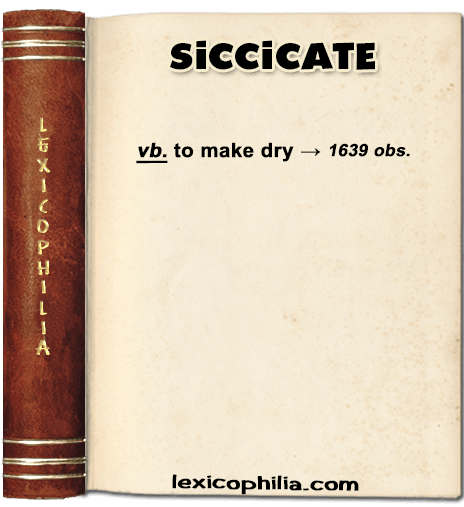
Word of the Day: SICCICATE

ETYMOLOGY
irregularly from Latin siccus or siccare

EXAMPLE
“… Thirdly, when you put forth your horses to run at grasse all, or the most part of Summer, during which time the scorching heats wil so siccicate and dry the planks, which will cause them to warp, and the pinnes which holdeth them down to the joyces will rot, and so the planks give way, especially when horses (who not being handled in some moneths before) becomming wild, rammage, and unruly, are newly brought into the Stable, who feeling the planks to move, yeeld, and give way under them, will fall from starting thereat, to slinging, leaping, bounding and plunging, till they have dislocated the planks, and thereby have endangered both themselves, the residue of their fellowes, and those who might come to their help and succour, which is a thing very frequent in a flore of this nature: …”

From: The Compleat Horseman and Expert Ferrier In two bookes. The first, shewing the best manner of breeding good horses, with their choyce, nature, riding and dyeting … The second, directing the most exact and approved manner how to know and cure all maladies and diseases in horses;
By Thomas de Grey, 1639

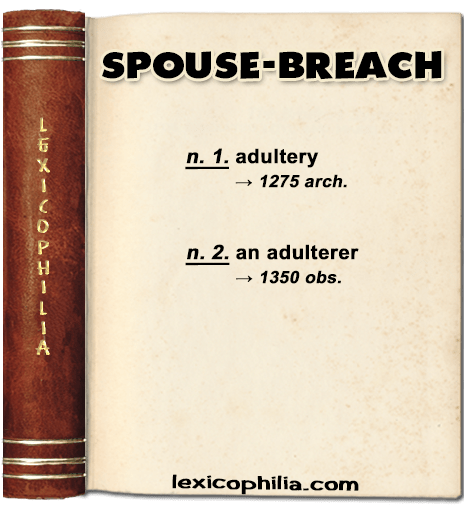
Word of the Day: SERVIGROUS

ETYMOLOGY
of uncertain origin;
possibly an alteration of savagerous (barbarously savage); perhaps influenced by vigorous

EXAMPLE
“… It now came to Spivey’s turn. There was nothing remarkable in his person or manner. He took his place, lowered his rifle slowly from a perpendicular, until it came on a line with the mark — held it there like a vise for a moment, and fired.
” Pretty
sevigrous, but nothing killing yet,” said Billy Curlew, as he learned the place of Spivey’s ball. …”

From: Georgia Scenes, Characters, Incidents, &c. : in the first half century of the republic,
By Augustus Baldwin Longstreet, 1835
“The Shooting Match”

PRONUNCIATION
suhr-VIGH-gruhss