ETYMOLOGY
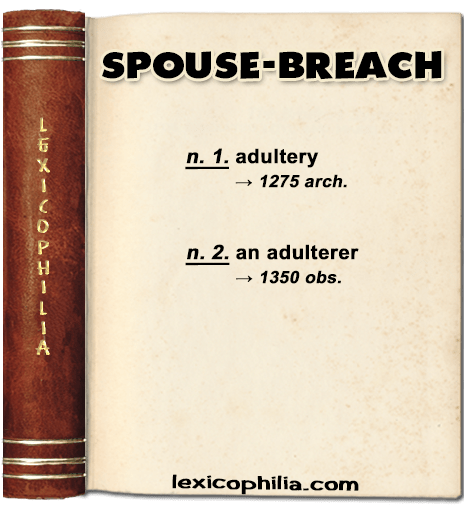
from spouse (n.) + breach (n.); possibly an alteration of spousebriche (adultery)
EXAMPLE (for n. 2.)
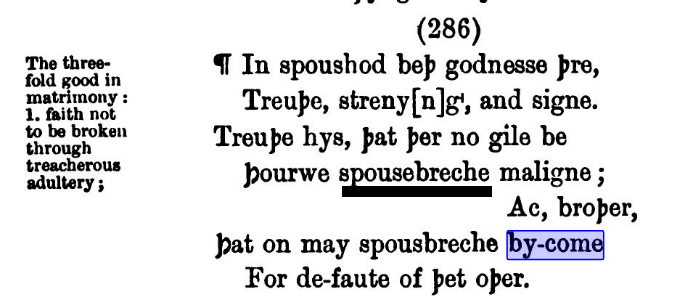
From: The Poems of William Of Shoreham, c1350
Edited by: Matthias Konrath
Published by The Early English Text Society, 1902
ETYMOLOGY
from spouse (n.) + breach (n.); possibly an alteration of spousebriche (adultery)
EXAMPLE (for n. 2.)
From: The Poems of William Of Shoreham, c1350
Edited by: Matthias Konrath
Published by The Early English Text Society, 1902

ETYMOLOGY
apparently from still (adj.) + worth, after stalworth
EXAMPLE
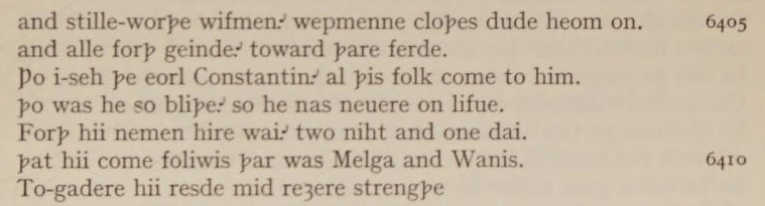
From: Laȝamon; Layamon: Brut, c1300
Edited from British Museum ms. Cotton Caligula A.IX and British Museum ms. Cotton Otho C.XIII
Edited by George Leslie Brook and Roy Francis Leslie, 1963
ETYMOLOGY
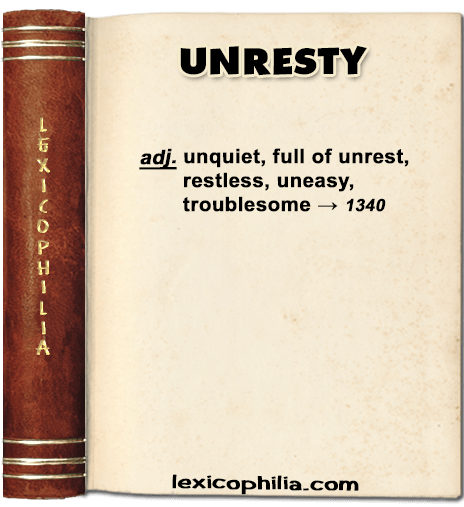
from un- + resty (restless, fidgety)
EXAMPLE
“… But for as muche as I mot nedes lyke.
Al þat yow lyst I dar not pleyne more.
But humbely with sorwful sykes syke.
Yow wryte ich myne vnresty sorwes sore.
Fro day to day desyryng euere more.
To knowen fully yf it youre wil [it] were.
How ye han ferd and don whyl ye be þere. …”
From: A parallel-text print of Chaucer’s Troilus and Criseyde from the Campsall ms. of Mr. Bacon Frank, a1413
Edited by Frederick James Furnivall
Published for the Chaucer Society, 1881
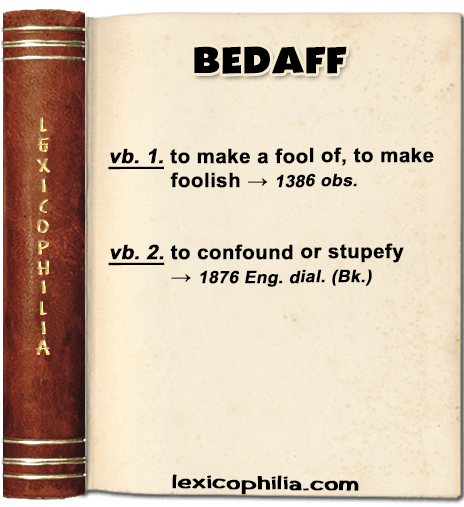
ETYMOLOGY
from be- + daff (a fool, a simpleton)
EXAMPLE (for vb. 1.)
“… Folweth ecco, that holdeth no silence,
But ever answereth at the countretaille :
Beth not bedaffed for your innocence,
But sharply taketh on you the governaille :
Emprenteth wel this lesson in your minde,
For comun profit, sith it may availle. …”
From: Canterbury Tales; The Clerkes Tale
By Geoffrey Chaucer, c1386
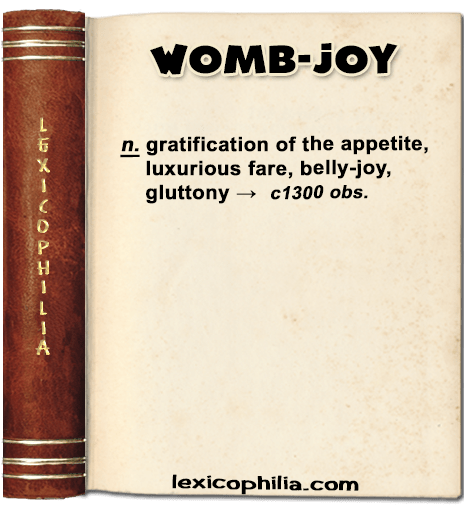
ETYMOLOGY
from womb (the abdomen or abdominal cavity of a person or animal; the belly, obs.) + joy
EXAMPLE
“… for bischopis, munkis & chanons sillen þe perfeccion of cristis pouert & his apostlis, & also trewe prechynge for a litil stynkyng muk or drit, & worldli lordschipe, & wombe ioie and idelnesse …”
From: The English Works of Wyclif hitherto unprinted
By John Wyclif, c1430
Edited by Frederic David Matthew, 1880

ETYMOLOGY
from Old Norse svangr, related to svangi (swange, groin), from swaŋgw-, perhaps identical with swaŋgw-, grade-variant of swiŋgw- (to swing – to scourge, whip, flog, beat)
EXAMPLE
“… Þe hungri in god he made stronge,
And þe riche he lette al swonge.
Þe folk of Israel haþ vndurfonge
Þe child þat heo abide longe; …”
From: The minor poems of the Vernon MS
Published for the Early English Text Society, 1892-1901
La estorie del Euangelie, a1300
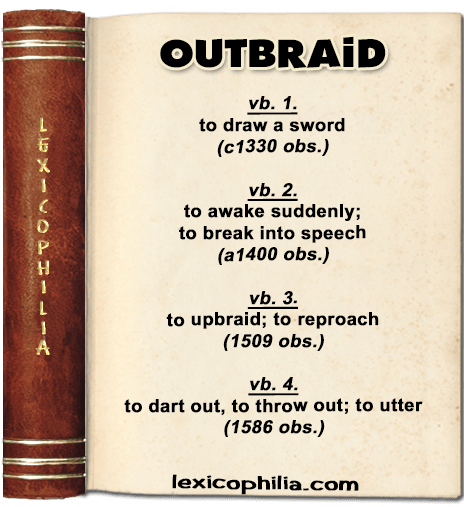
ETYMOLOGY
vb. 1. 2. 4. from out- + braid (to make a sudden movement with the hand, etc.; to brandish a spear;. to deal a blow)
vb. 3. altered form of abraid (to reproach, to reprove)
EXAMPLE (for vb. 3.)
“… And for that this displeasour doth hym dere
His frende: he soone out-braydeth of the same
Hym-self (for malyce) drawynge by the here
So hath this fole by malyce and yll name
His rewarde lost for it rebuked and shame
And no meruayle: for no man that hath skyll
Shall thanke hym for goodnes done agaynst his wyll …”
From: The Shyp of Folys of the Worlde
By Alexander Barclay, 1509

ETYMOLOGY
aphetic form of Old French enfaunt, enfant (infant);
The shortened form has not been found in French, but Italian has the corresponding fante (boy, servant, foot-soldier), whence German fant
EXAMPLE
“… The eiȝt day the fawnt shal be circumcidid. …”
From: Bible (Wycliffite, early version) Leviticus 12:3
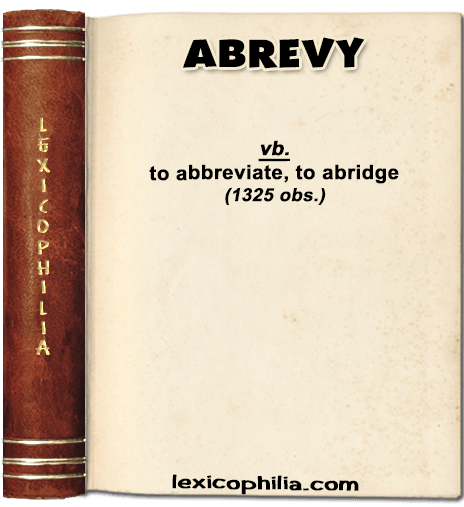
ETYMOLOGY
from Middle French abrevier, from Latin abbreviare (to abbreviate, to shorten)
EXAMPLE
“… Fyrst, diuide the denominator by hys numerator, and if anye number doe remaine, let your diuisor be diuided by the same number, and so you must continue vntyll you haue so diuided yt there may nothing remaine, then is it to be vnderstande, that your last diuisor (wherat you did ende, and that 0. did remaine after your last diuision) is the greatest number, by the which you must abreuiat, as you did in the laste example, but in case that your last diuisor be 1. it is a token that the same number can not be abreuied. Example, of 54/11 diuide 81. (which is the denominator) by 54. which is his numerator, and there resteth 27. then diuide 54. by 27. and there remaineth nothing, wherefore your last diuisor 27. is the number, by the which you must abreuiat 54/81 as in the last example is specifyed. …”
From: The Welspring of Sciences, which teacheth the perfecte worke and practise of arithmeticke both in vvhole numbers & fractions
By Humfrey Baker, 1564
The thirde Chapter treateth of abbreuiation of one great broken number into a lesser broken

ETYMOLOGY
representing Old English type líegestre, feminine agent-noun to leogan,
from lie (to tell a lie)
EXAMPLE
“… “Yif ich say ich hadde a hi-leman,
“That ich leighe meselue opon :
“Than ich worth of old and yong
“Be hold leighster and fals of tong.
“Yete me is best take mi chaunce,
“And sle me childe, and do penaunce. …”
From: Lai le Freine, c1325
in Metrical romances of the thirteenth, fourteenth, and fifteenth centuries: published from ancient manuscripts
By Henry William Weber, 1810
 Lexicophilia