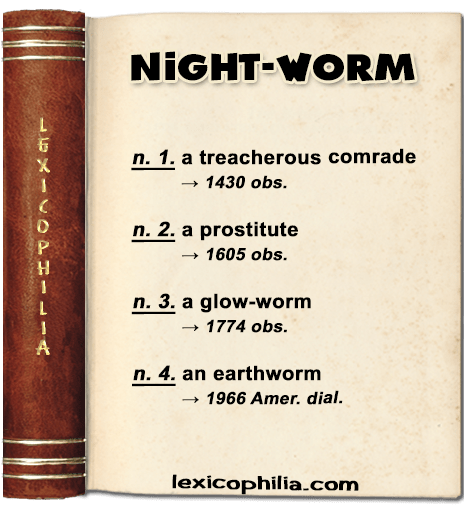
Word of the Day: NIGHT-WORM

ETYMOLOGY
from night + worm

EXAMPLE (for n. 1.)
“… Ye noble Pryncis, conceyueth the sentence
Off this story, remembrid in scripture,
How that Sampson off wilful necligence
Was shaue & shorn, diffacid his figure;
Keep your conceitis vnder couerture,
Suffre no 
nyhtwerm  withynne your counsail kreepe,
Thouh Dalida compleyne, crie and weepe!
…”

From: The Fall of Princes
Translated by John Lydgate, a1439
Edited by Dr. Henry Bergen
The Early English Text Society, 1924
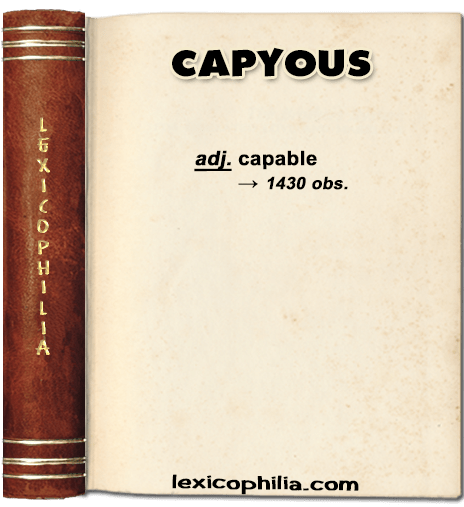
Word of the Day: CAPYOUS

ETYMOLOGY
from Latin capere (to take) + -ious

EXAMPLE
“… The wonderfullest and most meruaylous
That euer yet were seen tofore
Wherof no wyght by kynde is
capyous
First how god to saue that was forlore
Lowly in erthe list to be bore
And how a mayde in hir virgynyte
Myght also chylde and a moder be
…”

From: The Lyf of our Lady
By John Lydgate, 1484

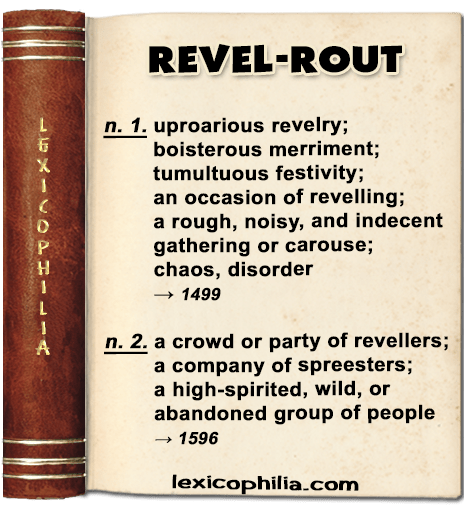
Word of the Day: REVEL-ROUT

ETYMOLOGY
from revel (exuberant merrymaking) + rout (a company or assemblage of persons)

EXAMPLE (for n. 1.)
“… Counter he coude (Olux) vpon a potte
An estryche fedder of a capons tayle
He set vp fresshely vpon his hat a lofte
What
reuell route quod he and gan to rayle
How ofte he hadde hit Ienet on the tayle
Of felyce fetewse dnd lytell prety cate
How ofte he knocked at her klycked gate
…”

From: Here begynneth a lytell treatyse named The Bowge of Courte
By John Skelton, 1499

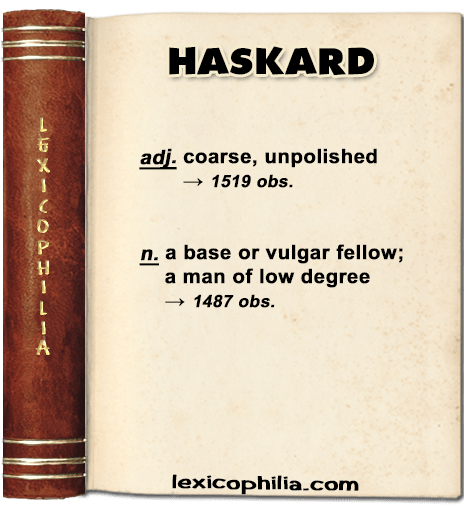
Word of the Day: HASKARD

ETYMOLOGY
of uncertain derivation; the suffix as in bast-ard, etc

EXAMPLE (for n.)
“… one daye as in a mornyng that he came out of the hous of a comyn woman He mette wyth a lewde haskarde, whyche for to doo the sayd synne of lechery went to the hous there as the holy man fro…”

From: Vitas Patrum
Translated by William Caxton, 1495

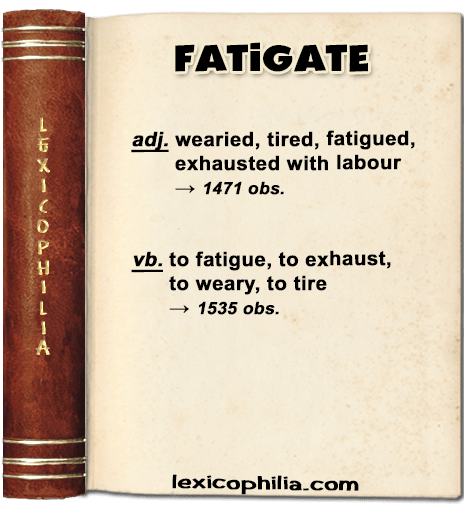
Word of the Day: FATIGATE

ETYMOLOGY
adj.:  from Latin fatigatus, past participle of fatigare (to fatigue)
vb.:  from Latin fatigat- participial stem of fatigare (to fatigue)

EXAMPLE (for adj.)
“… Oyle of Lune and water wyth labour grett,
I made Calcynyng yt with salt precipytate,
And by hyt selfe with vyolent hett
Gryndyng with Vynegar tyll I was
fatygate:
And also with a quantyte of Spyces acuate;
Uppon a Marble whych stode me oft in cost,
And Oyles with Corrosyves I made; but all was lost.
…”

From: Theatrum Chemicum Britannicum, Containing Severall Poeticall Pieces of our Famous English Philosophers, who have written the hermetique mysteries in their owne ancient language. Faithfully collected into one volume, with annotations;
By Elias Ashmole, 1652

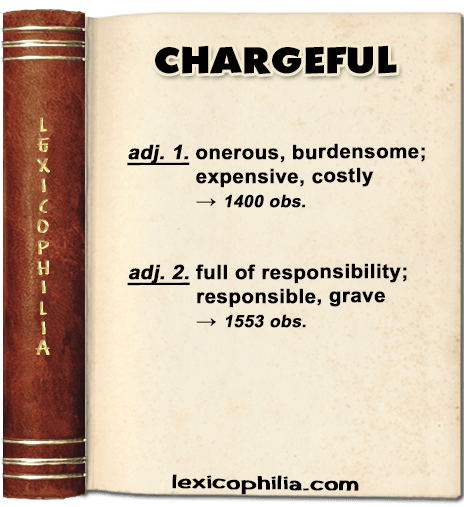
Word of the Day: CHARGEFUL

ETYMOLOGY
from charge (n.) + -ful

EXAMPLE (for adj. 1.)
“… For so it is that whan the Kyng coude nat fynde with the seid Lowes bi alle the forseid costeley and chargefull ambassades but fraude, deceipte, and illusion, his Highnesse, of a grete prudence and foresight, purchased alliaunces and amyties with two the myghtyest princes of Fraunce, the Dukes of Burgoigne and Britaigne, …”

From: Literae Cantuarienses: The Letter Books of the Monastery of Christ Church, Canterbury, 1474
Edited by Joseph Brigstocke Sheppard, 1887

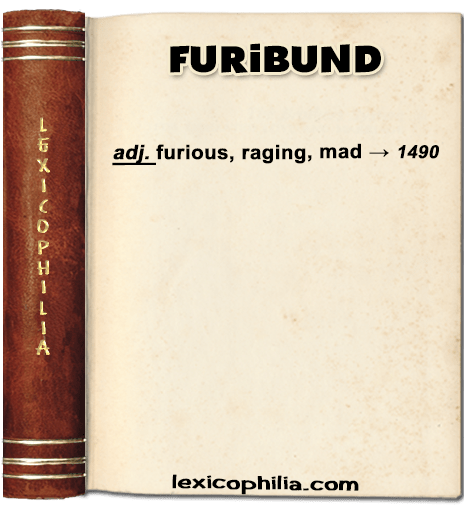
Word of the Day: FURIBUND

ETYMOLOGY
from Latin furibundus (from furere = to rage); the earlier forms through French furibond

EXAMPLE
“… In sayeng the whiche wordes by eneas / dydo lokyng at one side torned hir eyen sodaynli wythout to speke neuer a worde / as a persone furybounde & furyous: and or euer that she coude saye ony thyng. …”

From:The Boke yf Eneydos, compyled by Vyrgyle, which hathe be translated oute of latyne in to frenshe, and oute of frenshe reduced in to Englysshe by me Wyllm Caxton
By William Caxton, 1490

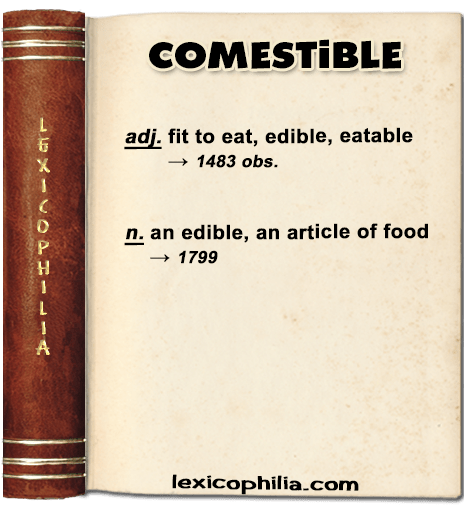
Word of the Day: COMESTIBLE

ETYMOLOGY
from French comestible (edible), or from Latin comestibilis (fit to eat, edible);
from comest- variant of comes- past participial stem of comedere (to eat up, devour);
from com- (altogether) + edere (to eat)

EXAMPLE (for adj.)
“… And they mocked hym and said that he raued and was a foole and gaf no faith to his sayeng, and contynued in theyr synnne and wickednes. Thenne whan the Arcke was parfyghtly maad god bad hym to take in to it of all the beestis of therthe, and also of the fowles of thayer of eche two male and female, that they may lyue and also of all the metes of therthe that ben comestible, that they may serue and fede the and them. And Noe dyde all that our lord commanded hym. Thenne said our lord to Noe entre thou and all thy houshold in to the Arke, that is to saye thou and thy wyf and thy thre sones & theyr thre wiuys I haue seen that thou art rightful in this generacion. …”

From: Legenda aurea sanctorum, sive, Lombardica historia/The Golden Legend
By Jacobus de Voragine
Translated by William Caxton, 1483

Word of the Day: LOSENGE

ETYMOLOGY
from Old French losenger = Provencal lauzengar, Spanish lisonjar, Portuguese lisonjear, Italian lusingare
from Old French losengelosange (flattery) = Provencal lauzengalauzenja, Spanish, 
Portuguese lisonja;
apparently adopted by the other Romance languages, from Provencal lauzenga = Old French loenge (French louange) (praise)
from medieval Latin laudemia, a derivative Latin laud-em (praise)

EXAMPLE
“… Thanne began Glaucus to call her and losenge her. …”

From: The Metamorphoses of Ovid 
Translated by William Caxton, 1480

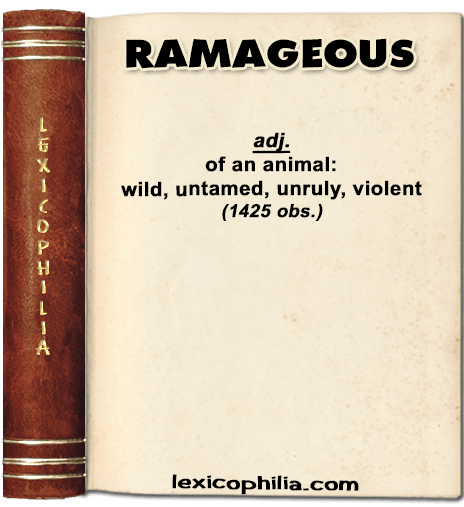
Reverse Dictionary: RAMAGEOUS

ETYMOLOGY
apparently from ramage (of an animal: wild, untamed, unruly, violent) + ‑ous 

EXAMPLE
“… Ordeyned hath, by ful gret cruelte,
This Ram to kepe, bolys ful vnmylde,
With brasen feet,
ramegous and wylde,
And ther-with-al ful fel and dispitous,
And of nature wood and furious,
To hurte and sleen euere of o desyre.
…”

From: Troy Book
By Guido delle Colonne
Translated by John Lydgate, c1425