Word of the Day: NIGHT-WORM

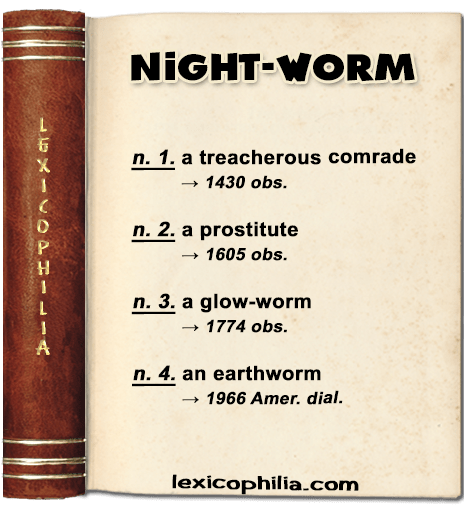
ETYMOLOGY
from night + worm

EXAMPLE (for n. 1.)
“… Ye noble Pryncis, conceyueth the sentence
Off this story, remembrid in scripture,
How that Sampson off wilful necligence
Was shaue & shorn, diffacid his figure;
Keep your conceitis vnder couerture,
Suffre no 
nyhtwerm  withynne your counsail kreepe,
Thouh Dalida compleyne, crie and weepe!
…”

From: The Fall of Princes
Translated by John Lydgate, a1439
Edited by Dr. Henry Bergen
The Early English Text Society, 1924

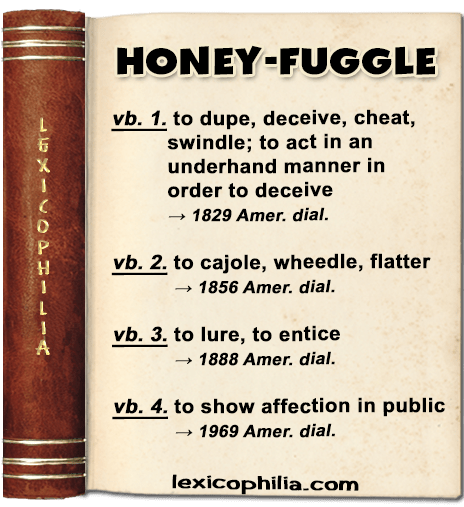
Word of the Day: HONEY-FUGGLE

ETYMOLOGY
apparently from honey (n.) + fugle (to cheat, trick), 
perhaps after dialect connyfogle (to deceive)

EXAMPLE
“… Let it be borne in mind that Sharp is a willing, a swift, and a long-winded witness, having come from the Territory, two thousand miles off, mainly for the purpose of devoting to the sitting Delegate the benefit of his counsel and his oath. Pardon me for using the word; but Sharp ‘honey-fuggled‘ around me; He came to me, and stated that Chapman wanted him to make an affidavit, but that he would rather not do it; that he had declined doing it; and thus he misled me and threw me off my guard, and then a few days afterwards, he makes this affidavit, gets on board the cars, and left the city for western Iowa, to pull wires in politics to secure his own election to the Iowa Legislature; …”

From: United States. Congress. Congressional Globe; Containing the Debates and Proceedings of the Congress 1855 – 1856
Nebraska Contested Election.
Speech of Hon. H. P. Bennet of Nebraska,
In the House of Representatives, July 22, 1856.
Word of the Day: SWITCH-TAIL


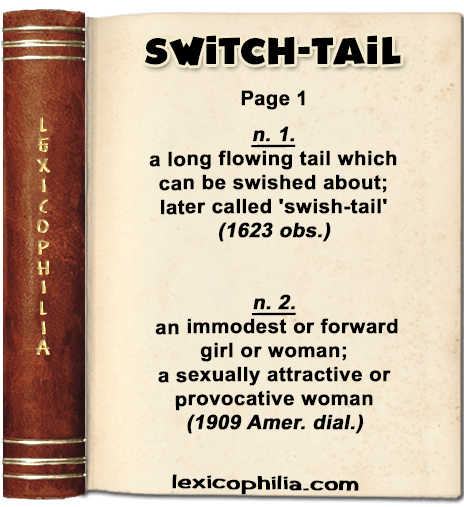
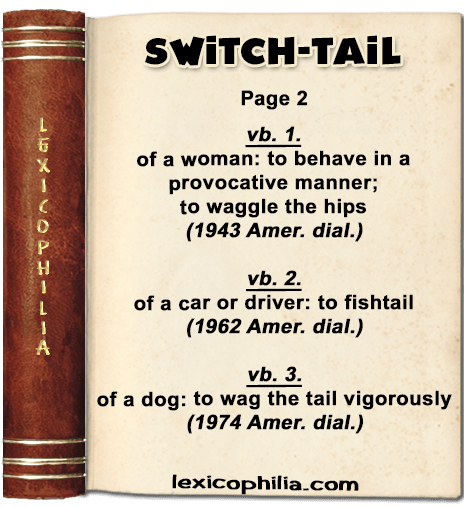
ETYMOLOGY
from switch + tail


EXAMPLE 1 (for n.1)
“…she was observed to ride forth in a Cavalcade somewhat extraordinary pleasant , viz. a good rich Velvet Saddle, and fashionable upon a sorry Horse with a Switch-Tail that us’d to carry Lime, and not Ladies; A gentile Surtout or riding-Suit; with her Shoulders warmly wrapt up in a good White Serge whittle: A pretty handsome Commode of the newest fashion, upon which was gracefully plac’d a good homely Straw Hat, with a long Pole like a Sugar Loaf, so that Cit and Bumpkin seem’d never better met or set off since the Creation …”

From: The Adventures of the Helvetian Hero, with the Young Countess of Albania;
Or, The Amours of Armadorus and Vicentina: a Novel
Unknown author, 1694


EXAMPLE 2 (for n. 2.)
“…I can look a gangster in the eye and make him change his mind, but I can’t do a thing with a woman no more. At one time I had nine big switch-tail women on my personal payroll, and they all stole from me, picked me clean. Buzzards!

From: McSorley’s Wonderful Saloon
By Joseph Mitchell, 1943

Word of the Day: RAGEOUS


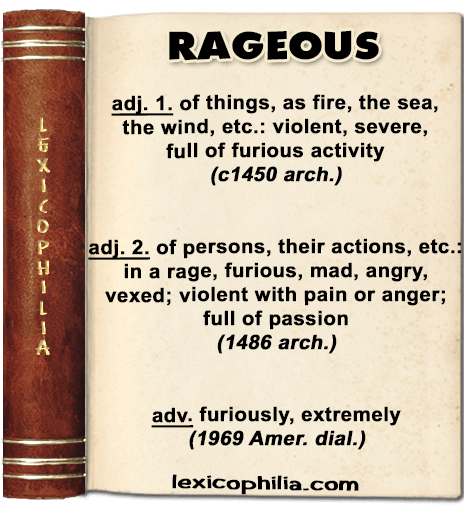
ETYMOLOGY
partly from Anglo-Norman ragous (raging), from rage (rage) + -ous,
and partly directly from rage (n.) + -ous 


EXAMPLE (for adj. 1)
“…What nede y spende more enke or parchement,
That fele the crampe of deth myn hert so nyghe
As thorugh this rageous fyre which hath me hent?
Thus calle y for yowre socoure pitously
…”

From: The English Poems of Charles of Orleans
Edited by R. Steele, 1941
Fortunes Stabilnes, c1450

Word of the Day: BUMBLE-BATH

ETYMOLOGY
of uncertain origin

EXAMPLE
“…This Stymphalist is he that with fiue or sixe Tenements, and the retinue thereunto belonging, infectes the aire with stench, and poisons that parish, yea and twentie parishes off with the contagion of such carrion as lies there in their bumble baths, and stinke at both ends like filthie greene elder pipes. For him and them master, such Landlordes and such Tenants. Good master wish as I wish…”

From: Maroccus Extaticus.
Or, Bankes bay horse in a trance
A discourse set downe in a merry dialogue, betweene Bankes and his beast: anatomizing some abuses and bad trickes of this age.
– By Iohn Dando the wierdrawer of Hadley, and Harrie Runt, head ostler of Bosomes Inne, 1595

Word of the Day: ROWDY-DOW

also Scottish and dialect form ROW-DE-DOW

ETYMOLOGY
 originally a variant of row dow dow ( a series of sounds as produced by beating a drum)
later possibly influenced by rowdy dowdy (characterized by noisy roughness)

EXAMPLE
“…There has been a terrible rowdydow in the operatic green-room…”

From: Dashes at Life with a Free Pencil
By Nathaniel Parker Willis, 1845