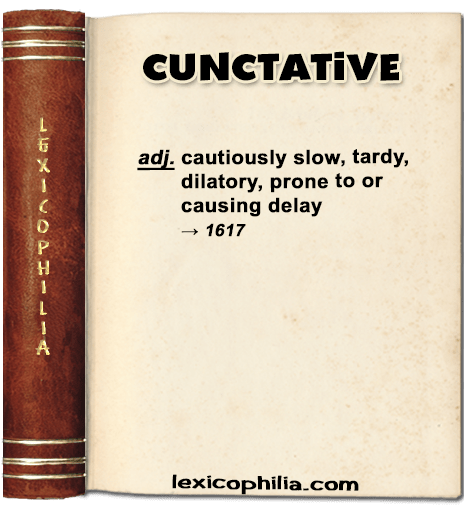
Word of the Day: CUNCTATIVE

ETYMOLOGY
from Latin cunctat-, participial stem of cunctari (to hesitate) + -ive

EXAMPLE
“… For it hath been a manner much used of late in my last lord’s time, of whom I learn much to imitate, and, somewhat to avoid ; that upon the solemn and full hearing of a cause nothing is pronounced in court, but breviates are required to be made; which I do not dislike in itself in causes perplexed. For I confess I have somewhat of the cunctative; and I am of opinion, that whosoever is not wiser upon advice than upon the sudden, the same man was no wiser at fifty than he was at thirty. …”

From: The Works of Francis Bacon, Baron of Verulam, Viscount St. Alban, and Lord High Chancellor of England, 1803
Speech on taking his Place in Chancery, May 1617
Word of the Day: CONTICENT

ETYMOLOGY
from Latin conticentem, present participle of conticere (to be silent or still),
from con- intensive + tacere (to be silent)

EXAMPLE
“… Here they all sit — not in my lord’s grand dining-room, you know, but in the snug study or parlor in front. The cloth has been withdrawn, the General has given the King’s health, the servants have left the room, the guests sit conticent, and so, after a little hemming and blushing, Mr. George proceeds …”

From: The Virginians, a tale of the last century
By William Makepeace Thackeray, 1859

Word of the Day: CAPYOUS

ETYMOLOGY
from Latin capere (to take) + -ious

EXAMPLE
“… The wonderfullest and most meruaylous
That euer yet were seen tofore
Wherof no wyght by kynde is
capyous
First how god to saue that was forlore
Lowly in erthe list to be bore
And how a mayde in hir virgynyte
Myght also chylde and a moder be
…”

From: The Lyf of our Lady
By John Lydgate, 1484

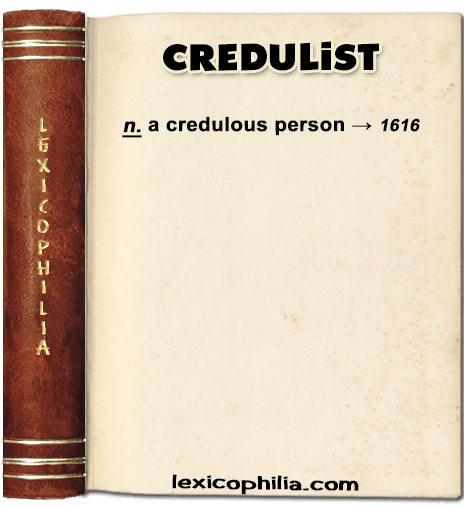
Word of the Day: CREDULIST

ETYMOLOGY
from Latin credulus (ready to believe or trust) + -ist

EXAMPLE
“… the couetous Bashaw of Aleppo, the gouernor of those parts, are contented to beare with things euen contrary to the lawes of their Alcheron, impugning altogether the Godhead and incarnation of Christ: as the Iews against his pouerty and humiliation: & for great sums of mony, & annuall entrado, suffer stil diuers friers & religious persons to entertain pil∣grims, trauellers, ignorant deuotists, superstitious papists, and simple credulists, with impudent, lying, & deceitfull relicks …”

From: The Secretaries Studie Containing New Familiar Epistles
By Thomas Gainsford, 1616

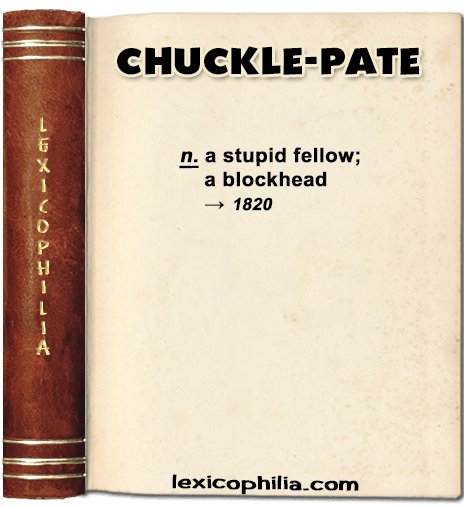
Word of the Day: CHUCKLE-PATE

ETYMOLOGY
from chuckle + pate (the head)

EXAMPLE
“…At the end, says the chief, in dispersing the poison.
“Come, come, subscribe, ’tis to carry the cause on,
Down with your cash, all I ask is a penny;”
And the pence were put down by the
chucklepate many.
We genii, you know, in a moment detected
The laugh-in-the-sleeve of the rogues who collected,
And followed unseen, ’till we saw them all seated,
Full of hopes of the spoil, but these hopes were soon cheated,
For among them swooped, and away in a minute.
…”

From: Blackwood’s Edinburgh Magazine
Volume III. April – September, 1820
The Building of the Palace of the Lamp.

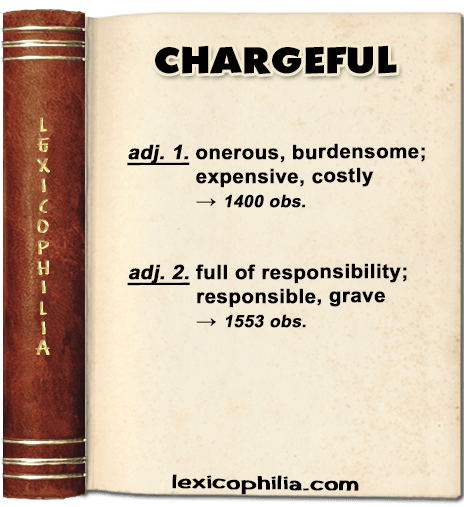
Word of the Day: CHARGEFUL

ETYMOLOGY
from charge (n.) + -ful

EXAMPLE (for adj. 1.)
“… For so it is that whan the Kyng coude nat fynde with the seid Lowes bi alle the forseid costeley and chargefull ambassades but fraude, deceipte, and illusion, his Highnesse, of a grete prudence and foresight, purchased alliaunces and amyties with two the myghtyest princes of Fraunce, the Dukes of Burgoigne and Britaigne, …”

From: Literae Cantuarienses: The Letter Books of the Monastery of Christ Church, Canterbury, 1474
Edited by Joseph Brigstocke Sheppard, 1887

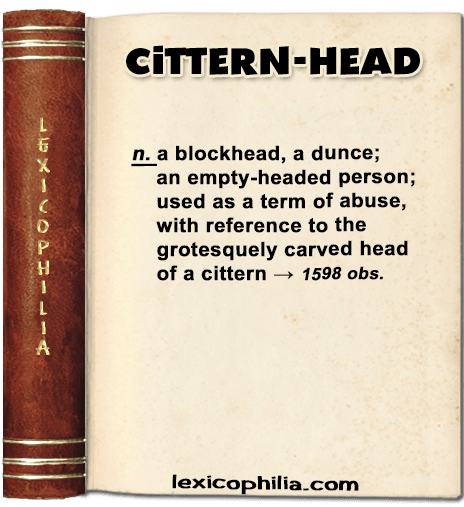
Word of the Day: CITTERN-HEAD

ETYMOLOGY
so called because the cittern (musical instrument) usually had a grotesque head carved at the extremity of the finger-board

EXAMPLE
“… Pedan.
I will not be put out of countenance.
Bero.
Because thou hast no face.
Pedan.
What is this?
Boyet.
A Cytterne head.
Duma.
The head of a Bodkin.
Bero.
A deaths face in a Ring.
Long.
The face of an olde Roman coyne, scarce seene.
Boyet.
The pummel of Caesars Fauchion.
Duma.
The carud-bone face on a Flaske.
Bero.
Saint Georges halfe cheeke in a Brooch. …”

From: A Pleasant Conceited Comedie called, Loues Labors Lost
By William Shakespeare, 1598

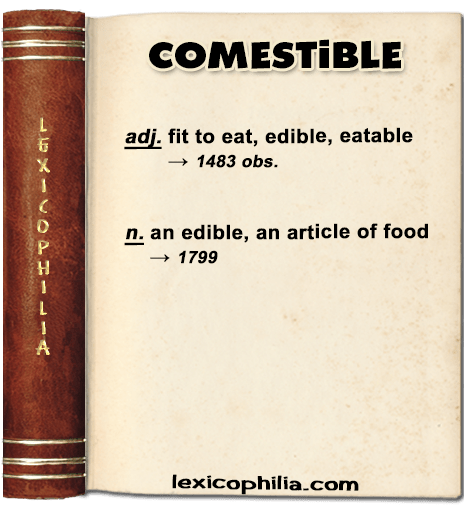
Word of the Day: COMESTIBLE

ETYMOLOGY
from French comestible (edible), or from Latin comestibilis (fit to eat, edible);
from comest- variant of comes- past participial stem of comedere (to eat up, devour);
from com- (altogether) + edere (to eat)

EXAMPLE (for adj.)
“… And they mocked hym and said that he raued and was a foole and gaf no faith to his sayeng, and contynued in theyr synnne and wickednes. Thenne whan the Arcke was parfyghtly maad god bad hym to take in to it of all the beestis of therthe, and also of the fowles of thayer of eche two male and female, that they may lyue and also of all the metes of therthe that ben comestible, that they may serue and fede the and them. And Noe dyde all that our lord commanded hym. Thenne said our lord to Noe entre thou and all thy houshold in to the Arke, that is to saye thou and thy wyf and thy thre sones & theyr thre wiuys I haue seen that thou art rightful in this generacion. …”

From: Legenda aurea sanctorum, sive, Lombardica historia/The Golden Legend
By Jacobus de Voragine
Translated by William Caxton, 1483

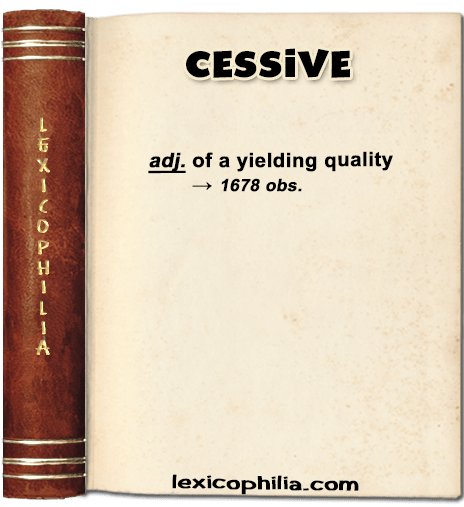
Word of the Day: CESSIVE

ETYMOLOGY
from Latin cess- participial stem of cedere (to yield) + -ive

EXAMPLE
“… Yet there is a Diversity in Softness by Argentrive, and in Softness by Sulphur: because Softness by Sulphur is Cessive, but Softness by Argentrive is Extensive. And this must necessarily be proved by Sight; seeing We see Bodies of much Argentrive, to be of much Extension; but Bodies of little, of little. …”

From: The Works of Geber
By Jabir ibn Haiyan
Translated by Richard Russell, 1678

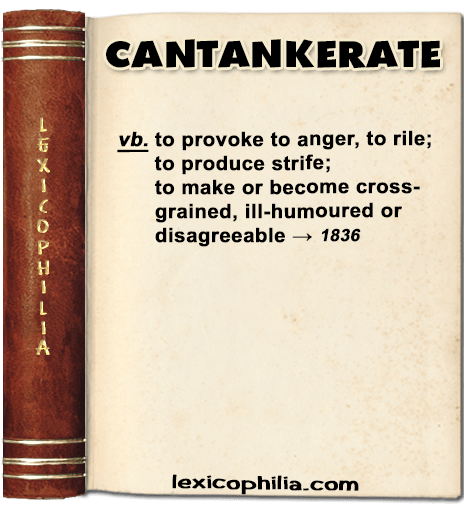
Word of the Day: CANTANKERATE

ETYMOLOGY
from cantankerous

EXAMPLE
“… I never see’d a convart made by that way yet; but I’ll tell you what I have see’d, a man set his own flock a doubtin by his own writin. You may happify your enemies, cantankerate your opponents, and injure your own cause by it, but I defy you to sarve it. …”

From: The Clockmaker,
Or, Sayings and Doings of Sam Slick, of Slickville,
By Thomas Chandler Haliburton, 1836