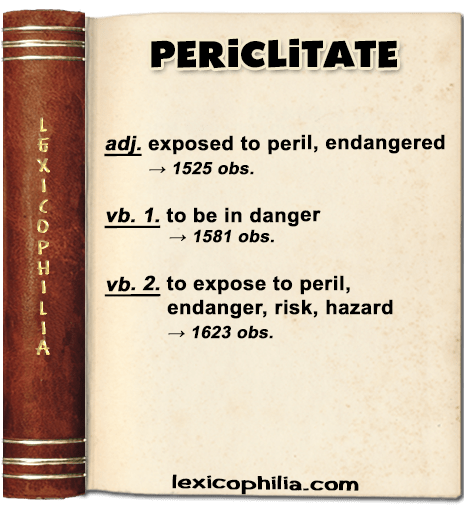
Word of the Day: PERICLITATE

ETYMOLOGY
adj.:  from Latin periclitatus (tried, tested, endangered) past participle of periclitari
vb:  from Latin periclitat-, past participial stem of periclitari (to expose to risk, danger, or peril), from periculumpericlum (trial, risk, danger)

EXAMPLE (for adj.
“… He alone be not noted to be the occasion of longer division werre and hostilite in Cristendome, wherby the hole state of the same may be periclitate and put in extreme daunger, but that by deliverance of the Frenche King, upon a convenient rawnsom, ther may ensue, God willing, generall peax bitwene al Cristen Princes, wherin He shal, besides the thanke of God, adquire more honour, than though by extreme force and violence He had attayned suche an other realme as Fraunce is. …”

From: State papers, published under the authority of His Majesty’s Commission. King Henry the Eighth, 1830
King Henry VIII. to Tunstall, &c., 1525

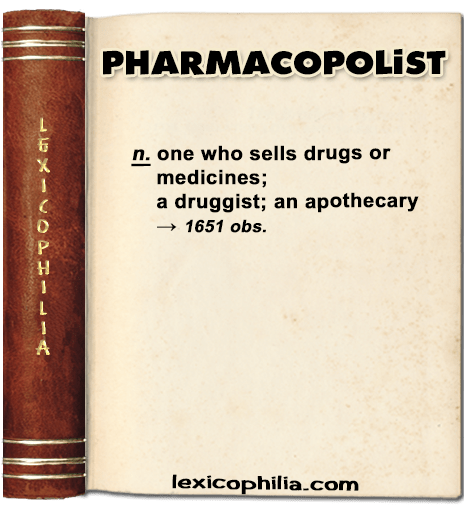
Word of the Day: PHARMACOPOLIST

ETYMOLOGY
from Latin pharmacopola, (from Greek ϕαρµακοπώλης (pharmakopoles) (dealer in drugs)) + -ist

EXAMPLE
“… That Science then, which enables men to look thorow the shop of medicine, the topick tabernacle of naturall powers, and teaches to unlock bodies that are shut, and to draw forth their hidden vertues, is not peculiar to the family of Pharmacopolists, nor truly is the Pharmaceutick part a hand-maid to it (as is the talk of ignorants) but is a powerfull Tecmarsis of naturall history.…”

From: Matæotechnia Medicinæ Praxeōs, The vanity of the craft of physick, or, A new dispensatory wherein is dissected the errors, ignorance, impostures and supinities of the schools in their main pillars of purges, blood-letting, fontanels or issues, and diet, &c., and the particular medicines of the shops
By Noah Biggs, 1651

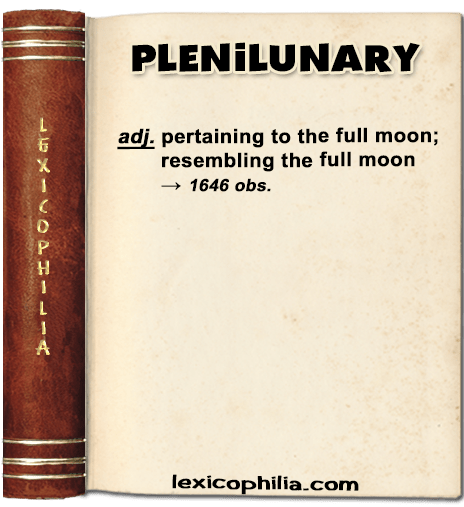
Word of the Day: PLENILUNARY

ETYMOLOGY
from pleni- (full) + lunary (pert. to the moon), after Latin plenilunium (full moon)

EXAMPLE
“… whereunto if we adde the two Aegyptian dayes in every moneth, the interlunary and pleniluary exemptions, the Eclipses of Sunne and Moone, conjunctions and oppositions Planeticall, the houses of Planets, and the site of the Luminaries under the signes, (wherein some would induce a restraint of Purgation or Phlebotomy) there would arise aboue an hundred more; …”

From: Pseudodoxia Epidemica, or, Enquiries into very many received tenents and commonly presumed truths;
By Thomas Browne, 1646

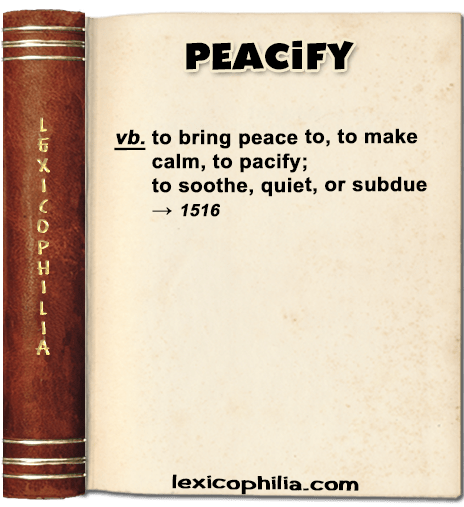
Word of the Day: PEACIFY

ETYMOLOGY
from peace (n.) + -ify, influenced by pacify (vb.)

EXAMPLE
“… yet she wolde not but rather suffre dethe she was so stedfaste in the feythe relygyous and chaste, and thus he beynge in great perplexyte and doutfull peryll, the foresayde Blessyd vyrgyne his Donghter was warnyd by an Aungell that she shulde goo to her Fader and bydde hym agree to the other Kynys requeste and desyre, and that she shulde assent therto, / and so shulde she comforte and assure her Fader and peacyfye and make glad the other parte.

From: Here Begynneth the Kalendre of the Newe Legende of Englande, 1516

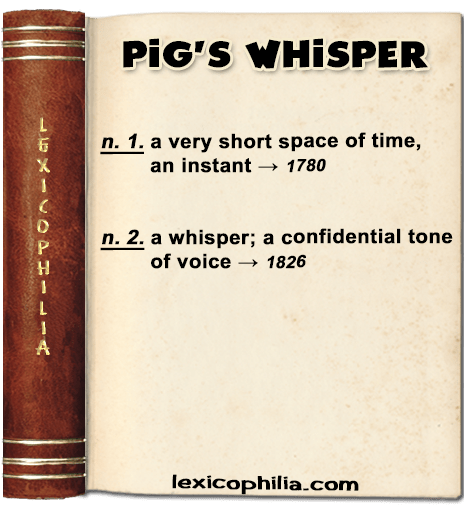
Word of the Day: PIG’S WHISPER

ETYMOLOGY
from pig + whisper

EXAMPLE (for n. 1.)
“… Frank.
Yes, sir; there are tailors, shoemakers, milliners, perfumers, dancing-masters, music masters and boxing masters.

Tickle.
I’ll be with them in a
pig’s whisper.

Frank.
Pig’s whisper! what a fellow for a gentleman’s tutor! O! he’s a shocking dog!
…”

From: Tony Lumpkin in town: A Farce
By John O’Keeffe, 1780

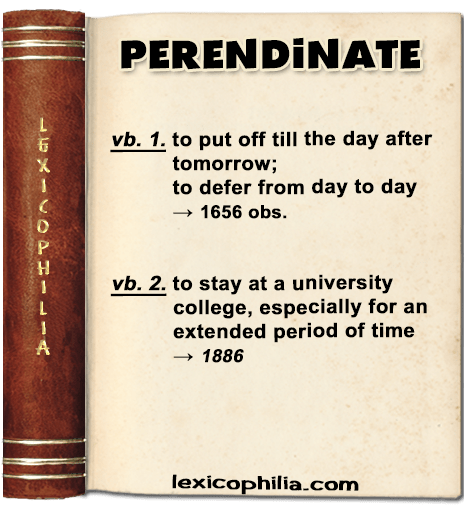
Word of the Day: PERENDINATE

ETYMOLOGY
from Latin perendinat-, past participial stem of perendinare (to defer until the day after tomorrow, to postone for a day) from perendinus ((the day) after to-morrow), from perendie (on the day after to-morrow) + -inus, or from peren- + din- (day)

EXAMPLE (for vb. 1.)
The chairman of the board perendinated the meeting so that all members would be able to attend.

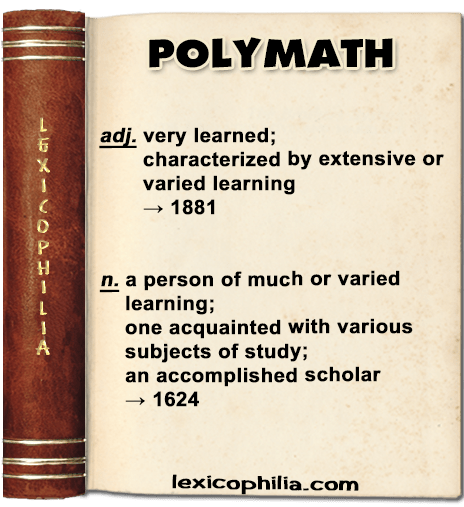
Word of the Day: POLYMATH

ETYMOLOGY
from Greek πολυµαθής (having learnt much), from πολυ- (poly-, much) + μάθη (learning) from the base of µανθάνειν (to learn)

EXAMPLE (for n.)
“… To be counted writers, scriptores ut Salutentur, to be thought and held Polumathes and Polyhistors, apud imperitum vulgus ob ventosæ nomem artis, to get a paper-kingdom: nulla spe quæstus sed ampla famæ, in this precipitate, ambitious age, nunc ut est sæculum, inter immaturam eruditionem, ambitiosum et præceps (’tis Scaliger’s censure); and they that are scarce auditors, vix auditores, must be masters and teachers, before they be capable and fit hearers. …”

From: The Anatomy of Melancholy 
By Robert Burton, 1624

Word of the Day: PLANILOQUENT

ETYMOLOGY
from Latin planiloquus (plain-speaking) (from planus [plain] + -loquus (from loqui [to speak])) + -ent

EXAMPLE
“… Dear Editor: Please continue your piperitious, planiloquent polemics against those omphaloskeptical, onychophagic, uxoravalent, philalethic, laodicean, opisthoporeiac, equivorous, kakorrhaphiophobiac, megalomaniacal, porlockian, contortuplicate, acritochromatic, and tragomaschaliac pseudoacademicians.
Cordially
Dr. Panos D. Bardis
Editor, Social Sciences …”

From: Maledicta (International Journal of Verbal Aggression, Volume 1 Number 2)
In Defense of Anticacademoidism
Edited by Reinhold Aman, 1978

Word of the Day: PROME

ETYMOLOGY
from Old French promeproesme, and Middle French proisme (near), also as (n.) a neighbour, from Latin proximus (nearest)

EXAMPLE
“… First sal ye luue god wid al yure herte and wid al yure saul and wid al yure uertu, And ti prome als ti-self; sua ah ye at do …”

From: Three Middle-English versions of the Rule of St. Benet, a1425
By Saint Benedict, Abbot of Monte Cassino.
Edited by Ernst Albin Kock
Early English Text Society edition, 1902