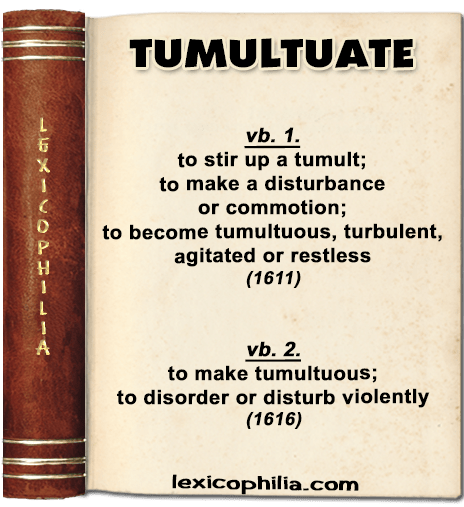
Word of the Day: TUMULTUATE

ETYMOLOGY
from participial stem of Latin tumultuari (to make a bustle or disturbance) + -ate

EXAMPLE
“… Secondly, beeing sued, and Iudgement passed against you, Acquiesce in the Iudgement, and doe not tumultuate against it; and take example from mee, whom you haue heard here protest, that when euer any Decree shall be giuen against me in my priuate right, betweene me and a Subiect, I will as humbly acquiesce as the meanest man in the Land. Imitate me in this, for in euery Plea there are two parties, and Iudgement can be but for one, and against the other; so one must alwayes be displeased. …”

From: James I of England
Speach Starre-chamber, 1616

Word of the Day: TROIL

ETYMOLOGY
vb.: from Old French troilliertruilliertreuiller, from Middle High German trüllen

EXAMPLE (for vb.)
“… Thus with treison and with trecherie · þow troiledest hem boþe,
And dudest hem breke [here] buxomnesse · þorw false by-heste;
Thus haddest þou hem oute · and hyder atte laste.
…”

(Thus with treason and with treachery · thou troiledest them both,
And diddest them break their buxomness · through false byhest;
Thus haddest thou them out · and hither at the last.
)

From: The Vision of William concerning Piers the Plowman
By William Langland, 1393

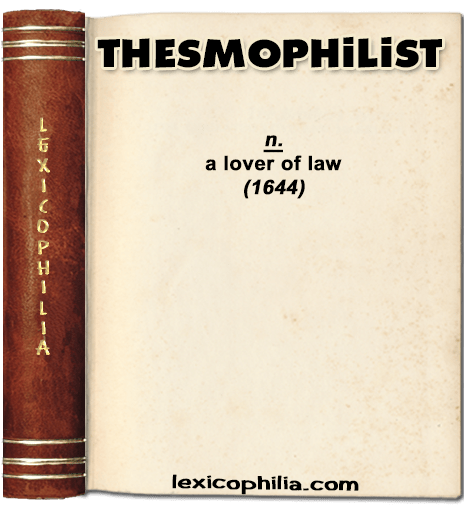
Word of the Day: THESMOPHILIST

ETYMOLOGY
from Greek θεσµός (thesmos – law); (from root θε– (to lay down)) + –ϕιλ-ος (-phil )-ist

EXAMPLE
“… To shut out any light that may be usefull in Gods house, is with the Jews to make it a denne: as they would do, that would shut out the Ceremonies out of the Church: for, take away Ceremonies out of the Church, and take away the light that is in it. Surely this is spoken in Ceremony, by way of complement to his Bishop, that great Thesmophilist: Have we no other candle in our candlestick but ceremony? …”

From: A Discourse of Proper Sacrifice
By Edward Dering, 1644

Word of the Day: TARDIGRADE

ETYMOLOGY
from French tardigrade (slow-paced) or from Latin tardigradus (walking slowly); from Latin tardus (slow) + -gradus (stepping, going)

EXAMPLE (for adj. 1)
“… Once more a cruelly long passage fell to my lot. The Deborah proved a marine hackney-coach of the most tardigrade order. But it could not be helped; so, like Diogenes, I resolved to be satisfied with my tub, and as for sunshine, I found it within and without! …”

From: Our Antipodes:
Or, Residence and Rambles in the Australasian Colonies.
By Lt. Colonel Godfrey Charles Mundy, 1852

Word of the Day: THINKATIVE

ETYMOLOGY
from think (vb.) + -ative, chiefly after talkative

EXAMPLE
“… They have not known I say, that the knowledge of Observation, doth not introduce an understanding into the essential thingliness of a thing, but erecteth only a thinkative knowledge: For otherwise, the understanding should perceive causes that are before in essence. Then also they have been deceived by the simplicity of the Water, which simpleness they have confounded with the unity of knowledge to us unknown. …”

From: Oriatrike or, Physick Refined
By Jean Baptiste van Helmont
Translated by J. Chandler, 1662

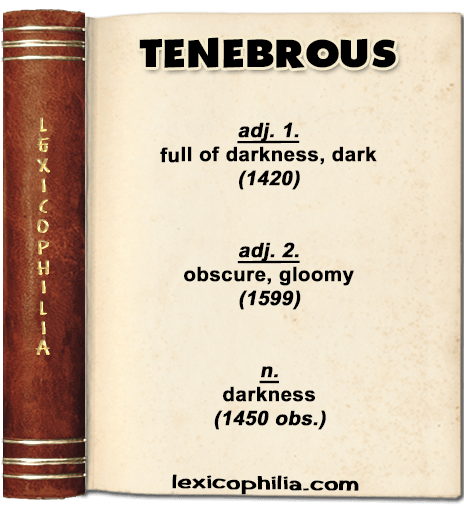
Word of the Day: TENEBROUS

ETYMOLOGY
from Old French tenebrus, modern French tenebreux, Provencal tenebros
Spanish, Italian tenebroso, from Latin tenebrosus (dark, gloomy)

EXAMPLE
“… The name of thys lady was callyd Prescience.
She neuer left Vyce, ne noon that wold hym folow,
Tyll they wer commyttyd by the diuine sentence
All to peyne perpetuell and infynyte sorow.
Ryghtwysnes went to see that no man shuld hem borow.
Thus all entretyd sharpely were they, tyll Cerberus
Had hem beshut withyn hys gates
tenebrus. …”

From: The Assembly of Gods:
or, The Accord of Reason and Sensuality in the Fear of Death
By John Lydgate, c1420

PRONUNCIATION
TEN-uh-bruhss

Word of the Day: TIB

ETYMOLOGY
perhaps the same as Tib, a shortened hypocoristic form of the female name Isabel; now rather rude or slighting (except playfully);
also with dim. -y or -ieTibbie, a common female name in the north

EXAMPLE
“… .Trupeny. Mary then prickmedaintie come toste me a fig,
Who shall then know our
Tib Talke apace trow ye?

An. Alyface. And why not Annot Alyface as fyne as she?

Trupeny. And what had Tom Trupeny, a father or none?

An. Alyface. Then our prety newe come man will looke to be one …”

From: Ralph Roister Doister 
By Nicholas Udall, a1556

Word of the Day: THRUMBLE

ETYMOLOGY
vb. 1: of uncertain origin
vb. 2, 3, 4: apparently from thrum (to press, to condense) + -le
vb. 5: apparently from thrum (to play on a stringed instrument) + -le

EXAMPLE (for vb.3)
“…PETER, quho was ever maist sudden, answers, and sayis: Thou art thrumbled and thrusted be the multitude, and ʒit thou speeris quha hes twitched thee, hee answers againe and he sayis, it is not that twitching that I speak of: It is ane vther kinde of twitching …”

From: Sermons vpon the Sacrament of the Lords Supper
By Robert Bruce, ?1591

Word of the Day: TERRIBLIZE

ETYMOLOGY
from terrible + -ize

EXAMPLE
“…Both Camps appoach, their bloudy rage doth rise,
And even the face of Cowards 
terriblize;
New Martial heat inflames their mindes with ire,
Their bloud is moov’d, their heart is all on fire.
Their cheerfull limbs (seeming to march too slowe).
Longing to meet, the fatall drums out-goe;
And even already in their gesture fight:
Th’ iron-footed coursers, lusty, fresh, and light,
…”

From: Du Bartas his Deuine Weekes and Workes translated
By Guillaume de Salluste Du Bartas
Translated by Josuah Sylvester, 1606