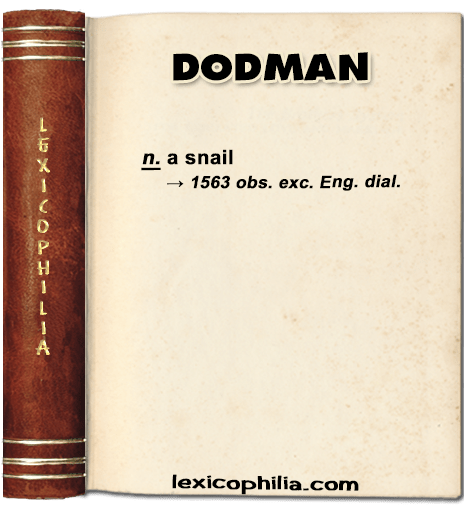
Word of the Day: DODMAN

ETYMOLOGY
origin unknown;
a connection with dod (a rounded summit or eminence (dialect)), has been suggested

EXAMPLE
“… KYNGE JOHAN. God hathe me ordeynned in this same princely estate
For that I shuld helpe such as be desolate.

SEDWSYON. Yt is as great pyte to se a woman wepe
As yt is to se a sely
dodman crepe,
Or, as ye wold say, a sely goose go barefote.

KYNGE JOHAN. Thou semyste by thy wordes to have no more wytt than a coote.
I mervell them arte to Englond so unnaturall,
Beyng her owne chyld: thou art worse than a best brutall.
…”

From: Kynge Johann,
By John Bale, a1563

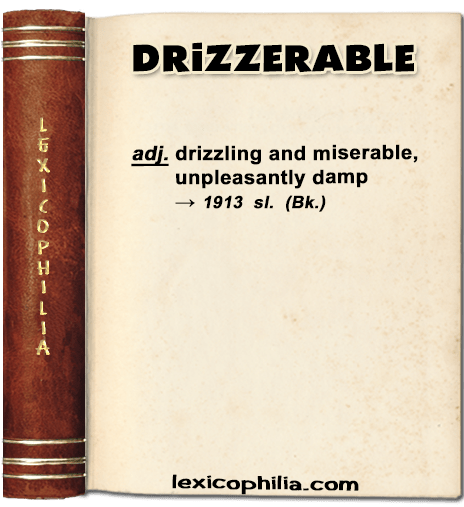
Word of the Day: DRIZZERABLE

ETYMOLOGY
from drizzling + miserable

EXAMPLE
“… As loggers used to say, two ‘drizzerable‘ days of sullen wet wind blew by before I dared risk the open lake in the canoe. To mollify my impatience, I spent the time rethinking the cabin logs, rebracing roof members, and chopping wood, should I decide to spend another winter there. …”

From: The Bears and I
By Robert Franklin Leslie, 1971

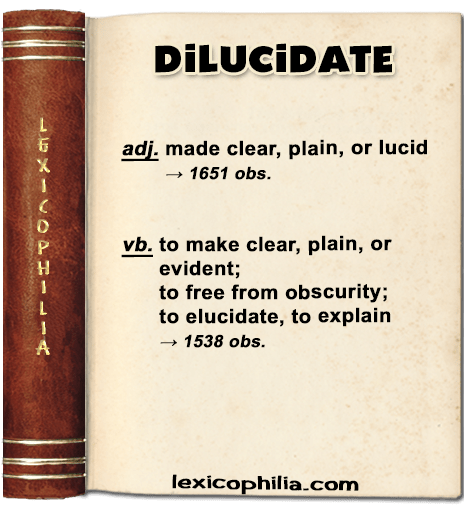
Word of the Day: DILUCIDATE

ETYMOLOGY
adj.:  from Latin dilucidatus, past participle of dilucidare (to make clear, to explain), from dilūcidus (clear, bright)
vb:  from Latin dilucidat- participial stem of dilucidare (to make clear, to explain)

EXAMPLE (for vb.)
“… .For we folowe not only a standynge text of the Hebrue, with the interpretacion of the Caldee, and the Greke, but we set, also, in a pryvate table, the dyversite of redinges of all textes, with suche annotacions, in another table, as shall douteles delucidate and cleare the same; as well without any singularyte of opinions, as all checkinges and reprofes. The prynt, no doubt, shall please your good Lordship. …”

From: State papers, published under the authority of His Majesty’s Commission. King Henry the Eighth
Coverdale and Grafton to Crumwell, 1538

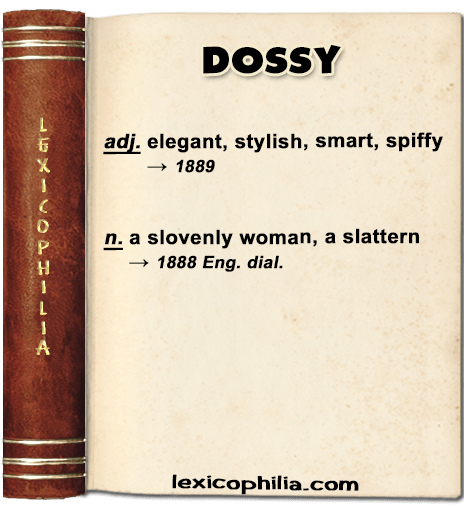
Word of the Day: DOSSY

ETYMOLOGY
of uncertain origin;
Scots has doss (neat, spruce) and dossie (a sprucely dressed person)

EXAMPLE (for adj.)
“… I’ll tell you where they’ll get the pull of us,” (this very confidentially and in my ear.)
“There ain’t no weather down there,” (pointing to asphalt with this whip), “and what with the ladies’ bonnets and blokes’
dossy hats, that’s a big matter. …”

From: The Daily Colonist
Victoria, BC, Sunday September 2 1900

Word of the Day: DIMICATION

ETYMOLOGY
from Latin dimicationem, noun of action, from dimicare (to fight)

EXAMPLE
“… At this time there was one Alexander, a godly and worthy man, Bishop of Constantinople. He in the dimication which arose about Arius, shewed himself a very prudent and pious man: For as soon as Arius came to Constantinople, he presently raised divisions amongst the people there also, so that great tumults ensued whilest one part of the people stood for the Faith confirmed by the Nicene Council: …”

From: The Marrow of Ecclesiastical History contained in the lives of one hundred forty eight fathers, schoolmen, first reformers and modern divines which have flourished in the Church since Christ’s time to this present age
By Samuel Clarke, 1654

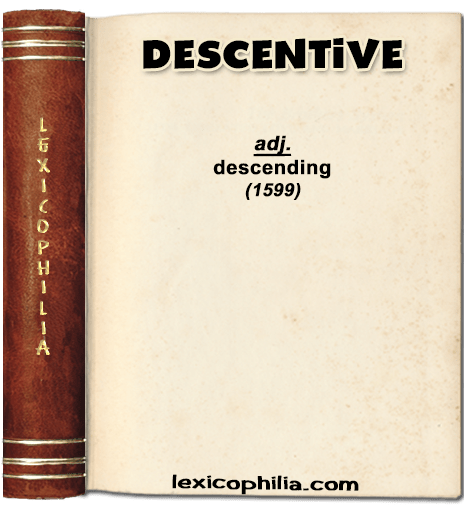
Word of the Day: DESCENTIVE

ETYMOLOGY
from descent + -ive

EXAMPLE
“… howsoeuer I purpose not in the like nice respect to leape ouer the laudable petigree of Yarmouth, but will fetch her from her swadling clouts or infancy, & reueale to you when and by whom she was first raught out of the oceans armes, and start vp and aspired to such starry sublimitie ; as also acquaint you with the notable immunities, franchises, priuileges she is endowed with beyond all her confiners, by the discentiue line of kings from the conquest. …”

From: Lenten Stuffe
By Thomas Nashe, 1599
The Praise of the Red Herring

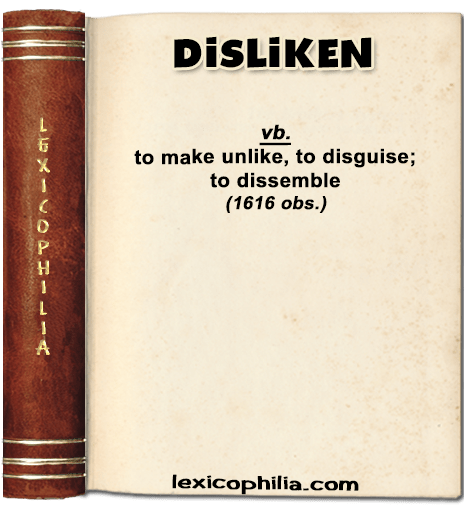
Word of the Day: DISLIKEN

ETYMOLOGY
from dislike (adj.) + -en, after likeliken

EXAMPLE
“… Dis-mantle you, and (as you can) disliken
The truth of your owne seeming, that you may
(For I do feare eyes ouer) to Ship-boord
Get vndescry’d.
…”

From: Mr. William Shakespeares Comedies, Histories, and Tragedies
By Wiliam Shakespeare, 1632
The Winters Tale, a1616

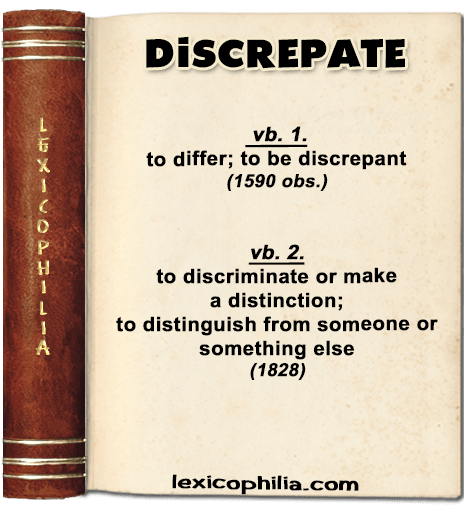
Word of the Day: DISCREPATE

ETYMOLOGY
from Latin discrepat-, past participial stem of discrepare (to differ in sound, to be out of tune, to be out of harmony or inconsistent with, to have differences or discrepancies, to lack agreement, to differ in opinion, to disagree,
from dis- + crepare (to make a noise, to creak)

EXAMPLE (for vb. 1.)
“… So that discrepating from his first propertie, vtterly corrupteth, decayeth, becommeth absumpt in the degree of death. …”

From: The Flower of Phisicke
By William Clever, 1590

Word of the Day: DECUMANAL

ETYMOLOGY
from Latin decumanus (very large, immense; usually of waves) + -al

EXAMPLE
“… till in the closure of the luxuriant period, the decumanal wave of the oddest whimzy of al, enforced the charmed spirits of the auditory (for affording room to its apprehension) suddenly to burst forth into a laughter; which commonly lasted just so long, as he had leasure to withdraw behind the skreen, shift off with the help of a Page, the suite he had on, apparel himself with another, and return to the stage to act afresh; for by that time their transported, disparpled, and sublimated fancies, by the wonderfully operating engines of his solacious inventions, had from the hight to which the inward scrues, wheeles, and pullies of his wit had elevated them, descended by degrees into their wonted stations, he was ready for the personating of another carriage; …”

From: Εκσκυβαλαυρον [Ekskybalauron]: or, The Discovery of a Most Exquisite Jewel, More Precious Then Diamonds Inchased in Gold, the Like Whereof Was Never Seen in Any Age
By Thomas Urquhart, 1652

Word of the Day: DISTRACTIOUS

ETYMOLOGY
from distraction + -tious

EXAMPLE
“… There were indeed bruits of fear, and there were companies of suspicious persons who at the best, live upon the vices of the Nation, and who like Coasters ride out at Sea, to expect prey from wrecks, and small Boats which they can Master and prey upon, such Cormorants of pillage and snaps of ruine My Lodgings were an eminent instance of before they were burned yet open violence there was none to speak of, but much even of exemplary Justice, and charitable Mercy, In the time of the Fires raging, and of the distractious impetuosity; which I write not to vindicate the dissolute Multitude of pretended Labourers, and other instruments of carriage (who exhansed the rates of their own portadge, while perhaps their Wives, Children, and Servants, or some of them, were busie at other work, all becoming theirs which their hook could reach, or their Net drag away.) …”

From: A short narrative of the late dreadful fire in London
By Edward Waterhouse, 1667