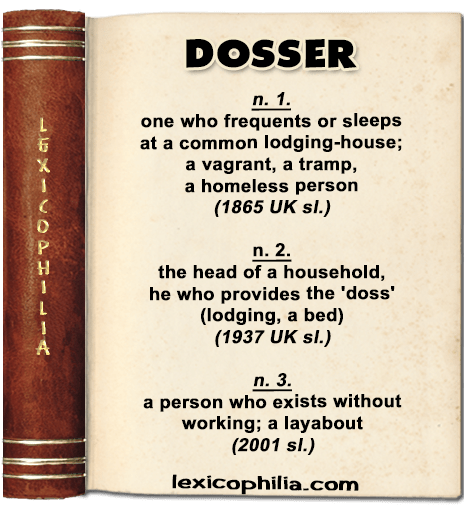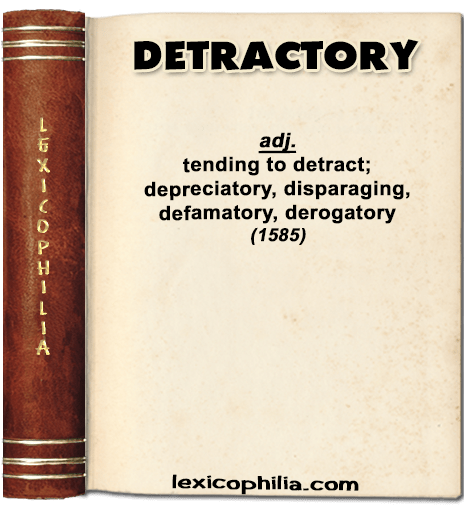
Word of the Day: DETRACTORY

ETYMOLOGY
from Latin detractorius (disparaging, slanderous), from detractor (a defamer, slanderer) + -ory

EXAMPLE
“… Let him say al this, and much more, which idle and slothfull Christians are accustomed to bring for their excuse: let him alleage the same as much and as often times as he wil: it is but an excuse, and a false excuse, and an excuse moste dishonourable and detractorie to the force of Christ holie grace purchased vnto vs by his bitter passion …”

From: A Christian Directorie guiding men to their saluation
By Robert Parsons, 1585
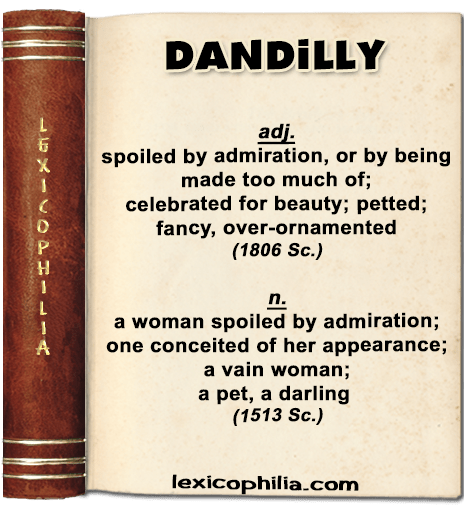
Word of the Day: DANDILLY

ETYMOLOGY
apparently a derivative of dandle (to move (a child, etc.) lightly up and down in the arms or on the knee)

EXAMPLE
“… I wes in youthe, on nureice kne,
Cald
dandillie, bischop, dandillie,
And quhone that age now dois me greif,
A sempill vicar I can nocht be:
Exces of thocht dois me mischief.
…”

From: Dunbar: A Critical Exposition of the Poems
By Tom Scott, 1965
Don is a Battell on the Dragon Blak
Composed by William Dunbar, a1513

Word of the Day: DUBITATE

ETYMOLOGY
from Latin dubitat-, participial stem of dubitare (to doubt)

EXAMPLE
“… as it shall now fare with him, the whole Future may be this way or be that. If, for example, he were to loiter dubitating, and not come; if he were to come, and fail: the whole Soldiery of France to blaze into mutiny. …”

From: The French Revolution: a History
By Thomas Carlyle, 1837

Word of the Day: DOSSER

ETYMOLOGY
from doss (n. lodging, a bed) (vb. to sleep)

EXAMPLE
“… Most of the ‘dossers’ were transient customers, people who were always on the move. …”

From: New York Police Gazette
Leaves from the Diary of a Celebrated Burglar; Being a Compilation of the Events and Occurences of the Most Exciting, Interesting and Extraordinary Character in the Life of a Thief
By Anonymous, 1865

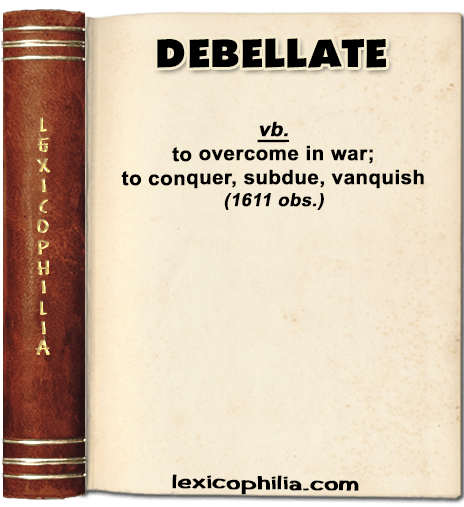
Word of the Day: DEBELLATE

ETYMOLOGY
from Latin debellat-, participial stem of debellare (to subdue in fight)

EXAMPLE
“… But let vs proceed: for now all claimes & quarrels were as open, as if no obstacle had euer beene interposed: the ignominie of their late terrible toiles wounded all true French hearts, and they desire (king Edward growne aged) not to seeme by sitting still vpon so many thornes of disgrace, and losse, to haue beene outwarred, though ouer-warred, and though in two or three battels inferior, yet not to haue beene clearely debellated. …”

From: The History of Great Britaine under the Conquests of ye Romans, Saxons, Danes and Normans
By John Speed, 1611

Word of the Day: DOCUS

ETYMOLOGY
of unknown origin

EXAMPLE (for n. 1.)
“… Eh man, but ye maun be an unco docus to mistak the yowlin’ o’ a wheen dougs for the squeelin’ o’ ghaists an’ deevils ! I wonner what ye made o’ the twa grumphies it ye had row’t up amang your falalls; gin ye thought it they war young de’ils or what, snoukin’ for a sappy emmeldyug about the harigals o’ ye. …”

From: Saint Patrick: A National Tale of the Fifth Century
By J. Rennie, 1819

Word of the Day: DROSSEL

ETYMOLOGY
of obscure origin

EXAMPLE
“… But lawfull weare it some be such, should all alike be coy’
Now dwels ech
Drossell in her Glas: when I was yong, I wot,
On Holly-dayes (for sildome els such ydell times we got)
A Tubb or Paile of water cleere stood vs in steede of Glas:
And yeat (which still I beare in mind) for it I schooled was,
Euen by an holy Fryer, that espyde me tooting so,
Who, softly stealing at my backe, cryde suddenly. Ho, Ho.
…”

From: Albions England: A Continued Historie of the same Kingdome, from the originals of the first inhabitants thereof
By William Warner, 1597

Word of the Day: DEXTERICAL

ETYMOLOGY
irregularly formed on Latin dexter (on the right hand or right side) + -ic + -al

EXAMPLE
“… It is called of the Hebrewes, … the hande of the Soule, or … the right hand of the minde, because it makes any conceit dexterical, one of the two things, for which a pregnant Poet (as imagine of Homer, Naso, or any other) especially is to be admired: …”

From: The optick glasse of humors.
Or The touchstone of a golden temperature
Or, The philosophers stone to make a golden temper.
By Thomas Walkington, 1607

Word of the Day: DOG-BOLT

ETYMOLOGY
of origin uncertain

EXAMPLE (for n.1.)
“… And as for Ser John Hevenyngham, Ser John Wyndefeld, and othere wurchepfull men ben mad but here doggeboltes, the which I suppose wull turne hem to diswurchep here-after…”

From: Paston Letters and Papers of the fifteenth century
Edited by Norman Davis, Richard Beadle, and Colin Richmond, 2004
Letter from Margaret Paston to John Paston, 1465

Word of the Day: DOWNSTEEPY

ETYMOLOGY
from down (in a descending direction) + steepy (full of steep places, steep) 

EXAMPLE
“… All which notwithstanding, perceiving life to remaine in him, he tooke heart againe; and getting vp on his feet, all goared with bloud, and loaden with strokes, making way through the prease, came to a craggie and downe-steepie rocke, where vnable to goe any further, by one of his wounds, with both his hands he pulled out his guts, and tearing and breaking them, cast them amongst such as pursued him, calling and attesting the vengeance of God to light vpon them. …”

From: The Essayes, or Morall, Politike, and Millitarie Discourses of Lord Michaell de Montaigne
By Michel de Montaigne
Translated by John Florio, 1603