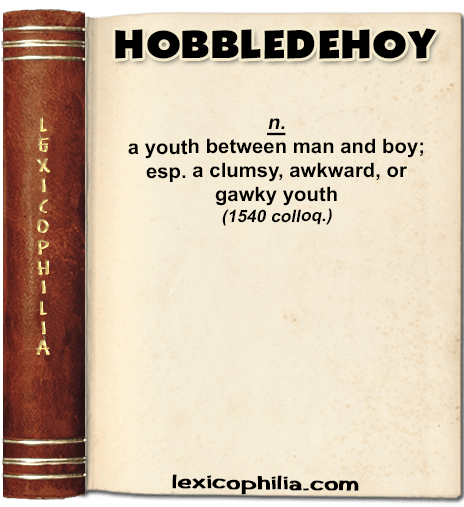
ETYMOLOGY
of uncertain origin;
the first element is possibly hob (clown, prankster);
the second element may be from French de haye (worthless, untamed, wild, literally ‘of the hedge’)
EXAMPLE
“…he began to clayme or chalenge his right more and more, and to cal in good lawes … and to desyre to haue the benefite or the succour of the lawes, whiche (were good and reasonable) by whiche they stryue … men vpholde or maynteyne suche as haue ouer shotte … ouer passed theyr fyrste parte of youthe … theyr hobledehoye tyme … the yeres that one is neyther a man nor a boye, at which yeres our voyce chagetij … that suche as haue passed theyr nonage, and be no longer berdelesse boyes, be to be loused from theyr fathers right … that theyr fathers haue no longer the guyding or correction of them, but that they be set at theyr lybertie…“
From: The Comedye of Acolastus
By Gulielmus Gnaphaeus
Translated by John Palsgrave, 1540
 Lexicophilia