ETYMOLOGY
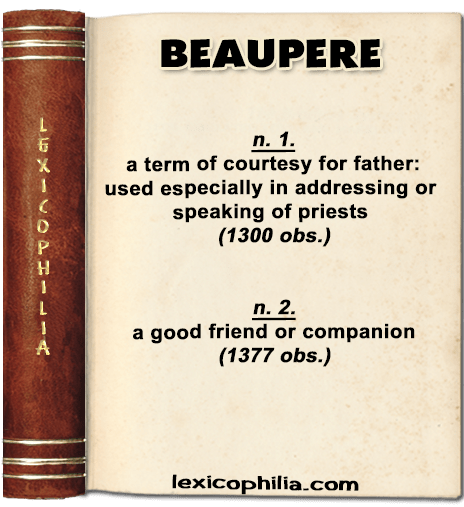
from Old French beau (fine, good_ + pre (father), or, in sense 2, per, peer (equal, peer):
From OED: In Old French, beau père was politely used in addressing every one whom one called ‘father’; i.e. one’s own father, a ‘father’ in the church, a god-father, a step-father, a father-in-law, an elderly man occupying a fatherly position in one’s regard; about the 16th or 17th century, this use of beau became obsolete, and beau-père was retained as a distinctive term for ‘father-in-law’ and ‘step-father’ as distinct from a real father. In English the use appears to have been much more limited.
EXAMPLE
“… Tho he hadde his tale itold and ymaked al his wise,
He sat adoun and the Bischop of Cicestre gan arise. “Beau pere,” he seide to the Pope: “me thinȝth hit
faith to the,
“To desturbi thing that falleth: to harm of communeaute; …”
From: The Life and Martyrdom of Thomas Beket, c1300
Edited by J.H. Black, 1848
 Lexicophilia