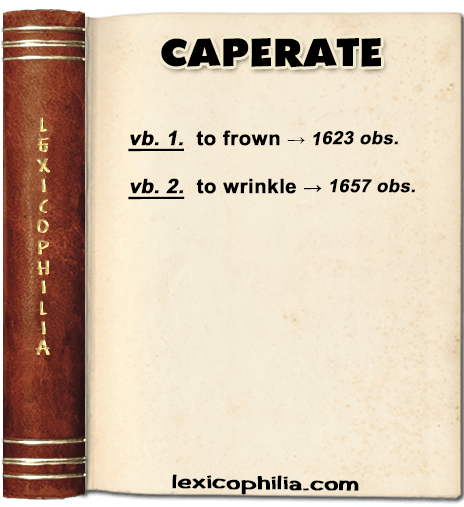
ETYMOLOGY
from Latin caperat- participial stem of caperare (to frown)
EXAMPLE (for vb. 2.)
“… the first is called a Limmon which is turbinated with an oblong effigies, is colorated herbaceously, and turgid with a more acid acerb and frigid succe, corticated with a thinner pill, and not so amare as an Orenge: the second is the more vulgar Citron, very like the former, but its colour is more luteous, its pill more crasse, rugous and caperated, and it selfe more crasse, odorate, medicative and convenient for antidotes: the third is greatest called Pom-Citron, orbiculated like a melon, with a thick carnous pill, somtimes aequalling a mans nayle in crassitude, with a concolorated superficies, which we call Poncerium, Citroniatum, Assyrian Apple, and Adams Apple, all which names seem to be deflected from the Tree, and as they are alike in Idea, so also in facultyes. …”
From: A Medicinal Dispensatory, containing the whole body of physick discovering the natures, properties, and vertues of vegetables, minerals, & animals
By Jean de Renou
Translated by Richard Tomlinson, 1657
“Of Limmons, Citrons.“
 Lexicophilia