Word of the Day

Word of the Day: BLUE PIPE

EXAMPLE
“…The blew Pipe groweth likewise in manner of a smal hedge tree, with many shootes rising from the roote like the former, as our common Priuet doth, whereof it is a kind. The branches haue some small quantitie of pith in the middle of the wood, and are couered with a darke black greenish barke or rinde. The leaues are exceeding greene and crumpled or turned vp like the brims of an hat, in shape very like vnto the leaues of the Poplar tree: among which come the flowers, of an exceeding faire blewe colour, compact of many small flowers in the forme of a bunch of grapes:…”

From: The Herball, or Generall Historie of Plantes
By John Gerard, 1597
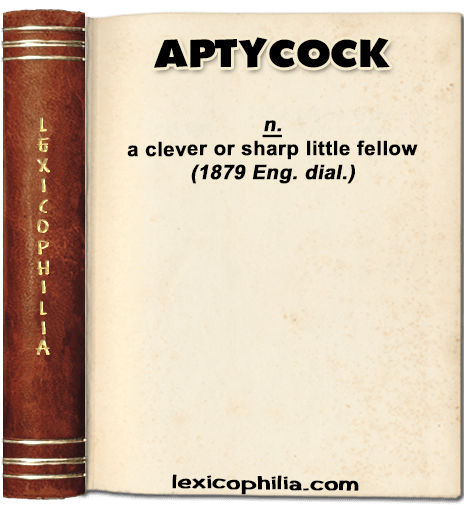
Word of the Day: APTYCOCK

ETYMOLOGY
from apt (intelligent, quick-witted) + -cock – a well-known suffix in surnames, as Alcock, Badcock;
probably from the use of ‘cock’ as a familiar term of appreciation for a man who fights with pluck and spirit

EXAMPLE
“…Tom marched away to school earlier than usual that afternoon, while the women went to the door and watched him trudge off, both mightily proud of his performance and his battered brown face.
“He be a reg’lar li’l
apty-cock, sure ‘nough!” said Joan.
Mrs. Tregenza answered with a nod, and looked along the road after her son.
…”

From: Collection of British Authors
Vol, 3228, 1897
Lying Prophets, By Eden Phillpotts

Word of the Day: BUCOLISM

ETYMOLOGY
from bucol-ic + -ism

EXAMPLE
“…The attempt produces a farrago which, in point of Greek, is disgraceful to the reputation of the University; for what can be more lamentably absurd than to see the lowest” bucolisms” of Theocritus thrust in as the necessities of a Sapphic ode require? The Greek Professor might very profitably publish a canon on this subject. …”

From: Introductions to the study of the Greek classic poets
By Henry Nelson Coleridge, 1830

Word of the Day: MALT-HORSE

ETYMOLOGY
from malt + horse

EXAMPLE
“…And bicause he passeth certain limites of a meane, that Reckelesness of his is curious, and not comly, and is a thing that commeth cleane contrarye to passe from the dryfte, (that is to wit) to cover arte. Therfore I judge it a no lesse vyce of curiositye to be in Reckelesness (which in it selfe is prayse worthye) in lettynge a mans clothes fal of his backe, then in Preciseness (whiche likewise of it self is praise worthy) to carie a mans head so like a malthorse for feare of ruffling his hear, or to keepe in the bottom of his cappe a looking glasse, and a comb in his sleeve, and to have alwayes at his heeles up and down the streetes a page with a spunge and a brushe: …”

From: The First Book of the Courtier
By Baldassare Castiglione
Translated by Thomas Hoby, 1561

Word of the Day: BIRSIE

ETYMOLOGY
adj. 1. from birse (Sc. – a bristle, hair) + -y
n. from birse (Sc. – to push, to press, to squeeze) + -y

EXAMPLE
“…The mekill howke hym bair was Tryton callyt,
For in hir forstam was the monstre stallyt,
With watry trumpe fleyand the fludis gray;
Quhar as scho salyt, men mycht se hym ay
With  
byrsy body porturyt, and vissage
All rowgh of harys, semyng of cullage
In mannys form fra hys cost to hys crown,
…”

From: Virgil’s Aeneid translated into Scottish verse
By Gavin Douglas, a1522

Word of the Day: IMPERFECTIOUS

ETYMOLOGY
from Latin imperfectus (imperfect), after factious, etc.

EXAMPLE
“…Come hither thou Imperfecksious slaue in
Regard of thy beggery, holde thee theres
Twoshillings for thee? to pay for the
Healing of thy left legge which I meane
Furiously to inuade or to maime at the least.
…”

From: A Pleasant Conceited Historie, called The Taming of a Shrew, 1594

Word of the Day: FOREMOTHER

ETYMOLOGY
from fore- (prefix) + mother, after forefather

EXAMPLE
“…Finallie the admirable humilitie, and inuincible patience and constancie in all aduersities and persecution euen to the death and martyrdome, of Iepthas daughter, Susanna, the mother of the seuen brethren, and women of the Machabites, and manie other: that looking in this glasse of the holie liues of their foremothers, they may christianlie conforme and adorne themselues after their good examples, and become for their rare vertues verie beautifull spouses in the fight of their spirituall bridegroome Iesus Christ: to whom, as the kings daughters, they may appeere all glorious within, …”

From: The Monument of Matrones Conteining Seuen Seuerall Lamps of Virginitie, or Distinct Ttreatises
Compiled by Thomas Bentley, 1582

Word of the Day: INFICIENT

ETYMOLOGY
from Latin inficientem (that does nothing), from in- + facientem (doing)

EXAMPLE
“… Lent. How well thy power can shun that which
I followe with obedience. Too true yfaith;
Thou mightst as well put out the eie of day,
Or cover sinne from heaven, or to erect
A towre of sand on the uncertain surge,
Or any thing that were more inficient,
Then to remoove one doting thought of mine
From her disdain. Thy aide, deere Tulley,
Be thou an Orratour for Lentulus,
My tongue stands tund to a harsher method
…”

From: Euerie Woman in her Humor 
Unknown author, 1609

Word of the Day: AMPLECT

ETYMOLOGY
from Latin amplecti (to embrace, clasp), from amb- (about) + plectere (to plait, twine)

EXAMPLE
“...With what ioy Charles the people the amplect
Theyr ryght great ioyes done playnly testifye
Mixed with swete sownes of many a sect
Some sownyng trumpes and clarions wonders hye
Some other syngynge most melodiously
Some vpon lutes some vpon harpes play
The to reioyce in all that euer they may
….”

From: Anonymous translation of Latin verses by William Lily, 1522
“Of the tryumphe and the verses that Charles th’emperour and the most myghty redouted kyng of England Henry_the_.viii. were saluted with passyng through London”