Word of the Day: INCAUTELOUS


ETYMOLOGY
from in- + cautelous (cautious, wary)


EXAMPLE
“…The bold Physitian, too incautelous,
By those he cures, himselfe is murdered,
Kindnes infects, pitie is dangerous,
And the poore infant, yet not fully bred,
Thear where he should be borne, lies buried,
So the darke Prince, from his infernall cell,
Casts vp his griesly Torturers of hell,
And whets them to revenge, with this insulting spell
….”

From: Christs Cictorie, and Triumph in Heauen, and Earth, Ouer, and After Death
By Giles Fletcher, 1610

Word of the Day: INQUIROUS


ETYMOLOGY
from inquire -ous


EXAMPLE
“…In our sixe dayes toile, traversing this Countrey, wee had many troubles and snarlings from these Savages; who somtimes over-laboured us with Bastinados, and were still inquirous, what I was, and whither I went; yea and enough for the Dragoman to save my life and liberty…”

From: The totall discourse, of the rare adventures, and painefull peregrinations of long nineteene yeares trauayles from Scotland, to the most famous kingdomes in Europe, Asia, and Affrica,
By William Lithgow, 1632

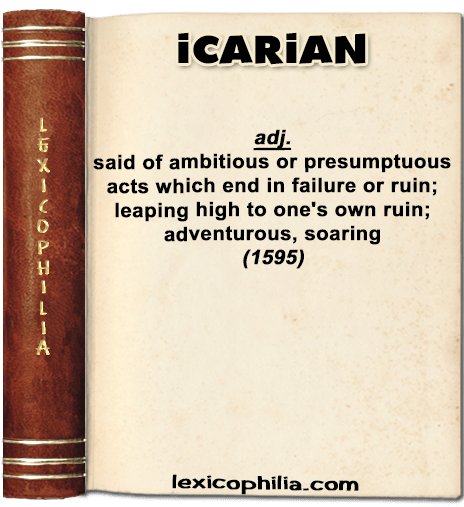
Word of the Day: ICARIAN


ETYMOLOGY
from Latin Icarius = Greek Ἰκάριος, from Icarus, Ἴκαρος the son of Daedalus, in Greek Mythology + -an 


EXAMPLE
“…And yet ’tis a bitter pang under any circumstances to find another preferred to yourself. It is about the same blow as one would probably feel if falling from a balloon. Your Icarian flight melts into a very grovelling existence, scarcely superior to that of a sponge or a coral, or redeemed only from utter insensibility by your very frank detestation of your rival…”

From: Coningsby: Or, The New Generation
By Benjamin Disraeli, 1844

Word of the Day: IDIOTICON


ETYMOLOGY
from Greek ἰδιωτικόν, neut. sing. of ἰδιωτικός (idiōtikos – private, unprofessional, ordinary);
taken in the sense of peculiar to oneself


EXAMPLE
“…The one Idea which gives the Tone to each play not seldom implied in the Titles, which deserve to be mentioned as an Idioticon of Shakespears…”

From: Coleridge’s Lectures 1808–19: On Literature, 1987

Word of the Day: IMBRIFEROUS


ETYMOLOGY
from Latin imbrifer (from imber (a shower))


EXAMPLE
“…at a time when large mountainous cumulostrati and cumuli appear more stationary, somewhat higher up, and when flimsy features of cirrostratus, cirrocumulus, and cirrus are visible in a region still more elevated. When this Scud is abundant we may be sure the imbriferous quality of the atmosphere remains, and we may expect a return of the showers…”

From: Researches about Atmospheric Phaenomena
By Thomas Forster, 1815

Word of the Day: INCULP


ETYMOLOGY
from Latin inculpare to inculpate, perhaps after French inculper 


EXAMPLE
“…For if Cri­sostomes impatience and headlong desire slew him; why should mine honest proceed­ing and care be inculped therewithall? If I preserve mine integrity in the society of these Trees; why would any desire me to lose it, seeing every one covets to have the like himself, to converse the better among men?…”

From: The History of The Valorous and Witty Knight-Errant, Don-Quixote, of the Mancha
By Miguel De Cervantes Saavedra
Translated by Thomas Shelton, 1612

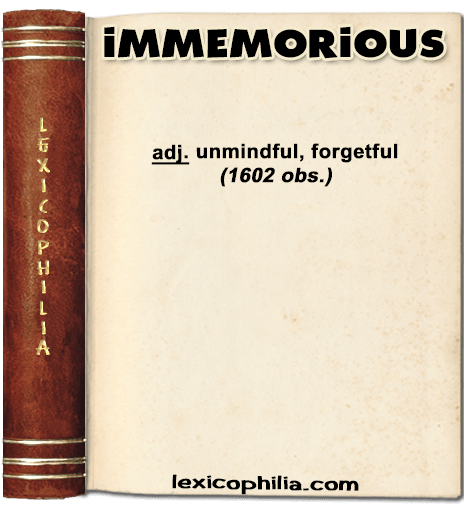
Word of the Day: IMMEMORIOUS


ETYMOLOGY
from im- + memorious


EXAMPLE
“…And we like wretches, carelesly oreseene
Neglecting all continuance of our good,
Of our owne birth haue immemorius beene,
And quite forgot the Nephewes of our blood,
And of neere kin are growne meere strāgers rather,
Almost forgetting we had all one father
…”

From: Svvord and Buckler, or, Seruing-Mans Defence
By William Basse, 1602

Word of the Day: IMAGINOUS


ETYMOLOGY
? from Latin imagoimaginem (image) + -ous,
or ? from imagine (vb.) + -ous


PRONUNCIATION
uh-MAJ-uh-nuhss


EXAMPLE
“…I oft haue heard there is a kind of cure
To fright a lingring Feuer from a man
By an  imaginous feare, which may be true,
For one heate (all know) doth driue out another,
One passion doth expell another still,
And therefore I will vse a fainde deuice
To kindle furie in her frozen Breast,
That rage may fire out griefe, and so restore her
To her most sociable selfe againe
…”

From: Monsieur D’Oliue
By George Chapman, 1606