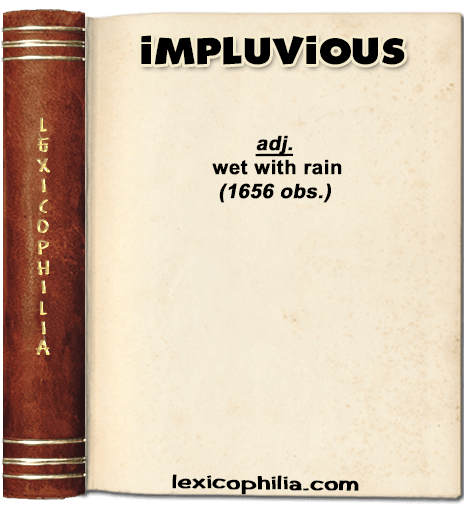
Word of the Day: IMPLUVIOUS


ETYMOLOGY
from im- + pluvious (characterized by rain, rainy) [from French pluvieux, or from Latin pluviosus (rain)]


EXAMPLE
“…Though (by the way) how that Expression should countenance an Impluvious state before the Flood, as the Latin Theory would make it, is not so clear and easie to be understood. For, if we consider, there was no Water upon that Earth, but what fell in Rain…”

From: Geologia: Or, A Discourse Concerning the Earth before the Deluge
By Erasmus Warren, 1690

Word of the Day: INSTIGATRIX


ETYMOLOGY
from Latin instigatrix, female agent-n. from instigare (to instigate, bring about by incitement or persuasion)


EXAMPLE
“…She was (saies Salme∣ron, a main Supporter of the Roman Church among the Tridentine Fathers) cooperatrix, that is, Christs Fellow-laborer in the very Passion to the end, that as a Man and a Woman did work out the utter ruine of Man-kind, so a Man and a Woman might perfect their Salvation; and as well here as there, the Woman should be the Instigatrix, or the first Sollicitress, Eve to temt, and Mary to set the Man to work. Thus she is, saies another, the Mother of Redemtion, by shedding her Soul into compassion under, as Christ did his in Passion upon the Cross…”

From: Saul and Samuel at Endor,
or The new waies of salvation and service, which usually temt men to Rome, and detain them there Truly represented, and refuted,
By Daniel Brevint, 1674

Word of the Day: INCAUTELOUS


ETYMOLOGY
from in- + cautelous (cautious, wary)


EXAMPLE
“…The bold Physitian, too incautelous,
By those he cures, himselfe is murdered,
Kindnes infects, pitie is dangerous,
And the poore infant, yet not fully bred,
Thear where he should be borne, lies buried,
So the darke Prince, from his infernall cell,
Casts vp his griesly Torturers of hell,
And whets them to revenge, with this insulting spell
….”

From: Christs Cictorie, and Triumph in Heauen, and Earth, Ouer, and After Death
By Giles Fletcher, 1610

Word of the Day: INQUIROUS


ETYMOLOGY
from inquire -ous


EXAMPLE
“…In our sixe dayes toile, traversing this Countrey, wee had many troubles and snarlings from these Savages; who somtimes over-laboured us with Bastinados, and were still inquirous, what I was, and whither I went; yea and enough for the Dragoman to save my life and liberty…”

From: The totall discourse, of the rare adventures, and painefull peregrinations of long nineteene yeares trauayles from Scotland, to the most famous kingdomes in Europe, Asia, and Affrica,
By William Lithgow, 1632

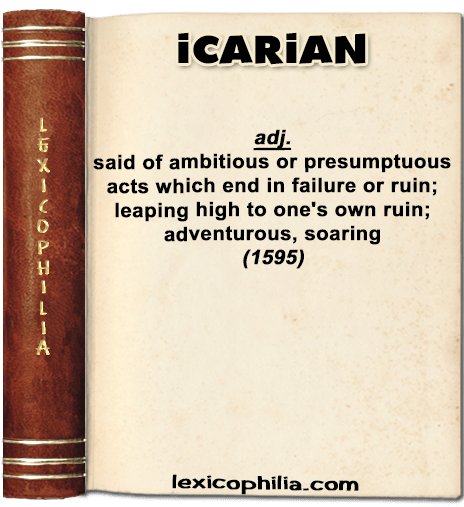
Word of the Day: ICARIAN


ETYMOLOGY
from Latin Icarius = Greek Ἰκάριος, from Icarus, Ἴκαρος the son of Daedalus, in Greek Mythology + -an 


EXAMPLE
“…And yet ’tis a bitter pang under any circumstances to find another preferred to yourself. It is about the same blow as one would probably feel if falling from a balloon. Your Icarian flight melts into a very grovelling existence, scarcely superior to that of a sponge or a coral, or redeemed only from utter insensibility by your very frank detestation of your rival…”

From: Coningsby: Or, The New Generation
By Benjamin Disraeli, 1844

Word of the Day: IDIOTICON


ETYMOLOGY
from Greek ἰδιωτικόν, neut. sing. of ἰδιωτικός (idiōtikos – private, unprofessional, ordinary);
taken in the sense of peculiar to oneself


EXAMPLE
“…The one Idea which gives the Tone to each play not seldom implied in the Titles, which deserve to be mentioned as an Idioticon of Shakespears…”

From: Coleridge’s Lectures 1808–19: On Literature, 1987

Word of the Day: IMBRIFEROUS


ETYMOLOGY
from Latin imbrifer (from imber (a shower))


EXAMPLE
“…at a time when large mountainous cumulostrati and cumuli appear more stationary, somewhat higher up, and when flimsy features of cirrostratus, cirrocumulus, and cirrus are visible in a region still more elevated. When this Scud is abundant we may be sure the imbriferous quality of the atmosphere remains, and we may expect a return of the showers…”

From: Researches about Atmospheric Phaenomena
By Thomas Forster, 1815

Word of the Day: INCULP


ETYMOLOGY
from Latin inculpare to inculpate, perhaps after French inculper 


EXAMPLE
“…For if Cri­sostomes impatience and headlong desire slew him; why should mine honest proceed­ing and care be inculped therewithall? If I preserve mine integrity in the society of these Trees; why would any desire me to lose it, seeing every one covets to have the like himself, to converse the better among men?…”

From: The History of The Valorous and Witty Knight-Errant, Don-Quixote, of the Mancha
By Miguel De Cervantes Saavedra
Translated by Thomas Shelton, 1612