ETYMOLOGY
from cormorant (a greedy or rapacious person)
EXAMPLE
“…There would be many money-cormorants, and their profit great….”
From: The Scales of Commerce and Trade
By Thomas Willsford, 1660

ETYMOLOGY
from cormorant (a greedy or rapacious person)
EXAMPLE
“…There would be many money-cormorants, and their profit great….”
From: The Scales of Commerce and Trade
By Thomas Willsford, 1660

ETYMOLOGY
from Latin mentition-, mentitio (lying, falsehood),
from mentit-, past participial stem of mentiri (to lie)+ -iō (-ion)
EXAMPLE
From childhood, she has never been good at mentition. Her face always turned bright red when she tried.

ETYMOLOGY
possibly from maum (mellow, soft, esp. over-ripe) + –ish
EXAMPLE
“…but she fed more vpon fancie, than glutted hir selfe with any cates there presente: more vpon daintie deuices, than any parcell of repast: for this meate forsooth was mawmish, & this melancholie: this dish would driue hir to drincke, and this cause hir to drie…”
From: Narbonus The Laberynth of Libertie
By Austin Saker, 1580

ETYMOLOGY
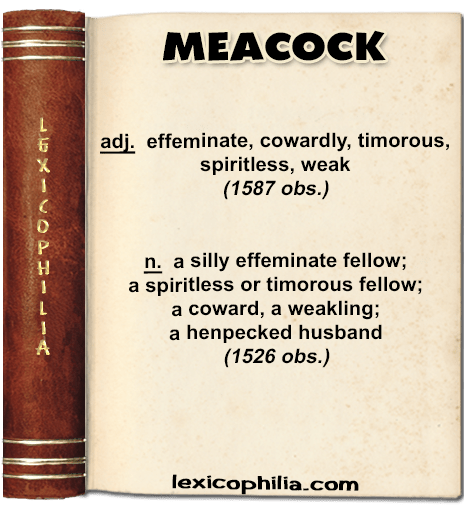
of obscure origin: perhaps originally a name of some bird
(From Murray’s N.E.D.: “the suggestion that it is from meek (adj.) is untenable”)
EXAMPLE
“…He shuld be no cowarde, no maycocke, ne fearfull persone that dare no thyng enterprise….”
From: Here Begynneth a Deuout Treatyse in Englysshe, called the Pylgrimage of Perfection,
By William Bonde, 1526

ETYMOLOGY
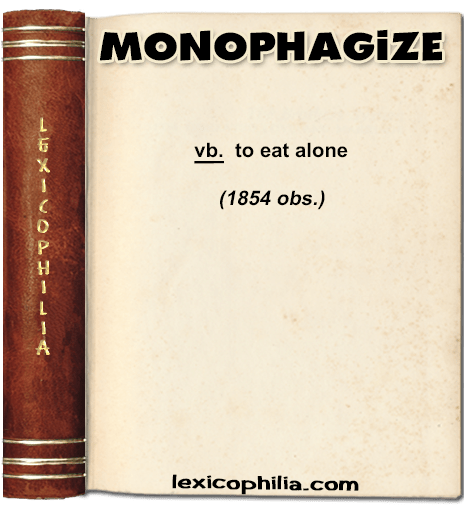
from Greek µονοϕάγος (monofagos) (that eats alone) + -ize
EXAMPLE
“…you who make us fight for every cabbage at the greengrocer’s, and prestige in its favour, that whereas the glutton might sometimes munch and monophagize in solitude, leading the life of a wolf or of a lion, those who drank generally drank together, and, as it was always said and supposed, to each other’s health and prosperity…”
From: Prose Halieutics
Or, Ancient and Modern Fish Tattle
By the Rev. C. David Badham, 1854
Chapter XXII. Opsophagy

ETYMOLOGY
from Latin morigeratus, past participial stem of morigerari (to to be obedient or compliant), from morigerus
EXAMPLE
“…Certaynely in the auncient tyme, whan thou were peopled with ryght and trewe Romayns, and not as thou arte nowe with bastarde chylderne, than the armies, that wente froo Rome, were as well disciplyned and morigerate, as the schooles of the philosophies, that were in Grece…”
From: The Golden Boke of Marcus Aurelius,
By Antonio de Guevara, 1546

ETYMOLOGY
from Latin mundus (world) + –cidious from –cida (killer)
EXAMPLE
“…Since I knew what to feare, my timerous heart hath dreaded three things: a blazing starre appearing in the aire: a State Comet, I mean a favourite rising in a Kingdome, a new Opinion spreading in Religion: these are Exorbitancies: which is a formidable word: a vacuum and an exorbitancy, are mundicidious evils…”
From: The Simple Cobler of Aggawam in America
By Rev. Nathaniel Ward, 1647

ETYMOLOGY
of uncertain origin; possibly imitative
EXAMPLE
“…for there is no more sullen beast, than a he drab. Ile make him pull his powting croscloath over his beetle browes for melancholie, and then my next booke, shall be Martin in his mubble fubbles…”
From: Pappe with a Hatchet:
Being a Reply to Martin Mar-prelate
By John Lyly, 1589

ETYMOLOGY
from Latin minac-, minax (threatening), from minae (threats) + -ax + -ous
EXAMPLE
“…or with a pleasant horrour and chilness look upon some silent Wood, or solemn shady Grove; whether the face of Heaven smile upon us with a chearfull bright azure, or look upon us with a more sad and minacious countenance, dark pitchy Clouds being charged with Thunder and Lightning to let fly against the Earth; whether the Aire be cool, fresh and healthful, or whether it be soultry, contagious and pestilential, so that while we gasp for life we are forc’d to draw in a sudden and inevitable Death…”
From: An Explanation of the Grand Mystery of Godliness
By Henry More, 1660

ETYMOLOGY
from Latin multiscius; multus (much) + scius (knowing), from scire (to know)
EXAMPLE
“…His somatic structure was procere and feateous; and his ostent, debonair. Multiscious in vitilitigation, omnipercipient, pansophical, emissitious, and obversant with anthroposophy, he was without dubitancy, a dabster…”
From: Letters to Squire Pedant, in The East
By Lorenzo Altisonant, an Emigrant to the West
By Samuel Klinefelter Hoshou. 1870
No. IX. Rixationville, July 7, 1843