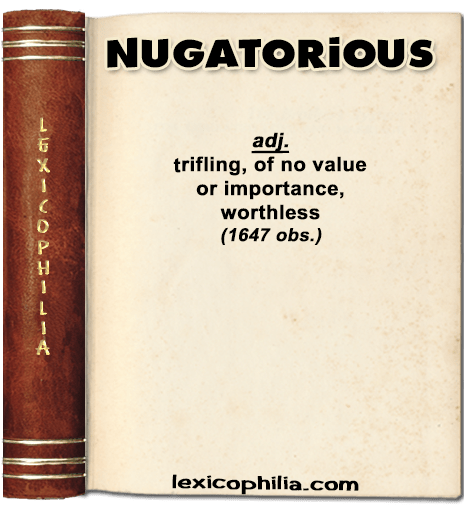
Word of the Day: NUGATORIOUS

ETYMOLOGY
from Latin nugatorius (frivolous, insignificant, worthless) + -ous

EXAMPLE
“… The tenet of the Catholick Church concerning Angels and Devils, that they are invisible spirits created of God in their own distinct substances separate from men, is nugatorious: that the Angels are only qualities and motions which God inspires into men, that the Devils are nothing but only boggles in the night to terrifie men arising from mens imaginations. …”

From: Anabaptism, the true fountaine of Independency, Brownisme, Antinomy, Familisme, and the most of the other errours, which for the time doe trouble the Church of England, vnsealed
By Robert Baillie, 1647

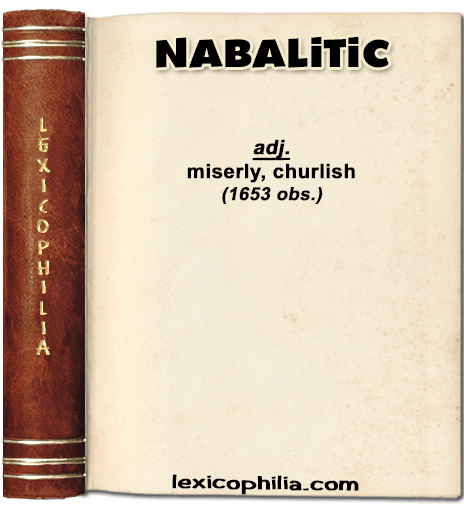
Word of the Day: NABALITIC

ETYMOLOGY
either  from nabal (a churlish or miserly person) + -itic;
or from nabalite (a foolish person) + -ic

EXAMPLE
“… since they see no reason, why these, as Christs Agents, and Gods Embassadours, should not as well deserve, and enjoy a competent, and comely maintenance, as any publique Officers, either Civill, or Military: Who have more of power to exact, but not more of right, either humane or divine; nor yet more of merit, to require their payes, and fees; Yea, Ministers still dare to hope, that those in power have not any such Nabalitick and churlish humor, as to feast those that shear, and sometimes slay the sheep; while they starve the Shepheards: …”

From: Hieraspistes a Defence by way of Apology for the Ministry and Ministers of the Church of England
By John Gauden, 1653

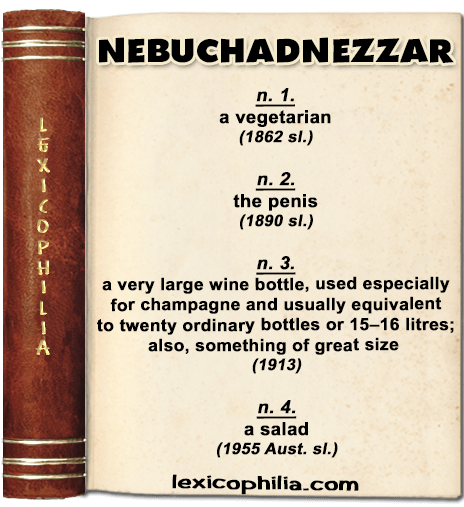
Word of the Day: NEBUCHADNEZZAR

ETYMOLOGY
from the name of Nebuchadnezzar (died c562 BC) ruler of the Babylonian empire (604–562 BC), after French nabuchodonosor (large wine bottle used for champagne)

EXAMPLE (for n. 3.)
“… That didn’t prevent me strewing my whole room with little bits of paper, when I undressed that night. Fireworks ensue, then (children dismissed) supper and afterwards, the most magnificent Nebuchadnezzars, and finally a good form of blind-man’s buff, where everyone stands round the room in a circle and the blind man walks up and prods someone, telling him at the same time to make a noise … sch as the sound of rain falling on mud – and the speaker has to be recognised by the sound of his voice. …”

From: Letters of Aldous Huxley
By Aldous Huxley, 1969
Letter to Leonard Huxley, 11 November, 1913

PRONUNCIATION
neb-yuh-kuhd-NEZ-uh

Word of the Day: NORISH

ETYMOLOGY
either an alteration of Norse (adj.) after Scottish, or directly from Norwegian norsk (Norse), with suffix substitution

EXAMPLE
“… for he was in prayer more frequent then yong ones are usually seen to be, of a spare diet, and so compassionate of the poor, as all that came in his hands he distributed among them: Servanus his Master loving him beyond others, was ordinarily wont to call him Mongah, which in the Norish tongue, signifieth a deare friend; and this way came he to be called Mungo. …”

From: The History of the Church of Scotland, beginning in the year of our Lord 203 and continued to the end of the reign of King James the VI
By John Spottiswood, 1677

Word of the Day: NIFFLING

ETYMOLOGY
either from niffle (to act in a trifling manner) + ‑ing,
or from nifle (a trifle) + ‑ing 

EXAMPLE
“…There are some that are so forestalled with a strong self-conceit of their own light and love of self-will, that whatsoever bears not the stamp and superscription of their approved patrons, schools and institutions, is but as darkness and nifling shadows unto them, and ungrounded prejudice, cavilling superstition, and vain suspicion do so much possess them, that they reject it as not worth the reading over; …”

From: The Epistles of Jacob Boehme
Translated by J. Ellistone, 1649
Preface to the reader

Word of the Day: NAVIGANT

ETYMOLOGY
adj.: from Latin navigant-navigans, present participle of navigare (to navigate)
n.: partly from French navigant, (navigator, seafarer) use as noun of present participle of naviguer (to navigate), and partly from Latin navigant-, navigans (seafarer) use as noun of present participle of navigare (to navigate)

EXAMPLE (for n.)
“… And now to declare something of the commodity and vtilitie of this Nauigation and discouerie: it is very cleere and certaine, that the Seas that commonly men say, without great danger, difficulty and perill, yea rather it is impossible to passe, that those same Seas be nauigable and without anie such danger, but that shippes may passe and haue in them perpetuall clerenesse of the day without any darkenesse of the night: which thing is a great commoditie for the nauigants, to see at all times round about them, as well the safegards as dangers, and how great difference it is betweene the commoditie and perils of other which leese the most part of euery foure and twentie houres the said light, and goe in darkenesse groping their way, I thinke there is none so ignorant but perceiueth this more plainely, then it can be expressed. …”

From: The Principal Nauigations, Voyages, Traffiques and Discoueries of the English Nation, made by sea or ouer-land, to the remote and farthest distant quarters of the earth, at any time within the compasse of these 1600. yeres
By Richard Hakluyt
A declaration of the Indies and lands discouered, and subdued vnto the Emperour, and the king of Portingal: And also of other partes of the Indies and rich countries to be discouered, which the worshipfull M. Robert Thorne merchant of London (who dwelt long in the citie of Siuil in Spaine exhorted king Henrie the eight to take in hand. a1527

Word of the Day: NOBS

ETYMOLOGY
of unknown origin

EXAMPLE (for n. 1.)
“… And I haue found it trew
Drinke now whyle it is new
And ye may it broke
It shall make you loke
yonger than ye be
yeres two or thre
For ye may proue it by me
Behold she sayd and se
How bright I am of ble
Ich am not cast away
That can my husband say
Whan we kys and play
In lust and in lykyng
He calleth me his whytyng
His mullyng and his nytyng
His
nobbes and his conny
His swetyng and his honny
With bas my prety bonny
Thou art worth good and monny
This make I my falyre fonny
Tyll that he dreme and dronny
For after all our sport
Than wyll he rout and suort
Than swetely togither wely
As two pygges in a sty.
…”

From: Here after foloweth certayne bokes
By John Skelton, 1545
The tunnyng of Elynour Rummynge

Word of the Day: NIDOROUS

ETYMOLOGY
from Late Latin nidorosus (steaming, reeking), from Latin nidor (strong or unpleasant odour, etc.) + –osus (-ous)

EXAMPLE
“…Incense, and Nidorous Smells, (such as were of Sacrifices,) were thought to Intoxicate the Braine, and to dispose Men to Devotion: Which they may doe, by a kinde of Sadnesse, and Contristation of the Spirits, And partly also by Heating, and Exalting them. …”

From: Sylva sylvarum; or, A Naturall Historie
By Francis Bacon, 1626

Word of the Day: NESCIOUS

ETYMOLOGY
from Latin nescius (ignorant, not knowing),
from nescire (to be ignorant, not to know) + -ous

EXAMPLE
“… The third cause of the decay of Trade, in Malynes accompt, are Litigious Law-suits. To the Efficiency whereof, Malynes cannot altogether agree, but rather to the Remedie. But I shall willingly pardon him that: for he that is so ignorant in the Essentiall causes, must needs be nescious in the Efficients also. I would there were no cause, for their sakes whose case it is, to dispute this Causalitie. …”

From: The Circle of Commerce.
Or The ballance of trade in defence of free trade: opposed to Malynes little fish and his great whale, and poized against them in the scale. 
By Edward Misselden, 1623

Word of the Day: NIPPITATE

ETYMOLOGY
variant of nippitatum (of unknown origin)

EXAMPLE (for n.)
“… Beside thiz in the field a good Marshall at musters: of very great credite & trust in the toun heer, for he haz been choze Alecuner many a yeere, when hiz betterz haue stond by: & euer quited himself with such estimation, az yet too the tast of a cup of Nippitate, hiz iudgement will be taken aboue the best in the parish, be hiz noze near so red. …”

From: A Letter: whearin, part of the entertainment vntoo the Queenz Maiesty, at Killingwoorth Castl, in Warwick Sheer
By William Patten, 1578