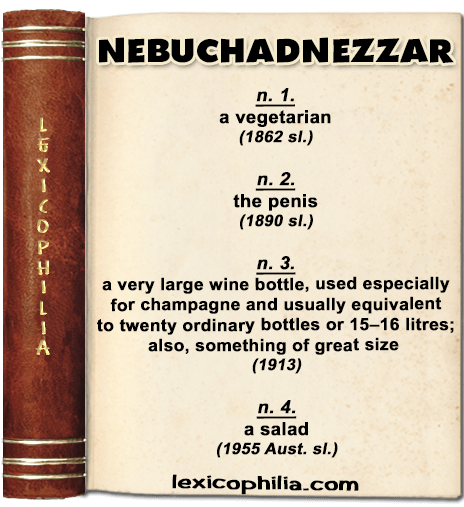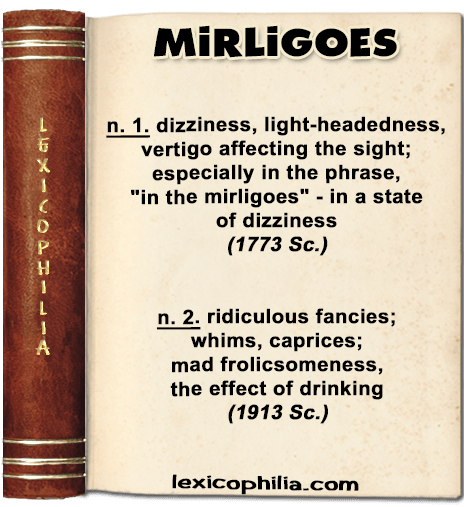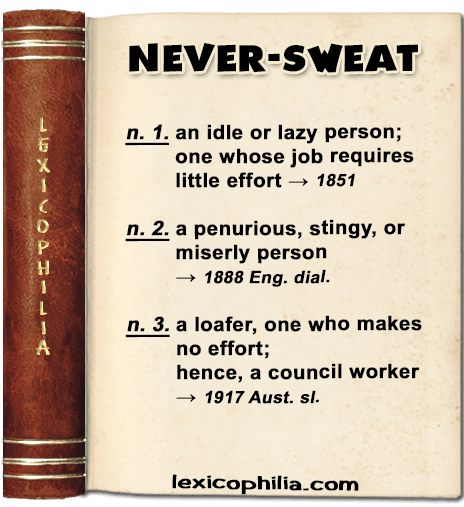
Word of the Day: NEBUCHADNEZZAR

ETYMOLOGY
from the name of Nebuchadnezzar (died c562 BC) ruler of the Babylonian empire (604–562 BC), after French nabuchodonosor (large wine bottle used for champagne)

EXAMPLE (for n. 3.)
“… That didn’t prevent me strewing my whole room with little bits of paper, when I undressed that night. Fireworks ensue, then (children dismissed) supper and afterwards, the most magnificent Nebuchadnezzars, and finally a good form of blind-man’s buff, where everyone stands round the room in a circle and the blind man walks up and prods someone, telling him at the same time to make a noise … sch as the sound of rain falling on mud – and the speaker has to be recognised by the sound of his voice. …”

From: Letters of Aldous Huxley
By Aldous Huxley, 1969
Letter to Leonard Huxley, 11 November, 1913

PRONUNCIATION
neb-yuh-kuhd-NEZ-uh

Word of the Day: MIRLIGOES


ETYMOLOGY
of uncertain origin;
perhaps from Scots mirl (to speckle, to spot),
with reference to the pattern seen before the eyes when in a state of dizziness + -igo 


PRONUNCIATION
MUR-luh-gohz


EXAMPLE
“…Sure Major Weir, or some sic warlock wight,
Has flung beguilin’ glamer o’er your sight;
Or else some kittle cantrup thrown, I ween,
Has bound in mirlygoes my ain twa ein,
If ever aught frae sense cou’d be believ’d
(And seenil hae my senses been deceiv’d),
This moment, o’er the tap of Adam’s tomb,
Fu’ easy can I see your chiefest dome:
Nae corbie fleein’ there, nor croupin’ craws,
Seem to forspeak the ruin of thy haws,
But a’ your tow’rs in wonted order stand,
Steeve as the rocks that hem our native land
….”

From: The Poems of Robert Fergusson
By Robert Fergusson, 1785
The Ghaists: A Kirk-yard Eclogue

Word of the Day: LICKSPITTLE


ETYMOLOGY
from lick (vb.) + spittle (a house or place for the reception of the indigent or diseased)


EXAMPLE
“…Yes – and to hear his lickspittles speak, you would think that a man of great and versatile talents was a miracle; whereas there are some thousands of them publicly acknowledged in England at this day…”

From: Noctes Ambrosianae (J. Wilson) in Blackwood’s Edinburgh Magazine,
Volume XVIII, July-December, 1825