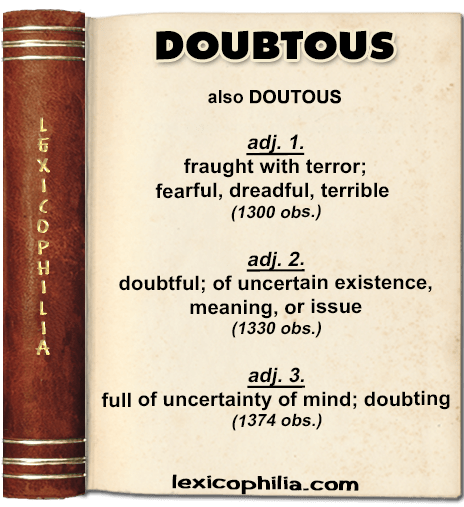
ETYMOLOGY
Middle English from Old French dutus, dotus, doutous;
from modern French douteux, from doute (doubt n.)
EXAMPLE 1 ( for adj. 1)
“…no for al is moch honoure
þat he ne worþ wel sone dede
Þe eiȝt dai so is dotus
and þat ful wel þou salt se
ful of tene and angus …”
From: Early English Poems and Lives of Saints with those of the wicked birds Pilate and Judas
Edited by Frederick James Furnivall, 1862
‘Fifteen Signs before Judgment‘, a1300
EXAMPLE 2 (for adj. 1)
“… And she said to hym: ‘My swete frend̛, yf it were possyble, soo wold I fayne doo, but it may not be. And wete it wel, that my departyng fro you is more gryeuous & doubtous a thousand tymes to me than to you, but it is the wyƚƚ & playsire of hym that can do & vndoo al thinges.’ and, with these wordes, she embraced & kyssed hym fuƚƚ tenderly, sayeng: ‘Farwel, myn owne lord & husbond̛; Adieu, myn herte, & al my joye; Farwel, my loue, & al myn wele …”
From: Melusine
By Jean d’Arras, c1500
(Published by Early English Text Society, 1895)
 Lexicophilia