ETYMOLOGY
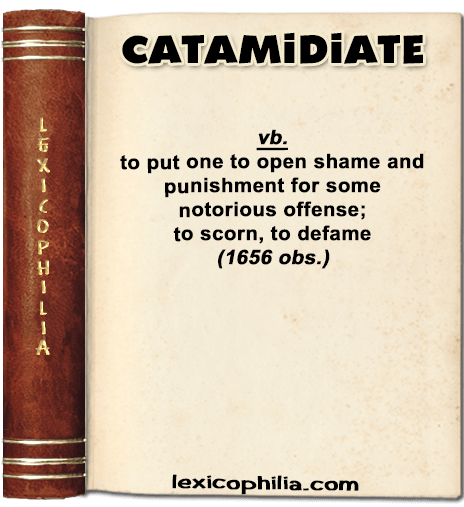
from Greek καταμειδιᾶν [katameidian] (to despise) + ‑ate
EXAMPLE
Politicians who make false, unrealistic promises are unethical, unscrupulous, immoral, and deceitful. Catamidiate them.
ETYMOLOGY
from Greek καταμειδιᾶν [katameidian] (to despise) + ‑ate
EXAMPLE
Politicians who make false, unrealistic promises are unethical, unscrupulous, immoral, and deceitful. Catamidiate them.
ETYMOLOGY
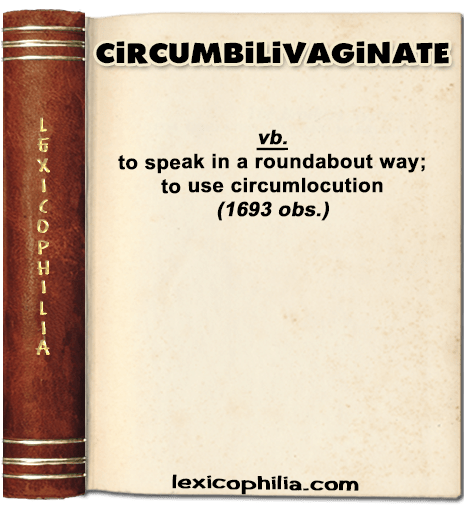
in 16th–17th century France: apparently, a fanciful creation of Rabelais
EXAMPLE
“…My counsel to you in that case, my friend, is that you marry, quoth Hippothadee; for you should rather choose to marry once than to burn still in fires of concupiscence. Then Panurge, with a jovial heart and a loud voice, cried out, That is spoke gallantly, without circumbilivaginating about and about, and never hitting it in its centred point…”
From: Gargantua and Pantagruel, Book III.
By Francois Rabelais
Translation by Sir Thomas Urquhart and Peter Antony Motteux, 1693

ETYMOLOGY
formed by compounding clip (that which is clipped or cut);
apparently from the form of its feelers, as having some resemblance to a pair of shears,
or scissors
EXAMPLE
“…turned out their russet recesses to the birsling sun, and the foggie-toddlers hirpled about their business in the warm sod, among golacks and clip-shears, while the grasshoppers chirped in merry concert…”
From: Proceedings of the Philosophical Society of Glasgow
Edited by Agnes McLean, Vol. XXX. 1898
V. Dr. James Colville on the Scottish Vernacular.

ETYMOLOGY
from Latin type cognoscibilis (knowable), from cognscere
EXAMPLE
“…There remains nothing entire, nor cognoscible in Germany, but the Sea and the Mountains…”
From: Le Prince
By Jean-Louis Guez de Balzac
Translated by H. Gresby, 1648
ETYMOLOGY
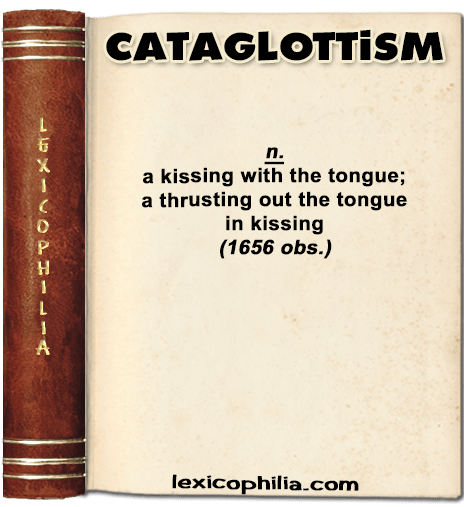
from French cataglottisme (‘a kisse or kissing with the tongue’ (Cotgrave)),
from Greek καταγλώττισµα, (kataglottisma) -ισµός (‘a lascivious kiss’)
EXAMPLE
“…The kiss is not only an expression of feeling; it is a means of provoking it. Cataglottism is by no means confined to pigeons…”
From: Studies in the Psychology of Sex,
Volume 4: Sexual Selection In Man
Havelock Ellis, 1905
ETYMOLOGY
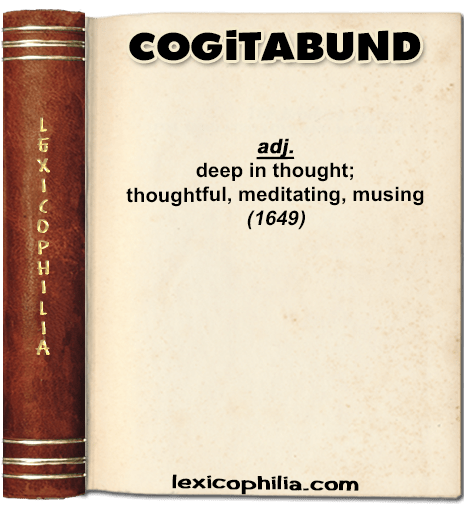
from Latin cogitabundus (thinking), from cogitare (to think)
EXAMPLE
“…To turn the apple of the eye towards the Nose, is their peculiar action who are Sowre and Severe; for, such are of a Contuitive, Grave, and Cogitabund aspect, such as is seen in those who with some Tragicall and Goblin-like look would affright and scare others…”
From: Pathomyotamia
By John Bulwer, 1649
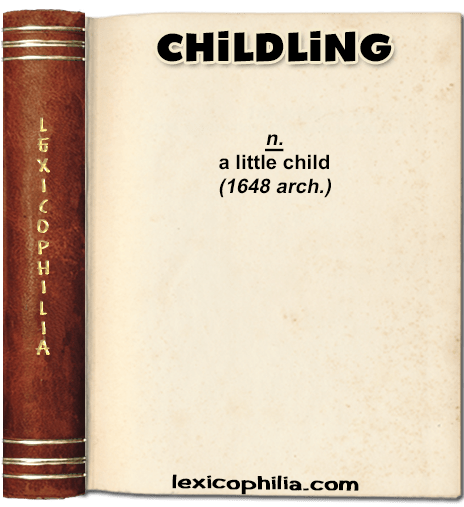
ETYMOLOGY
from child + -ling
EXAMPLE
“…and therefore more than one hundred times doth he in this his rayling pasquill expresse himselfe against me in such termes as these: Youngling, novice, boy, childe, youth, young springlius, young glorioso, young ignaro, young Phaeton, vaine young man, unworthy young man, young Jenkins, young simplicius, childling, young Pragmatico, shamelesse young man, young Dictator, young Metropolitan, young Thraso, green-head, young peece of presumption, Prelaticall peece of Presbytery, unhallowed peece of Presbytery, swelling peece of vanity, san of shame and folly, illiterate soule, poore man, silly brain, mancipium of illiteratenesse, friend William, Batte mi fili, (as if with his religion and reason, he had also abjured good manners.) And he plainly tels his Reader, that his aime in writing his booke was thus: To make me know my selfe; though a gracious heart would have put him upon writing to have made the people know the truth….”
From: Ὁδηγος Τυϕλος [Odegos Tuphlos]: The Blind Guide, or, The Doting Doctor
By William Jenkyn
Written by John Goodwin, 1648
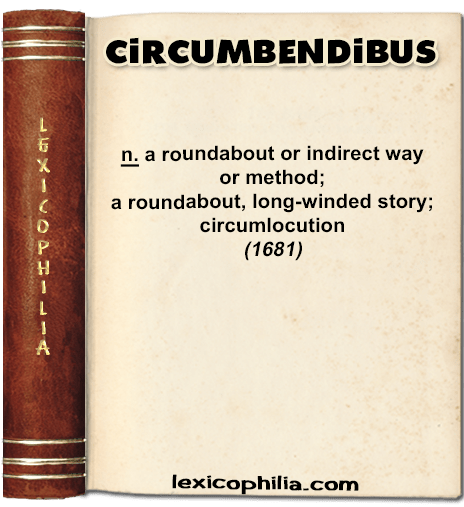
ETYMOLOGY
a humorous formation from Latin circum( round about) + bend + Latin –ibus (ablative plural ending)
EXAMPLE
“…Dominic: Let him alone; let him alone; I shall fetch
him back with a circum-bendibus I warrant him…”
From: The Spanish Fryar;
or, The Double Discovery
By John Dryden, 1681

ETYMOLOGY
from Latin concitat- participle stem of concitare (to move violently, to excite),
from con- + citāre (to move)
EXAMPLE
“…Cyrus king of Persia, mynding to concitate the myndes of his people, to wery & anger them, with payneful labour, held thē all one day at worke and vtterly tyred thē, in hewing vp a certayne Wood, on the morow after he made for them a very plentitious feast, demaunding in the feast tyme…”
From: A Right Exelent and Pleasaunt Dialogue Betwene Mercury and an English Souldier contayning his Supplication to Mars
Barnabe Rich, 1574
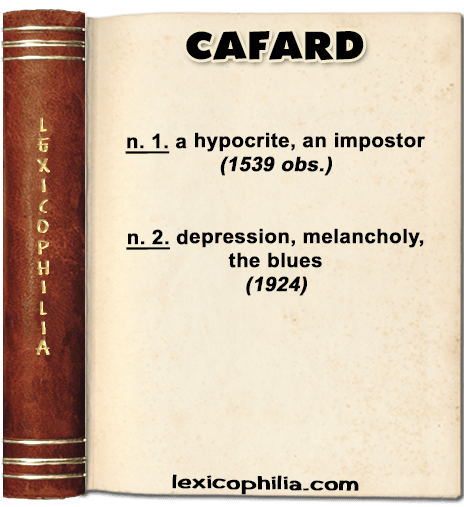
ETYMOLOGY
from French cafard, caphard, of doubtful origin:
some have proposed to identify it with Catalan cafre (infidel), Spanish, Portugese cafre (cruel), which are apparently adapted from Arabic kafir
PRONUNCIATION
kaff-AR
EXAMPLE
“…wherat he woundred, and sayd that he thought Your Grace the Prince best furnished thereof in Christendom. We commoned of the cafart, Cornibus, that slanderose frere. He said that Your Majesties Ambassadour, the Bishop of Hereford, hath sued and proposed certayn articles against him, athe copie whereof he hath promessed to sende unto me…”
From: State Papers Published Under the Authority of His Majesty’s Commission
King Henry the Eighth, 1830
Crumwell to King Henry VIII, 1539
 Lexicophilia