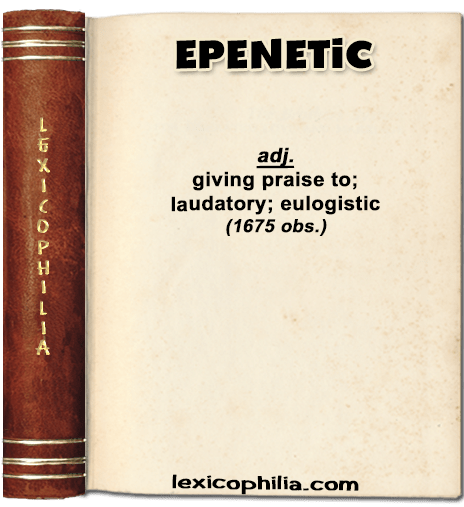
Word of the Day: EPENETIC

ETYMOLOGY
from Greek ἐπαινετικός, from ἐπαινεῖν (to praise)

EXAMPLE
“… another thing yet more considerable is conduct and design in whatever kind of Poetry, whether the Epic, the Dramatic, the Lyric, the Elegiac, the Epaenetic, the Bucolic , or the Epigram; under one of which all the whole circuit of Poetic design, is one way or other included; …”

From: Theatrum Poetarum, or, A Compleat Collection of the Poets especially the most eminent, of all ages, the antients distinguish’t from the moderns in their several alphabets
By Edward Phillips, 1675

Word of the Day: ERGOPHOBIA

ETYMOLOGY
from Greek ἔργον (work) + -phobia

EXAMPLE
“… to which might be added ergophobia, or mobid shrinking from active effort of every sort, etc. But these expressions add very little to definiteness of description. …”

From: Essentials of the Principles and Practice of Medicine
A Handbook for Students and Practitioners
By Henry Hartshorne, 1881
Part I, Principles of Medicine. Section I. General Pathology
Neuro-Pathology

Word of the Day: EXQUISITIVE

ETYMOLOGY
formed on exquisititious (adj.), from Latin exquisit- participial stem of exquirere (to search out)

EXAMPLE
“… It is enough that the Priests and learned Men explain the difficult Passages of it to the People, and write Commentaries for the Use of the more curious and exquisitive. The Persians, on the contrary, think it no Disparagement to the Arabick, or Profanation of the Sense, to translate this cursed Book into their own Language; and Copies are frequent among them. …”

From: The Philosophical Transactions and Collections 
to the End of the Year MDCC (1700)
By John Lowthorp, 1731
Chapter II, Chronology, History, Antiquities

Word of the Day: EQUIVOCANT

ETYMOLOGY
from Latin aequivocantem, present participle of aequivocare, from aequivocus (ambiguous)

EXAMPLE
“… to trie battaile with the Medes: yea, and and answere by Oracle later than these before cited, which verily was true, but no lesse ambiguous and equivocant, …”

From: The Roman History Of Ammianus Marcellinus
Translated by Philemon Holland, 1609

Word of the Day: EDACIOUS

ETYMOLOGY
from Latin edaci- (nominative edax), from edere (to eat) + -ous

EXAMPLE (for n. 1.)
“… Nor is this the sole circumstance that should, in mere justice, be
considered in connection with the rise of Christian monachism; for
before the mere facts can be understood, and certainly before the due
measure of blame can be assigned to the parties concerned, it is
indispensable that we divest ourselves of the prejudices, physical,
moral, and intellectual, which belong to our austere climate, high-toned
irritability,
edacious appetites, and pampered constitutions; to our
rigid style of thinking, and to our commercial habits of feeling.
…”

From: Natural History of Enthusiasm
By Isaac Taylor, 1829

Word of the Day: EMBRAID

ETYMOLOGY
from en- braid (to upbraid, to reproach);
possibly aphetic from abraid (to upbraid)

EXAMPLE
“… No besynes of famylyar thynges shal agayn your wyll departe you from suche plesaunt ydelnes, for I truste to oure goddes that my lytil feelde, of the which I am enbrayded by Corneli, shal suffise for our dayly lyvelode. …”

From: Gaius Flaminius refutes Publius Cornelius, his Rival for the Hand of Lucretia
In Tully of Old Age and Friendship
Translated by William Caxton, 1481

Word of the Day: EXTERRANEOUS

ETYMOLOGY
from  Latin exterraneus (from ex- (out) + terra (land)) + -ous

EXAMPLE
“… had they only a morsel of standing room – an exterraneous rock from which to pull. How the wheels crush and pulverise all that they come upon, under their three or four tons weight! …”

From: The Dublin University Magazine
A Literary and Political Journal
Volume II, July to December, 1833
Familiar Epistles from London. No. IV

Word of the Day: EGESTUOUS

ETYMOLOGY
from late Latin egestuosus, irregularly from egestas (poverty)

EXAMPLE
“… You call me oscitant, – ah! well,
Obtenebration hides my tears;
I may become sejungible,
When labefaction comes with years.
Exequial nights,
egestuous days
No nummary relief can soothe, –
No xenodochium allays
Radicate thirst with “Bass” or “Booth.”
…”

From: The Savage-Club Papers
Edited by Andrew Halliday, 1867
A Social Science Valentine, By Thomas Archer

Word of the Day: EFFUTITIOUS

ETYMOLOGY
from Latin effutitius, from Latin effutio (to chatter, prate)

EXAMPLE
“… No xenodochium allays
Radicate thirst with “Bass” or “Booth.”
Unaccendible paradigm!
Call not this
effutitious prate;
‘Tis ecphonesis, though it seem
But babbling to balbucinate.
…”

From: The Savage-Club Papers
Edited by Andrew Halliday, 1867
A Social Science Valentine, By Thomas Archer

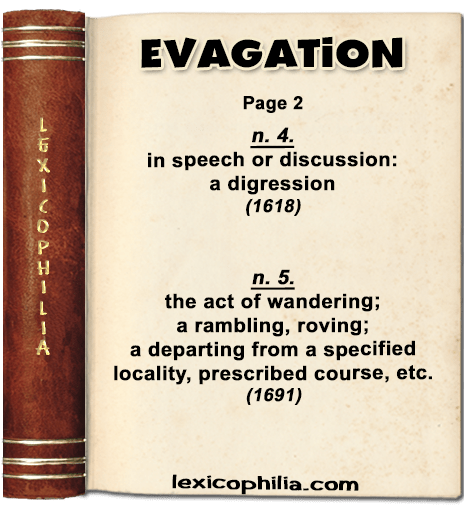
Word of the Day: EVAGATION

ETYMOLOGY
First introduced in the fig. n.1; from French evagation, Latin evagationem, noun of action from evagari, from e (out) + vagari (to wander)

EXAMPLE (for noun 1)
“… Clarefie me with fy clernesse of euerlastinge lijt, and bringe oute of fe liabitacle of myn herte aH maner of derkenes. Restreyne all euel evagacions & all miȝty temptacions. …”

From: The earliest English translation of the first three books of the De imitatione Christi
By Thomas à Kempis, c1425