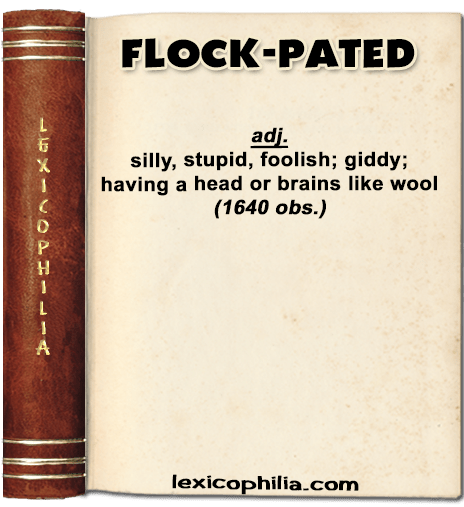
Word of the Day: FLOCK-PATED

ETYMOLOGY
from flock (material consisting of the coarse tufts and refuse of wool or cotton, used for quilting garments, and stuffing beds, cushions, mattresses, etc.) + pated (having a head or mind of the specified kind)

EXAMPLE
“…He that would be a Scholler,
Must hate your drinks that is muddy:
But a cup of good Canary
Will make him the better to study.
O this is a good old Woman, etc.

And he that would be a Poet,
Must no wayes be flocke-pated:
His ignorance if he show it,
He shall of all Schollers be hated.
O this is a good old Woman, etc.

He that would be a Goodfellow,
Of meanes must be prepared:
If that he love drinke and Tobacco,
Or else he shall be jeared.
O this is a good old Woman, etc.
….”

From: “The Merry Old Woman”, c1640
In The Roxburghe Ballads, Ballad Society, 1869-99

Word of the Day: FOGGISH

ETYMOLOGY
adj. 1.: from fog (fat, bloated) + -ish
adj. 2.: from fog (cloud of small water droplets that is near ground level) + -ish

EXAMPLE (for adj. 1.)
“…He that lyueth after the rules of phisike lyueth wretchedly. As thoughe it were an happynes and felicitie, the body to be swolen and stretched out with surfettyng, to be brasted with the pleasure of the body, to waxe foggyshe with drinkyng of good ale, & to be sepulte and drowned in slepe …”

From: Declamatio in Laudem Nobilissimæ Artis Medicinæ.
= A declamacion in the prayse and co[m]me[n]dation of the most hygh and excellent science of phisyke
By Desiderius Erasmus
Translated out of Latin into English, ?1537

Word of the Day: FEROCIENT

ETYMOLOGY
from Latin ferocientem, present participle of ferocire (to be fierce) , from ferox (fierce)

EXAMPLE
“…November 18 about four in the morning a lamentable fire seised upon the Lord Wimbletons house in the Strand, it being then the lodging of the States Lieger Ambassador, which consumed and demolisht it with all the rich furniture and utensils to the ground; so ferocient and impetuous it was, as the Ambassadour, his wife and children hardly, though half naked, escaped; all their other apparel, Jewels, money, &c. yea even the Commission it self perisht in the combustion…

From: The Reign of King Charles
By Hamon L’Estrange, 1655

Word of the Day: FORCELY


ETYMOLOGY
from force (n.) + -ly


EXAMPLE (for adv.)
“…Luke we the fische that swimmis in the se,
Luke we in eirth all kynd of bestyall,
The foulis fair sa forcelie thay fle,
Scheddand the air with pennis grit and small;
Syne luke to man that he maid last of all
Lyke to his image and his similitude;
Be thir we knaw that God is fair and gude.
…”

From: The morall fabillis of Esope the Phrygian
Translation by Robert Henryson
The Preiching of the Swallow. a1500

Word of the Day: FIDDLE-FACED


ETYMOLOGY
from fiddle (n.) + faced (adj.)


EXAMPLE
“…And would any but such like, sick-brained, corky-noddled, flea-lugg’d piper framed, fiddle faced, wagtailed fellows, saucy, and idle, lazy, lubbert, leeped, nasty, foul clacking, and a meer outside, a pinned up bacon, a stitched together stand-bra, can scarce put on her own cloaths, and can do nothing else but stand like a statue, with her gogling eyes, and black patches, and when they are off is ashamed to be seen in public, for fear they prove a scare crow…”

From: John Thompson’s Man
Or. A short survey of the difficulties and disturbances That may attend a married Life, c1785

Word of the Day: FAMATION


ETYMOLOGY
? aphetic from defamation (n.)


EXAMPLE 1
“…Ich wile þat y ben hanged & drawe
Boute y defende me wiþ þe lawe
Of þis famacioun,
Þat þow seist y scholde selle
Me lordes sone þat ich of telle,
Þat men clepede Reinbroun
…”

From: The Romance of Guy of Warwick
The first or 14th-century version, c1325


EXAMPLE 2
The well-known actor brought a legal action against the magazine for famation of character.