ETYMOLOGY
from for- (prefix) + wonder
EXAMPLE
“…All þatt teȝȝ haffdenn herrd off Crist,
& seȝhenn wel wiþþ eȝhne;
& iwhillc mann þatt herrde itt ohht
Forrwunndredd wass þæroffe…”
From: The Ormulum (transcript)
Edited by Robert William Burchfield

ETYMOLOGY
from for- (prefix) + wonder
EXAMPLE
“…All þatt teȝȝ haffdenn herrd off Crist,
& seȝhenn wel wiþþ eȝhne;
& iwhillc mann þatt herrde itt ohht
Forrwunndredd wass þæroffe…”
From: The Ormulum (transcript)
Edited by Robert William Burchfield

ETYMOLOGY
from Latin fatiloquus (prophesying, prophetic) + -ist
EXAMPLE
“…Fate, and Fatories, and Fatiloquists, and Fooles, all taken from talking they know not what …”
From: Πῦς-μαντία. The Mag-astro-mancer,
Or The Magicall-Astrologicall-Diviner posed, and puzzled
By John Gaule, 1652

ETYMOLOGY
a reduplicated formation on flanting (flaunting)
EXAMPLE
“…An old Doctor of Oxford shewd me Latine verses of his in that flourishing flantitanting goutie Omega fist, which he presented unto him (as a bribe) to get leave to playe, whe hee was in the heighth or prime of his Puer es cupis atque doceri…”
From: Have with You to Saffron-Walden Or, Gabriell Harveys Hunt is Up
By Thomas Nashe, 1596

ETYMOLOGY
from female + -ist
EXAMPLE
“…Beauty can turn the rugged face of War,
And make him smile upon delightful Peace,
Courting her smoothly like a femalist.
I grow a slave unto my potent love,
Whose power change hearts, make our fate remove…”
From: The Insatiate Countesse: A Tragedie
By John Marston and William Barksted, 1613

ETYMOLOGY
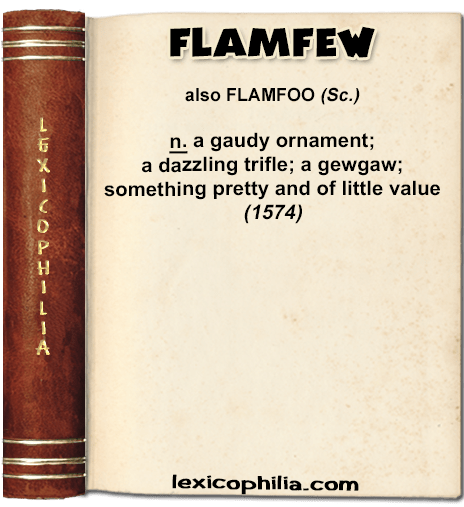
corruption of French fanfelue, from medieval Latin famfalūca (bubble, lie),
apparently from Greek πομϕόλυξ (bubble)
EXAMPLE
“…In brest of the Godesse Gorgon was cocketed hardlye,
With nodil vnioyncted, by death, light vital amoouing.
Voyd ye fro theese flamfews, quoa the God, set a part the begun wurck…”
From: Thee First Foure Bookes of Virgil his Aeneis
Translated intoo English heroical verse by Richard Stanyhurst, 1582

ETYMOLOGY
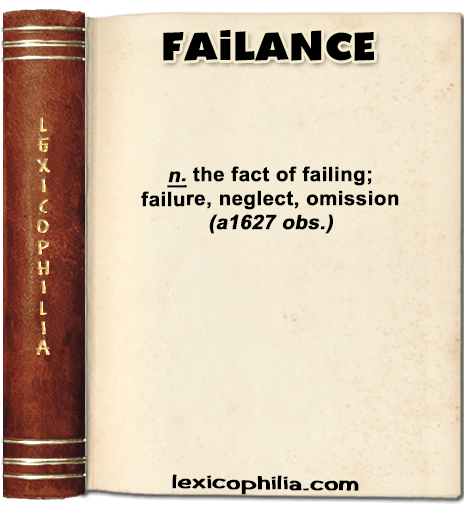
from Old French faillance, from faillir (to almost do something, to fail)
EXAMPLE
“…but when you come to Exercise the whole company ioyned, you may at some times for your owne satissaction in the more ready & gracefull performance of them, command the Postures to bee done by the whole number at once, with such pawse betweene euery Posture, as may afford you meanes to discerne any faylance therein: but whensoeuer you skirmish you shall vse no more of direction then,
1. Make Ready.2. Present.3. Giue Fyre…”
From: The Compleat Gentleman, fashioning him absolute in the most necessary & commendable qualities concerning minde or bodie that may be required in a noble gentleman
By Henry Peacham, 1627

ETYMOLOGY
from Latin fluctisonus; fluctus (wave) + sonus (sound)
EXAMPLE
“…Flash! White raw human waves make a fluctisonous roar!…”
From: G Day, Please God, Get Me Off the Hook
By Neil Baker, 2010

ETYMOLOGY
from flap (to move up and down) + sauce (n.)
EXAMPLE
“…hath nowe brought (to howse) nowe hathe this glutton. i. this flappe sawce (the thyng) that he may plentuously swallowe downe hole…”
From: Gulielmus Gnapheus’ Comedye of Acolastus
Translated by John Palsgrave, 1540

ETYMOLOGY
from Latin furaci- (nominative furax),
from furari (to steal) + -ous
EXAMPLE
“…This amazing, and indeed murderous villany of the Irishman brought them all to their wit’s ends how to defend themselves from the ruin therein threatened unto them; and whatever methods were proposed, it was feared that there could be no stop given to his furacious exorbitancies any way but one; he could not be past stealing, unless he were past eating too…”
From: Magnalia Christi Americana
Or, The Ecclesiastical History of New-England
– Cotton Mather, 1702

ETYMOLOGY
irregular from frigid + -ious
EXAMPLE
“…Like curelesse cures, past and repast repaire:
Frigidious Ianus two-fold frozen face,
Turnes moyst Aquarius into congeal’d yce:
Though by the fires warme side the pot haue place…”
From: All the workes of Iohn Taylor the water-poet
Beeing sixty and three in number
Anagrams and Sonnets, 1630