Word of the Day: FANDANGOUS

ETYMOLOGY
from fandangs (fanciful adornments in personal attire, trinkets (Eng. dial.))

EXAMPLE
“…who though a little proud and finical, to be sure he will yaw a parcel of nonsense about jukes and lords, and them sort of fandangus trumpery, and puts a parcel of gibberish whims into the head of all the women he falls in with…”

From: The Beggar Girl and Her Benefactors
– Agnes Maria Bennett, 1797

Word of the Day: FRIDAY-FACED

ETYMOLOGY
? from Friday being a day of fasting

EXAMPLE
“…without a sermon pareneticall for exhortation, that hee might seeke bethe where they were and were not, as Skoggin did the hare, and presse an army royall of arrand honest women, to scale the fortresse of modestie with friday faced scoulds, ere he coulde triump for halfe such a victory in twise so much space…”

From: Philotimus
– Brian Melbancke, 1583

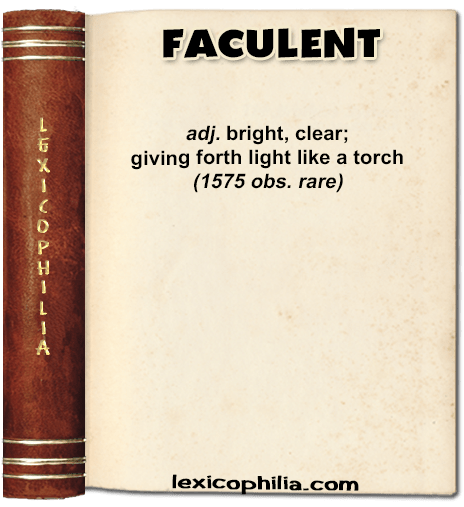
Word of the Day: FACULENT

ETYMOLOGY
from medieval Latin faculentus, from facula, fax (torch)

EXAMPLE
“…Als it is red in storyis ancient,
Thocht it be not in ald nor new Testament.
How that Vergill that worthie wise doctour,
In latin toung was ane most faculent,
Nane mair pregnant, facund, nor eminent,
To writ, or dyit, he was of Clerkis flour
…”

From: Ane Treatise callit the Court of VENVS,
deuidit into four Buikis,
Newlie Compylit be IOHNE ROL­LAND in Dalkeith, 1575

Word of the Day: FAMELICOSE

ETYMOLOGY
from Latin famēlicōsus, from fames (hunger)

EXAMPLE
“…We arrived there by 10:30 p.m. and were super hungry despite eating all the stuffed pranthas all the way. I guess all Punjabis are famelicose because no matter how much we eat, we can still manage to eat more if given something that is delicious…”

From: Unanswered Questions
Love is Lost When the Answers are Assumed,
Katie Khanna, 2016

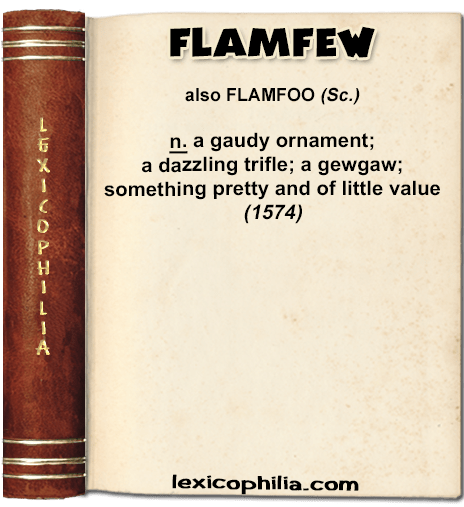
Word of the Day: FLAMBUGINOUS

ETYMOLOGY
– a burlesque formation on flam (a fanciful notion, caprice, whim obs.)

EXAMPLE
“…To these were added a number of the minor order of exhibitors. In one place you saw the miraculous and flambuginous sea-monster, known by the name of the Non-Descript. Next to it stood the Musical Rat, which played most divinely on the mouth-organ…”

From: The Sporting Magazine of the Transactions of The Turf, The Chase,
And every other Diversion Interesting to the Man of Pleasure, Enterprize, and Spirit.
Volume 42, 1813
Easter Amusements of the Year 1813