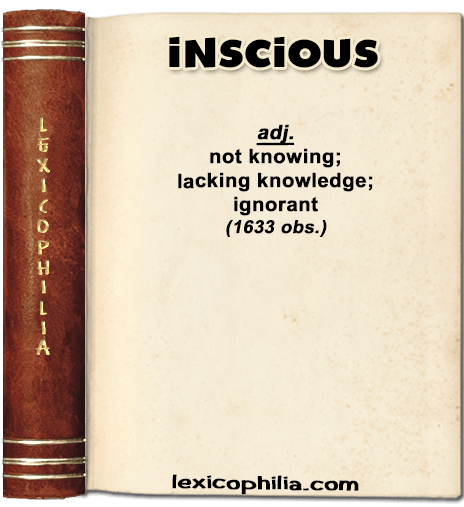
Word of the Day: INSCIOUS

ETYMOLOGY
from Latin inscius (not knowing, ignorant), (from in- + -scius (knowing)) + -ous

EXAMPLE
“… This they are willingly ignorant of. Hee begins with the Dunces, those stubborne and unruly Blockheads; inscious, nescious, conscious, wilfull Ignorants. It is one thing, velle scire quod oportuit latere; another, velle latere quod oportuit scire. The former, is a sawcie ambition of forbidden knowledge; the other, a headstrong preclusion of commanded knowledge. …”

From: A Commentary or, Exposition vpon the Diuine Second Epistle Generall, written by the Blessed Apostle St. Peter
By Thomas Adams, 1633

Word of the Day: INCREPATORY

ETYMOLOGY
from late Latin increpatorius (Sidonius), from participial stem of increpare (to increpate, to chide, to rebuke)

EXAMPLE
“… The power archbishop Loundres had as lord justice, and the pope’s legate, gave him the opportunity of encroaching on the rights of the crown and the liberties of the subject, by drawing temporal causes to the ecclesiastical courts, of which the citizens of Dublin complained to the king, who this year sent him an increpatory writ, prohibiting him front such practices for the future, with threats of severe treatment if he persisted. …”

From: The History and Antiquities of the City of Dublin, 
From the Earliest Accounts
By Walter Harris, 1766

Word of the Day: INNOCENTIOUS

ETYMOLOGY
from Latin innocentia (innocence)

EXAMPLE
“… To conclude, hee read vnto her so strict and austere a Lecture, concerning her base and debosht life, that from an impudent Strumpet, hee wrought her to be a repentant Conuertite. Her Brasen forhead melted at his fierie zeale, and all those skales of Immodestie (like a Maske plucked off) fell from her face, and shee appeared to him in her former simple and innocentious life. When further questioning with her of her birth and countrey, shee freely confessed vnto him, That shee was borne in the North countrey, her father a gentleman, once of faire Reuenue; but being impouerished by peeuish Suites in Law, her mother first, and hee (whether by age, or griefe, shee knew not) soone after died. …”

From: Γυναικεῖον [Gynaikeion]: or, Nine Bookes of Various History Concerninge Women
By Thomas Heywood, 1624

Word of the Day: INGLUVIOUS

ETYMOLOGY
from Latin ingluviosus (gluttonous), from ingluvies (gluttony) 

EXAMPLE
“…Wee must haue a good eye and a diligent respect to our health, and we must vse moderate exercises of the bodye. We must not be to ingluvious, in taking our foode and repaste , wee muste not pamper and gourmandise our selues withe excesse of meate and drinke, but so much and such competencie thereof muste be taken, as sufficeth to refreshe the vitall powers and naturall strengthe, and not to empaire, hebetate, and vtterly to extinguish them. …”

From: The Worthye Booke of Old Age othervvyse entituled the elder Cato contayning a learned defence and praise of age, and aged men
By Marcus Tullius Cicero
Translated by Thomas Newton, 1569

Word of the Day: INNUBILOUS

ETYMOLOGY
from Latin innubilus, (from in- + nubilus (nubilous, cloudy, foggy, misty)) + -ous

EXAMPLE
“… Through the benignity of our largifical essence always inclin’d to succour the egestuosity of our votaries conceptions, and to inlighten their offuscated intellects upon the least petitionary susurration, we will now descend from our innubilous empireum to infuse some rays of knowledge for solving the problem of our obsequious querist, so far as is fit to be communicated to the humble spawn of earth; …”

From: The British Apollo,
Containing Two Thousand Answers to Curious Questions in Most Arts and Sciences, Serious, Comical, and Humorous
1st Edition, 1708-1711

Word of the Day: IRRUENT

ETYMOLOGY
from Latin irruentem, present participle of irruere (to rush in or upon)

EXAMPLE
“… Under such an irresistible impulsion, mind and soul both were now following hand in hand a new path of progressive and irruent development. …”

From: Music:  A Monthly Magazine 
Devoted to the Art, Science, Technic, and Literature of Music
W. S. B. Mathews, Editor
Volume IV. May, 1893 to October 1893
The Old Lyric Stage and the New One

Word of the Day: IMPUDICOUS

ETYMOLOGY
from Latin impudicus (shameless, unchaste) + -ous

EXAMPLE
“… To the first, though the Libertines boast, that what is sinne in others, is not in them; and the Popish Canonists tell us, that though it may be a wanton and impudicous act in another to kiss a woman, yet a Priest doing it, it is to be pre­sumed he doth it onely to bless her; yet we think it abominable to have such divers Weights, and divers Measures; …”

From: Coena quasi Κοινὴ: The new-inclosures broken down, and the Lords Supper laid forth in common for all Church-members
By William Morice, 1657