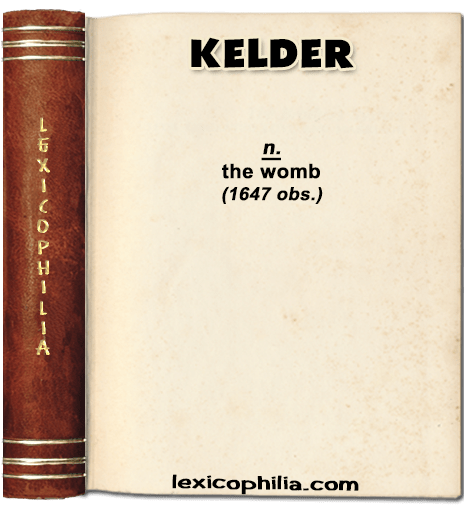
Word of the Day: KELDER

ETYMOLOGY
from Dutch kelder a (cellar)

EXAMPLE
“… Angell of light, und darknesse too, I doubt,
Inspir’d within, and yet posses’d without.
Majestick twilight in the state of grace,
Yet with an excommunicated face.
Charles and his Mask are of a different mint,
A Psalme of mercy in a miscreant print.
The Sun wears Midnight, Day is beetle-brow’d,
And Lightning is in
Keldar of a cloud. …”

From: The Character of a London-Diurnall with Severall Select Poems
By John Cleveland, 1647
The Kings Disguise

Word of the Day: KUMBIX

ETYMOLOGY
from Greek kimbix (tightfisted person)

EXAMPLE
“… for hee that saith unto a rich and great monied man, that he will be his broker, and helpe him to some usurers of whom he may take up mony at interest; or unto a sober person, who drinketh nothing but water, that he is a drunkard, or hath taken his wine too liberally; or he that calleth a liberall man, well knowen to spend magnificently, and ready to pleasure all men, a base mechanicall kumbix, and a pinching peni-father; or he who threatneth a famous advocate or counsellor at the barre, who hath a great name for lawe and eloquence in all courts of plea, and besides for policie and government is in high authoritie, that he will bring him to a non-sute, or overthrow him judicially, he (I say) ministreth matter of good spirit and laughter unto the partie whom he seemeth so to chalenge or menace. …”

From: The Philosophie, Commonlie called, The Morals
By Plutarch
Translated by Philemon Holland, 1603

Word of the Day: KITCHENIST


ETYMOLOGY
from kitchen (n.) + -ist


EXAMPLE
“…If, notwithstanding All that hath bin said,
TOBACCONISTS will still hold on their Trade,
And by their Practice still hold vp their Name,
Though Iewes, though Diuels, better suite the same;
I’le say no more but only This, of This:
Henceforth, let none whose meaner Lot it is
To liue in Smoak; Lime-burners, Alchymists,
Brick-makers, Brewers, Colliers, Kitchenists;
Let Salamanders, Swallowes, Bacon-stitches,
Red-Sprats, red-Herings, and like Chimnie-wretches,
Think no Disparagement, nor hold them base:
TOBACCONISTS their Companie will grace,
And teach them make a Vertue of Necessitie
…”

From: Tobacco Battered; & the pipes shattered
By Josuah Sylvester, 1617

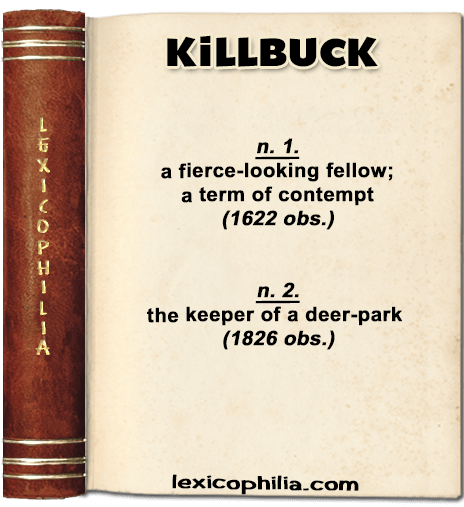
Word of the Day: KILLBUCK


ETYMOLOGY
from kill (vb.) + buck (the male of several animals)


EXAMPLE
“…Tharsalio.  Out, you young hedge-sparrow; learn to tread
afore you be fledge!
[He kicks her out.]
Well, have you done now, lady?


Arsace..  O, my sweet kilbuck!


Tharsalio.  You now, in your shallow pate, think this a
disgrace to me; such a disgrace as is a battered helmet
on a soldier’s head; it doubles his resolution. Say, shall
I use thee?


Arsace.  Use me?
…”

From: The Widdowes Teares
By George Chapman, 1612

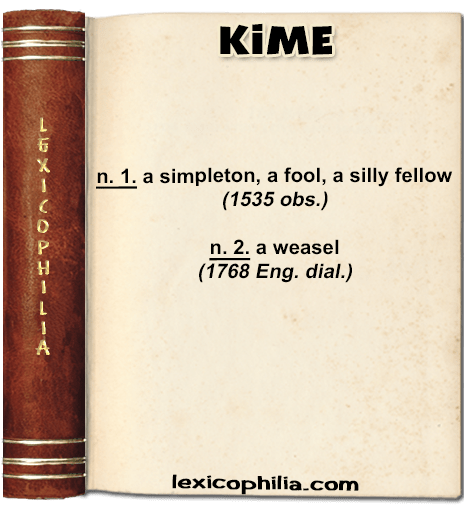
Word of the Day: KIME


ETYMOLOGY
of uncertain origin


EXAMPLE
“…The Emperour yaf the Pope somtyme
So hyghe lordshyp hym aboute,
That at the laste the sely kyme
The proude Pope putte hym out!
So of thys realme is in doute,
But lordes be ware and them defende;
For nowe these folke be wonder stoute:
The kynge and lordes nowe thys amende!
…”

From: The Ploughman’s Tale, c1535

Word of the Day: KICKIE-WICKIE

ETYMOLOGY
apparently a humorous formation of kicksey-winsey (a whim or erratic fancy)

EXAMPLE
“…Parolles. I that would be knowne: too’th warrs my boy, too’th warres: He weares his honor in a boxe vnseene, That hugges his kickie wickie heare at home, Spending his manlie marrow in her armes Which should sustaine the bound and high curuet Of Marses fierie steed: to other Regions, France is a stable, wee that dwell in’t Iades, Therefore too’th warre…”

From: All’s Well that Ends Well
By William Shakespeare, a1616