Word of the Day: LIP-LICK

ETYMOLOGY
from lip + lick

EXAMPLE
“… Thee gay boy kindlye playing, thee knowne lads phisnomye taking:
That when Queene Dido shal col the, and smacklye bebasse thee,
When quaffing wynebols, when bancquets deyntye be serued,
When she shal embrace thee, when
lyplicks sweetlye she fastneth;
That then thow be suer, too plant thy poysoned hoat looue.
…”

From: Thee first foure bookes of Virgil his Aeneis
Translated intoo English heroical verse by Richard Stanyhurst, 1582

Word of the Day: LEAN-WITTED

ETYMOLOGY
from lean (adj.) + witted (having wit)

EXAMPLE
“… A lunatike leane-witted foole,
Presuming on an agues priuiledge,
Darest with thy frozen admonition
Make pale our cheeke, chasing the royall bloud
With furie from his natiue residence.
Now by my seates right royall maiestie,
Wert thou not brother to great Edwards sonne,
This tong that runnes so roundly in thy head,
Should runne thy head from thy vnreuerent shoulders.
…”

From: The Tragedie of King Richard the Second 
1st Quarto
By William Shakespeare, 1597

Word of the Day: LUCTISONOUS

ETYMOLOGY
from Latin luctisonus (from luctus (grief )+ son- root of sonus (sound)) + -ous

EXAMPLE
“… Let me coacervate a few
Ambagious words amarulent,
Ludificatory, but true,
Ere I become so macilent,
That without voice to ululate
My lov’d one’s
luctisonous name,
My honour I impignorate,
And raise a temulentive flame.
…”

From: The Savage-Club Papers
Edited by Andrew Halliday, 1867
A Social Science Valentine, By Thomas Archer.

Word of the Day: LIRIPOOP

ETYMOLOGY
from Latin liripipiumleropipium, (explained in glosses as ‘tippet of a hood’, ‘cord’, ‘shoe-lace’, and ‘inner sole-leather of shoes’); 
no plausible etymology has been found; connection of the latter part with French pipe (pipe (n.)) is not unlikely;
the form loripipium, which suggests Latin lorum strap, is likely an etymologizing corruption

EXAMPLE (for n. 3)
“… I say againe, my horses:
Are ye so hot? have ye your private pilgrimages?

Must ye be Jumping-Jone? Ile wander with ye:
Ile jump ye, and Ile joggle ye: my horses;
And keep me this young
Lirry-poope within dores,
I will discover, dame. …”

From: Comedies and Tragedies
By Francis Beaumont and John Fletcher, 1647
The Pilgrim

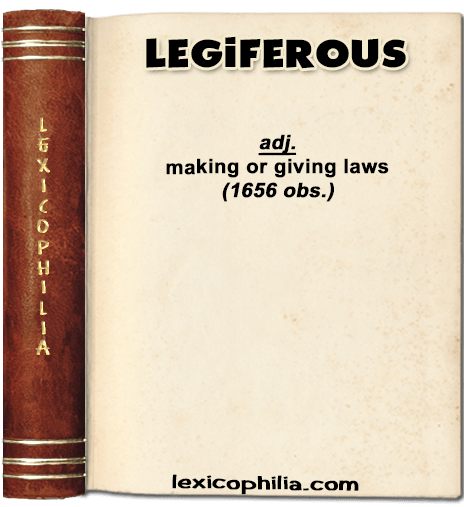
Word of the Day: LEGIFEROUS

ETYMOLOGY
from Latin legifer (law-giving); (from legi-lex (law) + -fer (bearing, bringing)) + -ous

EXAMPLE
“… When both joynd issue to Entertaine the King
(Your Royall Grandfather of blessed memory)
Then did the issues of the Schollars braine
Put Ignoramus on’s 
Legiferous straine …”

From: Ignoramus. Or, The Academical Lawyer
By Ferdinando Parkhurst, 1662
in The Prologues and Epilogues of the Restoration 1660-1700
By Pierre Danchin, 1981

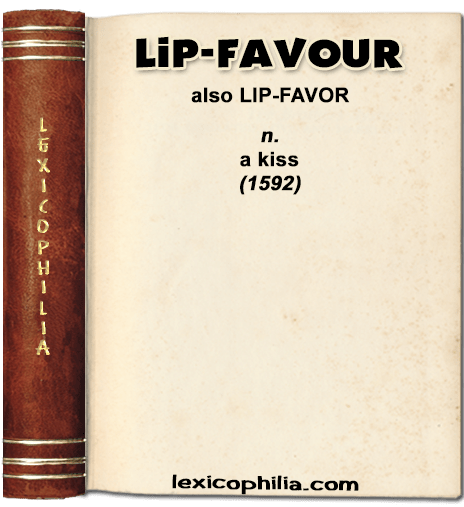
Word of the Day: LIP-FAVOUR

ETYMOLOGY
from lip + favour

EXAMPLE
“… As soon as she had sealed up her letter, she brooked no delay but sent it straight by one of
her waiting-women to Lutesio, whom she found sitting alone in his chamber reading
upon a book. Interrupting his study, she delivered him the letter and the message of her
lady. Lutesio, kind, gave the gentlewoman a kiss, for he thought she valued a
lip-favour
more than a piece of gold, and with great courtesy gave her leave to depart. She was
scarce out of the chamber but he opened the letter and found what he expected, the
resolution of a chaste countess, too worthy of so jealous a husband. …”

From: Philomela
The Lady Fitzwater’s Nightingale
By Robert Greene, 1592

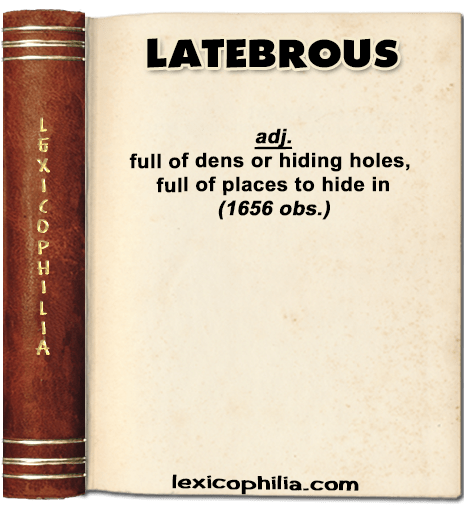
Word of the Day: LATIBULATE

ETYMOLOGY
from participial stem of Latin latibulari, from latibulum (hiding place)

EXAMPLE
“…Shhhh! Do you hear the whispers?
ones that taunt, laugh and persuade
they are here, there, and everywhere
as I
latibulate with my face to the wall

Sometimes they chant a single word
in chorus or in perpetual canon
until the sound overwhelms my thoughts
Shhhh! Do you hear the whispers?
…”

From: The Monday Morbs – Volume 1 Of Fearful and Monstrous Things
By S.B. Pearce, 2023
‘Hiding in the Corner’

Word of the Day: LION’S TOOTH

also LION’S TEETH

ETYMOLOGY
from the French Dent de lion (lion’s tooth) (Latin Dens leonis)

EXAMPLE
“… It is temperate, cold, and drye with Roses and Uineger tepered togeather, it helpeth the hed in hotte diseases, the sowthistle called Sonchos hath ye same vertue & so hath Cicory: if they be sodden, the loose the belly & quencheth heat which burneth in the stomacke and defendeth the head from hot smoking vapoures, and purgeth yellow choller, and rebateth venerous & fleshly heat, & is good to be sodden & dronk in hote burning Agues: though this herbe be commonly knowen and counted of many as a vile wede, yet it is reported of Dioscorides to be an excellent herbe, & is called Lyons teeth. …”

From: Bulleins Bulwarke of Defence against all Sicknesse, Soarenesse, and VVoundes that doe dayly assaulte mankinde
By William Bullein, 1562
“The Booke of Simples”