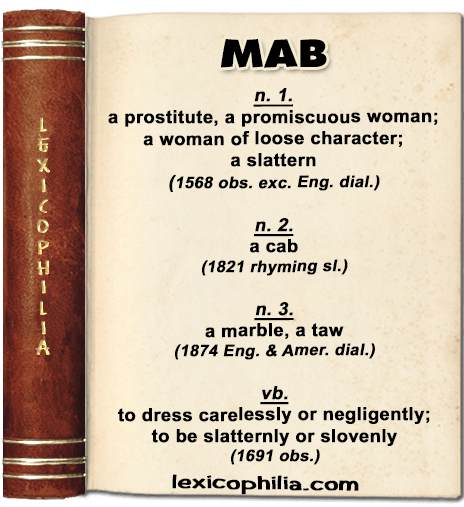
Word of the Day: MAB

ETYMOLOGY
n. of uncertain origin uncertain;
perhaps from the female forename Mab, shortened in Middle English from Mabel, from Amabel
vb. related to mab (a promiscuous woman), perhaps as a variant of mob (to dress oneself untidily

EXAMPLE (for n. 1.)
“… Mido. Take my life for a penny, whither shall I ren?
Esau. Come out, thou little fiend, come out, thou skittish gill.
Abra. Out, alas, alas! Esau will us all kill.
Esau. And come out, thou mother Mab; out, old rotten witch!
As white as midnight’s arsehole or virgin pitch. Where be ye? come together in a cluster.
…”

From: A Newe Mery and Wittie Comedie or Enterlude, Newely Imprinted, Treating vpon the Hhistorie of Iacob and Esau, 1568

Word of the Day: MALEVOLO

ETYMOLOGY
from Italian malevolo, from Latin malevolus (enemy, foe, ill-wisher)

EXAMPLE
“… We had many pamphlets commended daily unto us, The integrity of a parliament; how that it could have no sinister end: as if a multitude could be void of knaves to contrive, and of fools to concur in mischief. Many plots were discovered daily against our religion and our laws, in which ye Machiavels of Westminster, ye Malevolos might have claimed the chiefest livery, as Beelzebub’s nearest attendants in that kind: but they must be fathered still upon our old justicers; and indeed they can do little, that cannot bely an enemy. …”

From: The British Bellman
Printed in the Year Of the Saints Fear. 1648

Word of the Day: MOLLITUDE

ETYMOLOGY
from Latin mollitudo, from mollis (soft) + -tudo (-tude)

EXAMPLE
“… Which, if you had otherwise expressed his sense rightlie, yet should you haue forborne to apply to yours for the observing of decorum, a thing that you commend so in Homer, and your selfe aime at: sith those maides and wooers, intended both by Homer and you, to be wantons, must vse lascivious danses; and the man (if you will needes haue such resemblances) bee compared rather to Mollitude, or Cowardnes, the woman to Incontinencie. …”

From: Th’overthrow of Stage-Playes, by the way of controversie betwixt D. Gager and D. Rainoldes
By John Rainolds, 1599

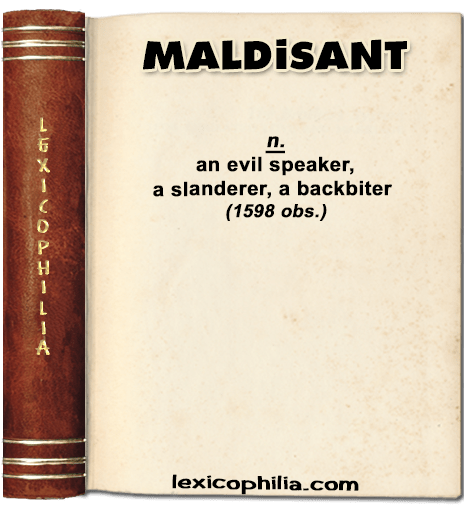
Word of the Day: MALDISANT

ETYMOLOGY
from French maldisant (evil speaker), use as noun of present participle of maldire, maudire (to speak evil), from maledicere; from male (badly) + dicere (to speak, say)

EXAMPLE
“… He is to blame (faith Martiall, and further he brandes him with a knavish name) that will be wittie in another mans booke. How then will scoffing readers scape this marke of a maledizant? whose wits have no other worke, nor better worth then to flout, and fall out?…”

From: A Worlde of Wordes, or, Most Copious, and Exact Dictionarie in Italian and English
Collected by John Florio, 1598

Word of the Day: MAN OF BELIAL

ETYMOLOGY
from Belial, the spirit of evil personified; 
used from early times as a name for the Devil or one of the fiends, and by Milton as the name of one of the fallen angels

EXAMPLE
“… Semey stones and stokkes and myre on Dauid kest;
The Sinagoge spittinges and thornes & buffets on Crist fest.
Semey callid Dauid “
man of Belial” and “manquhellere:
The Synagoge Crist “a wyche, gyloute and mysdoete”.
…”

From: The Mirour of Mans Saluacioun:
a Middle English translation of Speculum humanae salvationis : a critical edition of the fifteenth-century manuscript illustrated from Der Spiegel der menschen Behältnis, Speyer, Drach, c1429
Edited by Avril Henry, Scolar Press edition, 1986

Word of the Day: MAGIRIST

ETYMOLOGY
from Greek µάγειρος (cook) + -ist

EXAMPLE
“… As no inhabitable Corner of the Earth ever was without a sufficient Medicinal Produce of it’s own for it’s Inhabitants, so the respective Natives never wanted a competent Number of their own, that made it their Business, to cultivate those several natural Physical Productions, and even to Carry on their Intelligence further therewith, so as to dive deeper into the Knowledge of all the Medicinals; that they could come any way to be acquainted with, or to know the Use of. And such were call’d at first variously pro re nata, as Magists, Magirists, Opsonarians, Caterers, Carvars, Nurserists, Geoponists, Hygeisys, Prophylactists, Remedists, Aliptists, Gymnastists, Unguentarians, Emplastrists, Veterinarians, Hippo-Jatrists, Mulomedicists. Operators, Herbalists, Botanists, Anatomists, Naturalists, Physicists, Medicinists, Myropolists, Ropopolists, …”

From: Athenæ Britannicæ; or, a critical history of the Oxford and Cambridge writers and writings
By Myles Davies, 1716

Word of the Day: MIFF-MAFF

ETYMOLOGY
of unknown origin;
possibly from maffle (to talk or act in a silly manner)

EXAMPLE
“… If I had a souple-jack in my hand, wouldn’t I ken whaar to lay it. Don’t ye stand there ogglin’ like a gowk, ye strackle-brain’d scollops! Not a word out o yer head. I’ll hae nane o’ yer miff-maff here. Sarts! it’s bonny doins; fires out, and narra pittayta, and the best pou’t o’ the lot stole, and you sittin’ here croodlin’ in a scog! …”

From: The Shorter Works of Joseph Sheridan Le Fanu
The Bird of Passage, 1838

Word of the Day: MEDISANCE

ETYMOLOGY
from French medisance, from mesdisant present participle of mesdire (to speak evil), from mes- (mis-) + dire (to say)

EXAMPLE
“… Let every one then make this good use of the respect and difference which is given to their persons or conditions; the taking upon them to discredit this so pernitious fashion of receiving (as justifyable Presents from their observers) the desamation of their brother; for when this humour of Medisance springeth in the head of the company, it runnes fluently into the lesse noble parts; but when it riseth first but in the inferior and dependent persons, it requireth a force of wit and ingeniosity to raise and diffuse it upward, which capacity is not very familiar: …”

From: Miscellanea Spiritualia: or, Devout Essaies
By Walter Montagu, 1648

Word of the Day: MISOGELASTIC

ETYMOLOGY
from miso- (hatred or dislike of)+ Greek γελαστός (laughable) + -ic;
apparently after agelastic (never laughing, hating laughter)

EXAMPLE
“… We have in this world men whom Rabelais would call agelasts; that is to say, non-laughers; men who are in that respect as dead bodies, which if you prick them do not bleed. The old grey boulder-stone that has finished its peregrination from the rock to the valley, is as easily to be set rolling up again as these men laughing. No collision of circumstances in our mortal career strikes a light for them. It is but one step from being agelastic to misogelastic, and the μῖσογέλως, the laughter-hating, soon learns to dignify his dislike as an objection in morality. …”

From: New Quarterly Magazine, Vol. 8, 1877
On the Idea of Comedy, and of the Uses of the Comic Spirit
By George Meredith

Word of the Day: MOTITATION

ETYMOLOGY
from Latin motitat-, past participial stem of motitare (to move),
from motare (to set in motion, to keep moving) + -itare (-itate) + -ion

EXAMPLE
“… because muscles in this, scarce otherwise then in other functions, are strained; & therefore you rest a trembling Head upon a cush∣on, you shall soon stay the trembling, and free it from that motitation. And hence it is that we know this motion of the Head is voluntary …”

From: Pathomyotamia, or, A dissection of the significative muscles of the affections of the minde
By John Bulwer, 1649