Word of the Day: MALIFEROUS

ETYMOLOGY
from Latin malus (bad) + -ferous (bearing, producing)

EXAMPLE
“… I had really forgotten to mention that gallant, fine-hearted soldier, who – as I heard to my infinite regret, shared by every one who knew his kindly, honest, genial nature – fell a victim to the maliferous climate of China! …”

From: From: My Diary in India,  In the Year 1858-9,
By William Howard Russell, Volume I, 1860
Cowasjee’s Shop

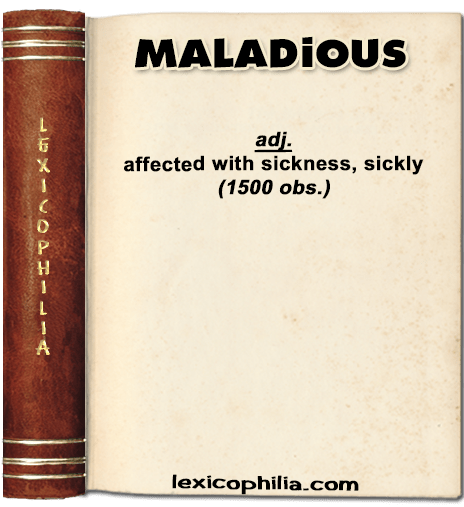
Word of the Day: MALADIOUS

ETYMOLOGY
from malady (ill health, sickness, disease) + -ous;
or from French maladieux

EXAMPLE
“… Fro that tyme forth my sone began
To werke myracle gloriouse
He kyst oute feendis of many a man
Dume defe blynd lame all maladiouse
He made hem hole that to hym wan
And taught hem to be vertuouse
Vnto the temple went he than
Droue oute marchaunts of godds house …”

From: De Arte Lacrimandi (Harley MS.), a1450
Edited by Robert Max Garrett, 1909

Word of the Day: MORBULENT

ETYMOLOGY
from Latin morbus (disease) + -ulent

EXAMPLE
“… they should apply such medicines as are suitable, and in such a Proportion as is most proper to assist Nature in the Discharging of the Malignant and Morbulent Matter; but never to clog and hinder its Motions by too many and useless doses. …”

From: The History of the Works of the Learned,
Or, An Impartial Account of Books Lately Printed in all parts of Europe.
Done by Several Hands, Volume VI
The Works of the Learned, for February 1704

Word of the Day: MANQUELL

ETYMOLOGY
back formation from manqueller (a murderer), from man + queller (a person or thing who subdues someone or something)

EXAMPLE
“… At which wordes kyng Edward sayd nothyng, but with his hād thrust hym from hym (or as some say, stroke him with his gauntlet) whom incontinent, they that stode about, whiche were George duke of Clarence Rychard duke of Gloucester, Thomas Marques Dorset, and Williā lord Hastynges, sodaynly murthered, & pitiously manquelled. The bit ternesse of which murder, some of the actors, after in their latter dayes tested and assayed by the very rod of Iustice and punishment of God. …”

From: The vnion of the two Noble and Illustre Famelies of Lancastre [and] Yorke
By Edward Hall, 1548

Word of the Day: MAKE-SPORT

ETYMOLOGY
from make (to produce by action, bring about) + sport (activity involving physical exertion and skill)

EXAMPLE (for adj.)
“… Graunt that this present Tyrian with Troian asemblye
May breede good fortune to our freends and kynred heer after.
Let
make sport Bacchus, with good ladye Iuno, be present.
And ye, my freend Tyrians, thee Troian coompanye frollick
Thus sayd, with sipping in vessel nycelye she dipped.
…”

From: Thee first foure bookes of Virgil his Aeneis
Translated by Richard Stanyhurst, 1582

Word of the Day: MOSTWHAT

ETYMOLOGY
from most (greatest in size, bulk, etc.) + what (pronoun); probably after somewhat (adv.)

EXAMPLE (for adv. 2.)
“…  The parentes and freindes with whom I haue to deale, be mostwhat no latinistes: and if they were, yet we vnderstand that tounge best, whervnto we are first borne, as our first impression is alwaie in English, before we do deliuer it in Latin. …”

From: Positions vvherin those primitiue circumstances be examined, which are necessarie for the training vp of children, either for skill in their booke, or health in their bodie,
By Richard Mulcaster, 1581

Word of the Day: MULLIGRUBS

also MA-LE-GRUBBLES, MOULDY-GRUBS, MULLEYGRUBS, 
MULLIEGRUMS, MULLIGRUMPHS (Sc.), MULLYGRUBS

ETYMOLOGY
alteration (probably influenced by grub) of earlier mulliegrums, perhaps alteration (perhaps influenced by obsolete English mully (dusty, mouldy), from English mull + -y) of megrims (low spirits) 

EXAMPLE (for n. 1.)
“… Hee was as good as his word, and had no sooner spoke the worde, but he did as he spoke. with a heauy heart to the pallace the yeoman of the mouth departed, and rehearsed this second il successe, wherwith Peters successour was so in his mulliegrums that he had thought to haue buffeted him, & cursed him with bell, book, & cndle ; but he ruled his reaso[n], & bad him, thgh it cost a million, to let him haue that third that rested behind, and hie him expeditely thither, lest some other snatched it vp, and as fast from thence againe, for hee swore by his triple crowne, no crumme of refection woulde he gnaw vpon, till he had sweetened his lippes with it. …”

From: Lenten Stuffe
By Thomas Nashe, 1599
“The Praise of the Red Herring”

Word of the Day: MALT-HORSE

ETYMOLOGY
from malt + horse

EXAMPLE
“…And bicause he passeth certain limites of a meane, that Reckelesness of his is curious, and not comly, and is a thing that commeth cleane contrarye to passe from the dryfte, (that is to wit) to cover arte. Therfore I judge it a no lesse vyce of curiositye to be in Reckelesness (which in it selfe is prayse worthye) in lettynge a mans clothes fal of his backe, then in Preciseness (whiche likewise of it self is praise worthy) to carie a mans head so like a malthorse for feare of ruffling his hear, or to keepe in the bottom of his cappe a looking glasse, and a comb in his sleeve, and to have alwayes at his heeles up and down the streetes a page with a spunge and a brushe: …”

From: The First Book of the Courtier
By Baldassare Castiglione
Translated by Thomas Hoby, 1561