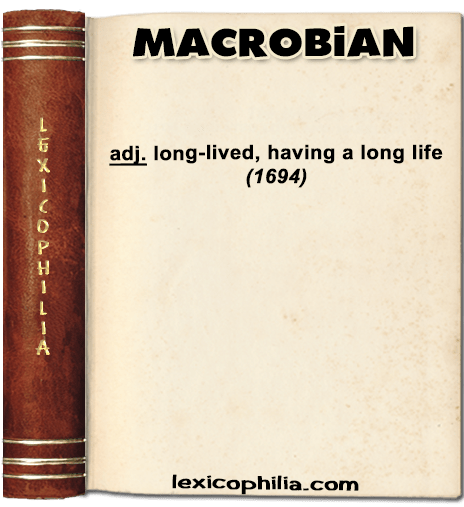
Word of the Day: MACROBIAN


ETYMOLOGY
formed on Greek.µακρόβιος (long-lived (from µακρός (long) + βίος (life)) + -an


PRONUNCIATION
muh-KROH-bee-uhn


EXAMPLE
“…Nor did we think it more reasonable to doubt of the Transmogrification of the Macrobian Children into Swans, or that of the Men of Pallene in Thrace into Birds, as soon as they have bath’d themselves in the Tritonie Lake. After this the Devil a word we could get out of him but of Birds and Cages…”

From: The Fifth Book of The Works of Francis Rabelais, M.D.
Translated by Peter Anthony Motteux, 1694
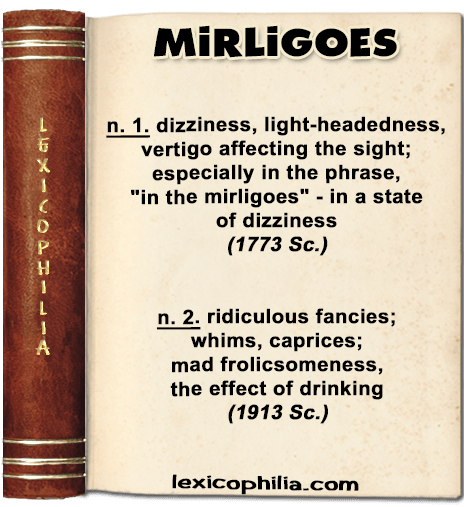
Word of the Day: MIRLIGOES


ETYMOLOGY
of uncertain origin;
perhaps from Scots mirl (to speckle, to spot),
with reference to the pattern seen before the eyes when in a state of dizziness + -igo 


PRONUNCIATION
MUR-luh-gohz


EXAMPLE
“…Sure Major Weir, or some sic warlock wight,
Has flung beguilin’ glamer o’er your sight;
Or else some kittle cantrup thrown, I ween,
Has bound in mirlygoes my ain twa ein,
If ever aught frae sense cou’d be believ’d
(And seenil hae my senses been deceiv’d),
This moment, o’er the tap of Adam’s tomb,
Fu’ easy can I see your chiefest dome:
Nae corbie fleein’ there, nor croupin’ craws,
Seem to forspeak the ruin of thy haws,
But a’ your tow’rs in wonted order stand,
Steeve as the rocks that hem our native land
….”

From: The Poems of Robert Fergusson
By Robert Fergusson, 1785
The Ghaists: A Kirk-yard Eclogue

Word of the Day: MERRYTHOUGHT


ETYMOLOGY
from merry (adj.) + thought (n.)
‘The name alludes to the custom of two persons pulling the furcula of a fowl until it breaks; according to the popular notion, the one who gets the longer (in some districts, the shorter) piece will either be married sooner than the other, or will gain the fulfilment of any wish he may form at the moment.


EXAMPLE
“…Fetherstone. O youle make her sicker then.
Greeneshield. I warrant you; would all women thought no more hurt then thou doost now, sweet villaine, Kate, Kate.
Kate. I longd for the merry thought of a phesant.
Greeneshield. She talkes in her sleepe….”

From: North-ward Hoe
By Thomas Dekker & John Webster, 1607

Word of the Day: MONTIVAGANT


ETYMOLOGY
from Latin monti-mons (mountain) + vagantem, pres. pple. of vagari (to roam) + -ant


EXAMPLE
“…Downward he speeds to mingle in the fray
As headlong rolls the torrent of the hills
When wintry storms montivagant outpour
Their pluvious treasures from the deep purloined
…”

From: Rogvald: An Epic Poem
By John Fitzgerald Pennie, 1823

Word of the Day: MAUMISH


ETYMOLOGY
possibly from maum (mellow, soft, esp. over-ripe) + ish 


EXAMPLE
“…but she fed more vpon fancie, than glutted hir selfe with any cates there presente: more vpon daintie deuices, than any parcell of repast: for this meate forsooth was mawmish, & this melancholie: this dish would driue hir to drincke, and this cause hir to drie…”

From: Narbonus The Laberynth of Libertie
By Austin Saker, 1580

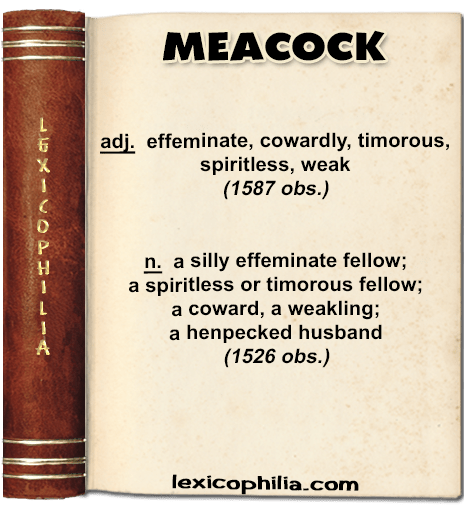
Word of the Day: MEACOCK


ETYMOLOGY
of obscure origin: perhaps originally a name of some bird  
(From Murray’s N.E.D.: “the suggestion that it is from meek (adj.) is untenable”)


EXAMPLE
“…He shuld be no cowarde, no maycocke, ne fearfull persone that dare no thyng enterprise….”

From: Here Begynneth a Deuout Treatyse in Englysshe, called the Pylgrimage of Perfection,
By William Bonde, 1526

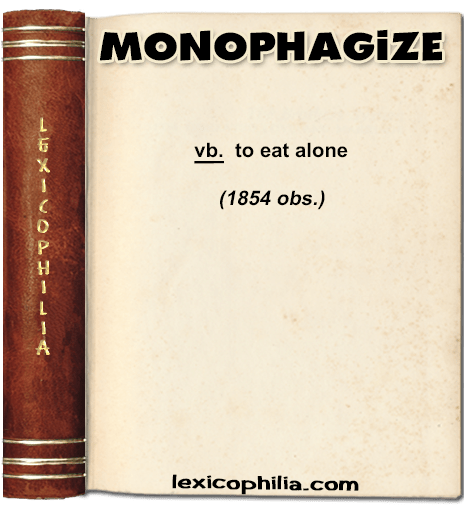
Word of the Day: MONOPHAGIZE


ETYMOLOGY
from Greek µονοϕάγος (monofagos) (that eats alone) + -ize


EXAMPLE
“…you who make us fight for every cabbage at the greengrocer’s, and prestige in its favour, that whereas the glutton might sometimes munch and monophagize in solitude, leading the life of a wolf or of a lion, those who drank generally drank together, and, as it was always said and supposed, to each other’s health and prosperity…”

From: Prose Halieutics
Or, Ancient and Modern Fish Tattle
By the Rev. C. David Badham, 1854
Chapter XXII. Opsophagy

Word of the Day: MORIGERATE


ETYMOLOGY
from Latin morigeratus, past participial stem of morigerari (to to be obedient or compliant), from morigerus


EXAMPLE
“…Certaynely in the auncient tyme, whan thou were peopled with ryght and trewe Romayns, and not as thou arte nowe with bastarde chylderne, than the armies, that wente froo Rome, were as well disciplyned and morigerate, as the schooles of the philosophies, that were in Grece…”

From: The Golden Boke of Marcus Aurelius,
By Antonio de Guevara, 1546