Word of the Day: NOTT-HEADED

ETYMOLOGY
from nott for notted (shorn, cut close, or smooth), from nott (to shear or poll), which is from the Saxon hnot, meaning the same

EXAMPLE
“… Your Sages in generall, by seeing too much ouersee that happinesse; Only your block-headly Tradesman; your honest meaning Cittizen; your not-headed Countrie Gentleman; your vnapprehending Stinckerd is blest with the sole prerogatiue of his Wiues chamber. …”

From: The WIddowes Teares, A Comedie
By George Chapman, 1612
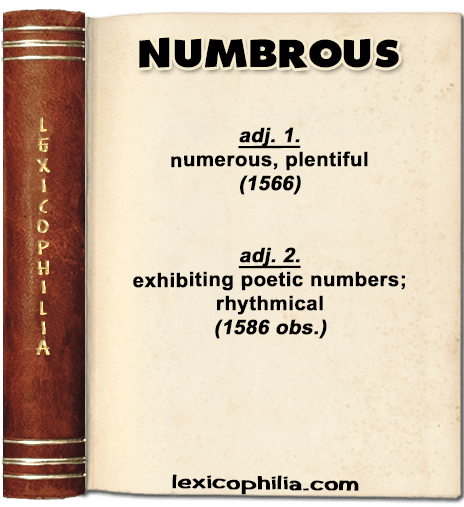
Word of the Day: NUMBROUS

ETYMOLOGY
from number (n.) + -ous

EXAMPLE
“… She sawe, she sawe the prophane route,
rushe in, without all measure:
Unto thy sacred holy house,
that route, whiche thou (O Lorde)
Forboddste, that they, ne shoulde come in,
the mansion of thy worde.
Her 
numbrous folke (a syghyng flocke)
and seekyng after foode,
Dyd geue for meate, what so they had,
thynges precious or good.
To cheryshe theyr so needie sowles.
…”

From: A Medicinable Morall, that is, the two bookes of Horace his satyres,
Translated by T. Drant, 1566

Word of the Day: NIDDICK

also NEDDICK, NIDDOCK, NODDOCKE, NUDDICK, NUDDOCK

ETYMOLOGY
of unknown origin

EXAMPLE
“… Like Almain rutters, borespeares longe they whirle, or foynyng forks,
Their nuddockes bolstred ben, and skulles of heads with barkes of corks
Thei shine with brasen sheeldes, thei shine with swords, & rapiers bright.
And thée to warres thy countrey Nursa sent, O noble knight,
O Vfens, much renowmed both of déedes, and great good chaunce,
Whose mountayne people strong, with practise longe of sworde & launce,
And huntyng still in woods, and breakyng clottes ben hard of flesh …”

From: The whole .xii. Bookes of the Æneidos of Virgill
Translated by Thomas Phaer, 1558

Word of the Day: NESTCOCK

also NESCOCK, NESCOOK (Eng. dial.)

ETYMOLOGY
from nest + cock

EXAMPLE
“… As for Rafe – despite his love for the theater and his determination to travel the Circuit, he was essentially a homebody, a confirmed nestcock eagerly anticipating marriage to Crisiant and a settled home with a dozen rambunctious children. …”

From: Touchstone
By Melanie Rawn, 2012

Word of the Day: NAME-COUTH

ETYMOLOGY
formed similarly to Middle Dutch namecontnaemcont, Danish navnkund (obs.); from the Germanic base of name (n.) + the Germanic base of couth (known (obs.)

EXAMPLE
“…In eche of this Epicicles was ficched one of the seven namecouth planetes, that be called sterres Erratikes, saaf only þat the sonne was withowt þe epicicle, fiched evene in the circumference of his difference. ….”

From: The Booke of the Pylgremage of the Sowle
Translated from the French of Guillaume de Guileville
From the Egerton Manuscript, a1500

Word of the Day: NIPFARTHING

ETYMOLOGY
from nip (to pinch, bite, squeeze tightly) + farthing

EXAMPLE
“…A goodlye dishe, who taughte the this?
why doste thou thus compare
Extremyties? Is there no shifte,
all spende, or els all spare?
I woulde the not a 
nipfarthinge,
nor yet a niggarde haue,
Wilte thou therefore, a drunkard be,
a dingthrifte, and a knaue?…”

From: A Medicinable Morall, that is, the two bookes of Horace his satyres
By Horace
Translated by Thomas Drant, 1566

Word of the Day: NEMOPHILOUS

ETYMOLOGY
from Greek νέμος [némos] (wooded pasture, glade) + ‑philous

EXAMPLE
“…The remainder may be classed with regard to requisite moisture as Hygrophilous, Xerophilous, or Noterophilous, the former division including most shade-loving or Nemophilous plants, the Dryads of Martius, and the Xerophiles most but not all Calcophiles or lime-loving plants…”

From: Journal of Botany, British and Foreign
Edited by James Britten, Vol. IX, 1880
‘Proceedings of Societies. Geologists’ Association’

Word of the Day: NIBSOME

ETYMOLOGY
from nib (a person of superior social standing or wealth; a gentleman [slang]) + – some


EXAMPLE
“…I ne’er was a nose, for the reg’lars came 
  Whenever a pannie was done:— 
Oh! who would chirp to dishonour his name,
And betrays his pals in a nibsome game 
  To the traps?—Not I for one! 
Let nobs in the fur trade hold their jaw
  And let the jug be free:— 
Let Davy’s dust and a well-faked claw 
For fancy coves be the only law, 
And a double-tongued squib to keep in awe 
  The chaps that flout at me!
…”

From: The House Breaker’s Song
By G. W. M. Reynolds in Pickwick Abroad, 1839