ETYMOLOGY
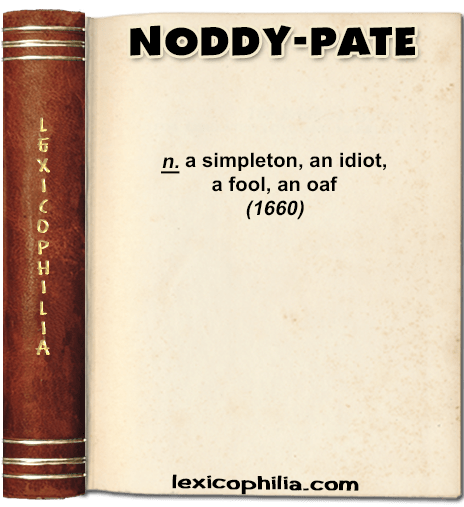
from noddy (a fool, a simpleton) + pate (the head)
EXAMPLE
“…Needy poor and noddy pate, never part …”
From: Lexicon Tetraglotton, an English-French-Italian-Spanish Dictionary
By James Howell, 1660
British or Old Cambrian Proverbs
ETYMOLOGY
from noddy (a fool, a simpleton) + pate (the head)
EXAMPLE
“…Needy poor and noddy pate, never part …”
From: Lexicon Tetraglotton, an English-French-Italian-Spanish Dictionary
By James Howell, 1660
British or Old Cambrian Proverbs
ETYMOLOGY
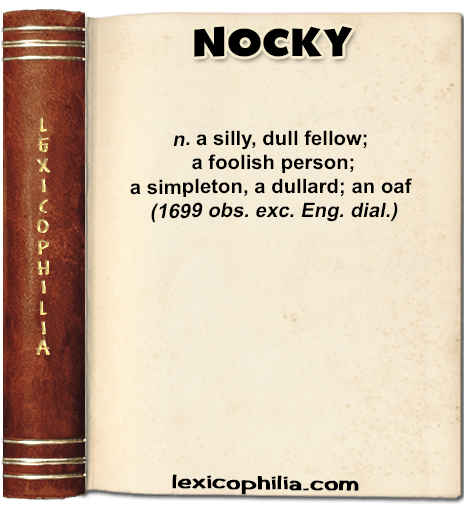
of unknown origin
EXAMPLE
“…Was there ever less head in a brainless world?” said Johns. “Here, simple Nocky, I’ll do it.” He leapt off, and with much puffing climbed the post, striking a match when he reached the top, and moving the light along the arm, the lad standing and gazing at the spectacle…”
From: The English Illustrated Magazine
1883-1884
Interlopers at the Knap. I.

ETYMOLOGY
from naughty + pack
EXAMPLE
“…Calle hir a naughtie packe: withe that one woorde thou haste taken all from hir, and haste lefte hir bare and foule…”
From: A very frutefull and pleasant boke called the instructio[n] of a Christen woma[n]
By Juan Luis Vives, a1530
(translated by Richard Hyrde)

ETYMOLOGY
from Neptune + -ist
EXAMPLE
“…Let euery man in his degree enioy his due; and let the braue enginer, fine Dædalist, skilfull Neptunist, maruelous Vulcanist, and euery Mercuriall occupationer, that is, euery Master of his craft and euery Doctour of his mystery, be respected according to the vttermost extent of his publique seruice or priuate industry.…”
From: Pierces Supererogation:
Or A New Prayse of The Old Asse
By Gabriell Harvey, 1593

ETYMOLOGY
– ? reduplication of ninny
EXAMPLE
“…Yes , do , my pretty little ninny nonny,
And when I’ve done , I’ll whip your brother Johnny…”
From: Visions of Taste. A Satire.
By David Douglas, 1823
Part I. Sect. II
Vision I, The School of Poetry
ETYMOLOGY
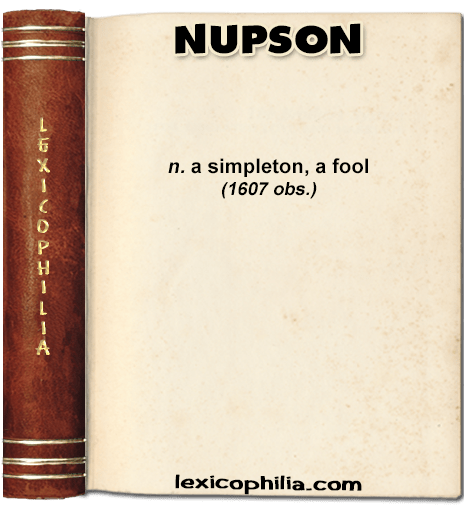
– from Nup (a fool – of unknown origin) + son
EXAMPLE
“…I say Phantastes is a foolish transparent gull; a meere fanatick nupson in my immagination not worthie to sit as a Iud∣ges assistant…”
From: Lingua: or The Combat of the Tongue, and the Fiue Senses for Superiority,
A pleasant comoedie
Thomas Tomkis, 1607

ETYMOLOGY
from Latin nichilat-, past participial stem of nichilare,
variant of nihilare to reduce to nothing, to destroy
FIRST DOCUMENTED USE
1560 – see EXAMPLE below
EXAMPLE
“…immediatlie after the proclamacion that Sir Robert Worsselye send that was nichlate, etc. …”
From: Liverpool Town Books
Proceedings of Assemblies, Common Councils, Portmoot Courts, &c., 1550 – 1862,
Edited by J. A. Twemlow, 1918
 Lexicophilia