Word of the Day: NIMBLE-CHOPS


ETYMOLOGY
from nimble + the plural of chop (the jaws and cavity of the mouth)


EXAMPLE
“…Why frend Nimblechaps me thinks you seeme rather ready to play with ye shadowe of euery thing then wi[l]ling to vnderstand the substantiall matter in a­ny thing: can you rightly gather vpon my speech that a woman is euill? if you do well vnderstande mee, you shal finde nothing lesse, but rather that shee is for the most parte one of the greatest good thinges in this world, and most necessa­ry of any thing els besydes…”

From: A Short Inuentory of Cer­tayne Idle Inuentions
The Fruites of a Close and Secret Garden of Great Ease, and Litle Pleasure
By C. Thimelthorpe, 1581

Word of the Day: NOVANTIQUE


ETYMOLOGY
from Latin novus (new) + antique


EXAMPLE
“…yet as they will not counterbalance the weight of those other arguments that militate on the contrary side, so they will without any difficulty be answered by the assertors of this Novantique philosophy…”

From: Treatise Concerning Eternal and Immutable Morality
By Ralph Cudworth, a1688

Word of the Day: NOSE-HOLE


ETYMOLOGY
from nose + hole


EXAMPLE
“…Whan a bodi is stinged of an Adder than shall the woūde be wasshed ther with and clowtes wet layd ther vpō I Cotton wet in the same water & put in the nose holes is good agaynst Polippus that is stynkinge flesshe in the nose…”

From: The vertuose boke of distyllacyon of the waters of all maner of herbes 
By Hieronymus Brunschwig
Translated by Laurence Andrewe, 1527

Word of the Day: NOVERCAL


ETYMOLOGY
from Latin novercalis (characteristic of a stepmother),
from noverca stepmother + -ālis (-al)


EXAMPLE
“…But Fortune that lends her smiles as Exctors do mony, to undoe the Debtor, soone cald for the Principall and Interest from this Prince, to whom she was meerly Novercall, and he might well call her with the expert Heros …”

From: The History of the Life and Reigne of Richard the Third
By Sir George Buck, 1646

Word of the Day: NEEZE


ETYMOLOGY
From Oxford English Dictionary: either from early Scandinavian (compare Old Icelandic hnjósa , Norwegian nyse , †njosa , Old Swedish niusa (Swedish nysa ), Danish nyse ), or the reflex of an unattested Old English word from the same Germanic base, as is perhaps suggested by the number of cognates in other West Germanic languages: Middle Dutch niesen (Dutch niezen ), Middle Low German nēsen , neysen , neesen , etc., Old High German niesan , niosan , niusan (German niesen)


EXAMPLE (for noun)
“…Soto was in an exteam Agony for his Master: Lamia was grieved and her Hand-Maids heavie, but the Inchantress soon recovered him by watering his Visnomy with her warm Urine (the customary way (it seems) of that Countrey to revive the enfeebled) which not onely illuminated his dim eyes, but circumgyring about his weasand, enforced him to a manly neese, so that within a little time (to their great comfort) he sate up, calling for some Wine, which being brought, he drank a hearty draught to the Inchantress, though one might perceive (with half an eye) wrath and disdain in Capitall Characters on his front; which Lamia perceiving, administred this Julip to allay his fiery Choller….”

From: Don Zara del Fogo; A Mock-Romance
By Samuel Holland, 1656

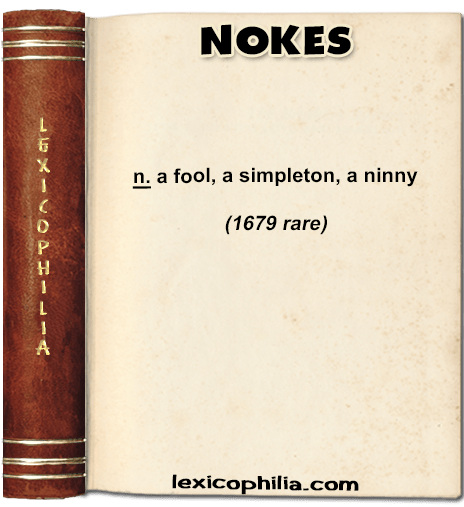
Word of the Day: NOKES


ETYMOLOGY
of uncertain origin


EXAMPLE
“…Foster could make an Irish Lord a Nokes,
And Betty Morris had her City Cokes.
A Woman’s nere so ruin’d, but she can
Be still reveng’d on her Undoer Man:
How lost so e’re, she’ll find some Lover more
A lewd abandon’d Fool, then she’s a Whore…”

From: Artemisa to Cloe.
A letter from a lady in the tovvn to a lady in the country; concerning the loves of the tovvn.
John Wilmot Rochester, 1679