Word of the Day: OPSIGAMY


ETYMOLOGY
from Greek ὀψιγαµία (opsigamia, marriage late in life),
from ὀψίγαµ-ος (late-married),
formed on ὀψέ, ὀψι– (late) + γάµος (marriage)


EXAMPLE
“…Nor is there any danger of Donald’s being flogged for opsigamy by the Highland nymphs, as the Spartans were of old. Marriage is here as much matter of course as eating and drinking; and as the sexes are more truly balanced than in Arabia, no pining damsel need sing, “Oh what will I do for a man…”

From: The Highlands and Western Isles of Scotland
By John Macculloch, 1824
Word of the Day: OFTLY


ETYMOLOGY
from oft (adv.) + -ly


EXAMPLE
“…And faste approcht: which newes when so I knew
I placed me where comming I behold
A seemely band, as eie di euer vewe,
And goodly dight as hart defier cold,
Oftlie returning vnto freends I told,
That I had seene of noblenes the flower
For discipline in ordring of a power
…”

From: The True Vse of Armorie
By William Wyrley, 1592

Word of the Day: OPSOPHAGIZE


ETYMOLOGY
from opsophagy (the eating of delicacies) + -ize;
from Greek ὀψοϕαγία (opsofagia), formed on ὀψοϕάγος (opsofagos – an eater of dainties);
formed on ὄψον (opsonic)  + -ϕάγος (phage, eating, eater)


EXAMPLE
“…Few men enjoyed the privilege of going ‘tick’ with the fishmonger, who, secure of a ready sale, did not encourage long bills; and even had they been complaisantly disposed, the opsonomoi, or comptrollers of the fish-market, would have interfered to prevent it. At Corinth, where the supervision was particularly strict, the law enacted that none should ‘opsophagize‘ but such as could prove their income sufficient to support the extravagance; a poor offender was first cautioned, then mulcted and, if still incorrigible, handed over to the ‘carnifex’…”

From: Prose Halieutics, Or, Ancient and Modern Fish Tattle
By David Badham, 1854

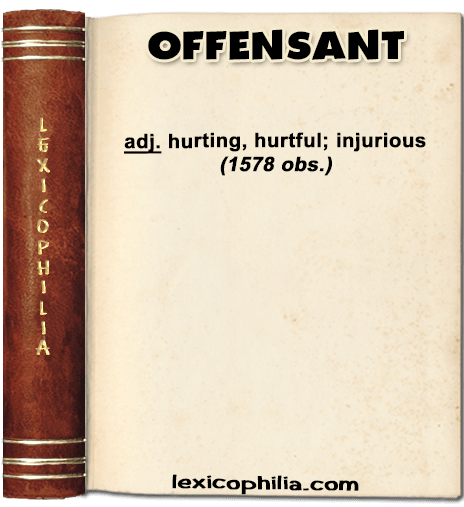
Word of the Day: OFFENSANT


ETYMOLOGY
from offence (to offend) + -ant


EXAMPLE
“…Now agayne because the ribbes, in their inner region or side, are succinged and clothed with a most sensible Membran called Pleura, and to the end that, the asperitie and roughnes of the ribbes, might not be at any time, to the sensibilitie of the same, offensaunt, it was therfore carefully prouided for, they beyng inwardly, wrought so smooth & easie for the same as may be deuised…”

From: The Historie of Man 
By John Banister, 1578

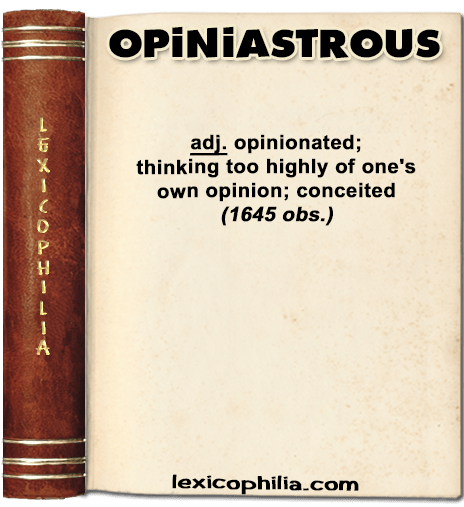
Word of the Day: OPINIASTROUS


ETYMOLOGY
either from French opiniastre (adj. – opinionated) + -ous,
or from opiniastre (n. – an opinionated person) + -ous 


EXAMPLE
“…Next, in matter of death, the Laws of England, wherof you have intruded to bee an opiniastrous Sub advocate, and are bound to defend them, conceave it not enjoyn’d in Scripture, when or for what cause they shall put to death, as in adultery, theft, and the like; your minor also is fals, for the Scripture plainly sets down for what measure of disagreement a man may divorce…”

From: Colasterion
A Reply to a nameless Answer against the Doctrine and Discipline of Divorce
By John Milton, 1645

Word of the Day: ONOMATOUS


ETYMOLOGY
from Greek ὀνόµατὄνοµα (name) + -ous


PRONUNCIATION
uh-NOM-uh-tuhss


EXAMPLE
“…For our own parts, we will not be forward to remove the disguise, and, indeed, in very many cases we should as a rule prefer the anonymous to the onomatous mode of addressing the public…”

From: The Spectator
A Weekly Review of Politics, Literature, Theology, and Art
Volume the Forty-Second, 1869

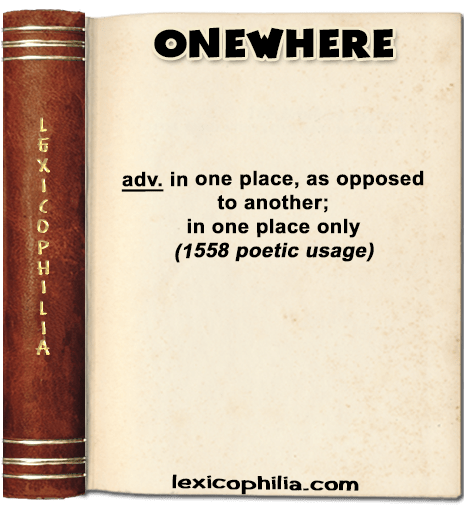
Word of the Day: ONEWHERE


ETYMOLOGY
from one + where, after somewherenowhere


EXAMPLE
“…if we translate the Hebrew or the Greek word once by purpose, never call it intent; if onewhere journeying, never traveling, if one where think, never suppose; if one where pain, never ache; if one where joy, never gladness…”

From: Bible (King James)
Translator Miles Smith, 1611

Word of the Day: OPEN-TAIL


ETYMOLOGY
from open + tail (posterior extremity)


EXAMPLE
“…Kate still exclaimes against great Medlers,
A busie-body hardly she abides,
Yet she’s well pleas’d with all Bum-fiddlers,
And hir owne Body stirring still besides:
I muse her  stomacke  now so much should faile,
To loath a Medlar, being an Open-taile…”

From: The Scourge of Folly,
By John Davies, 1611