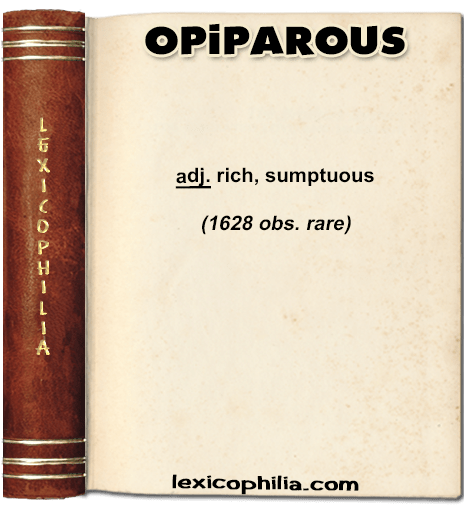
Word of the Day: OPIPAROUS


ETYMOLOGY
from Latin opiparus (richly furnished, sumptuous),
from opem (wealth, means) + parāre (to prepare, furnish, equip) + -ous


EXAMPLE
“…With sweet odours and perfumes, generous wines, opiparous fare, &c., besides the gallantest young men, the fairest virgins, puellae scitulae ministrantes, the rarest beauties the world could afford, and those set out with costly and curious attires…”

From: The Anatomy of Melancholy
By Democritus Junior (Robert Burton)
The Cure of Melancholy. Memb. IV. Exercise Rectified of Body and Mind

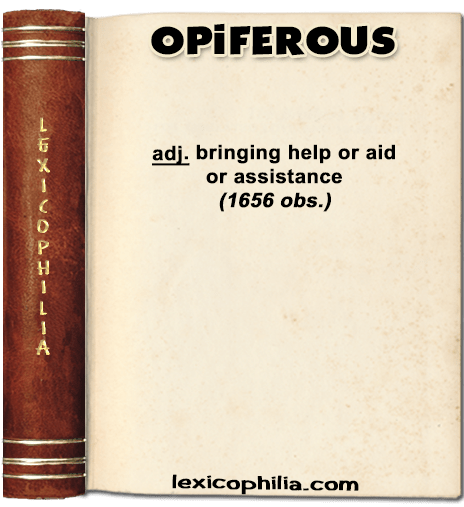
Word of the Day: OPIFEROUS

ETYMOLOGY
from Latin opifer (help-bringing),
from opem (help) + -fer


EXAMPLE
“…I heard that a hardy little band tried to read it through , but fell asleep after having read the opiferous leaves of the first chapter . I speak not of the puffs , profusely given to it by generous friends , interested or stipended parties…”

From: Critical Dialogue Between Aboo and Caboo On A New Book:
Or A Grandissime Ascension
Edited by E. Junius (A.E. Rouquette), 1880

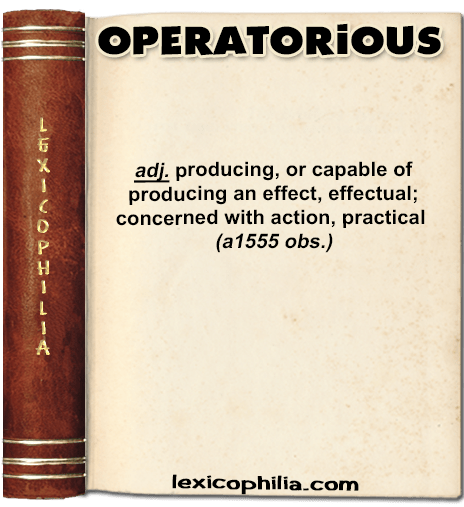
Word of the Day: OPERATORIOUS

ETYMOLOGY
from Latin operatorius (creating, forming) + -ous

EXAMPLE
“…For no Lesse are they effectuall to transubstantiate the cup, then their wordes spoken of the bread are operatorius & myghty to transubstātiate the bread. For as they say of the bread, Thys is my body, so say they of the Cup, This cup is the new testament…”

From: Two Notable Sermons
By John Bradford, 1574

Word of the Day: OVERSLOP

ETYMOLOGY
Old English oferslop (in Old Norse yfirsloppr), 
from over- + slop (a smock)

EXAMPLE
“…By cause of which men sholde hym reuerence
That of his worshipe rekketh he so lite
His ouerslope nys nat worth a myte
As in effect to hym / so moot I go
It is al baudy and to-tore also
…”

From: Canon’s Yeoman’s Tale
By: Geoffrey Chaucer, c1395

Word of the Day: OPINANT

ETYMOLOGY
from opine + -ant,
possibly from French opinant (someone who gives an opinion in a deliberation)

EXAMPLE
“…The opinions differ pretty much according to the nature of the opinants. I say the Duke and Tom could have held out, that they meant to hold out, that they did hold out, and that there has been fistifying enough…”

From: Roundabout Papers.
On Some Late Great Victories
By William Makepeace Thackeray, 1860