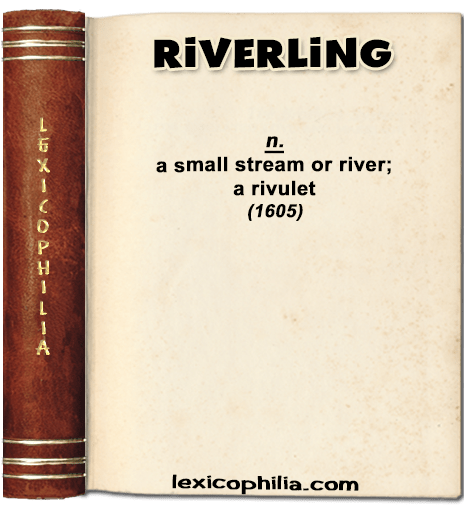
Word of the Day: RIVERLING

ETYMOLOGY
from river + -ling

EXAMPLE
“… Of him she also holds her silver Springs.
And all her hidden Crystall
Riverlings:
And after (greatly) in two sorts repayes
Th humour she borrows by two sundry wayes.
…”

From: Bartas His Deuine Weekes and Workes
By Guillaume de Saluste Du Bartas
Translated by Joshua Sylvester, 1605
The third Day of the first Week.

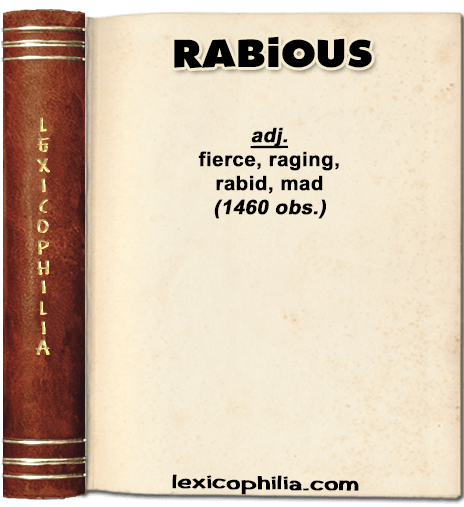
Word of the Day: RABIOUS

ETYMOLOGY
from Latin rabiosus (rabid, mad, frenzied, furious), from rabies (rabies) + –osus (-ous)

EXAMPLE
“… Ethelred, languishing in minde and body, Edmond his sonne, surnamed Ironside (to oppose youth to youth) was imployed against this rabious inuador. A Prince worthy of a better time, and had he found faith, had made it so, and deliuered his country at that turne, from the worst of miseries, the conquest by strangers. …”

From: The First Part of the Historie of England
By Samuel Daniel, 1612

Word of the Day: RIGENT

ETYMOLOGY
from Latin rigent-rigens (stiff, rigid), present participle of rigere (to be stiff)

EXAMPLE
“… An hous [y]maad of aller is but shent; 
Yet ther the ground is myre, weet, vnsure,
Pile in aller as for the fundament.
Ek elm & asshe ydried beth rigent,
And while they beth vndried, so curuable,
ffor shippis that they beth right profitable. …”

From: Middle-English translation of Palladius De Re Rustica. ?1440
Edited by Mark Liddell, 1896

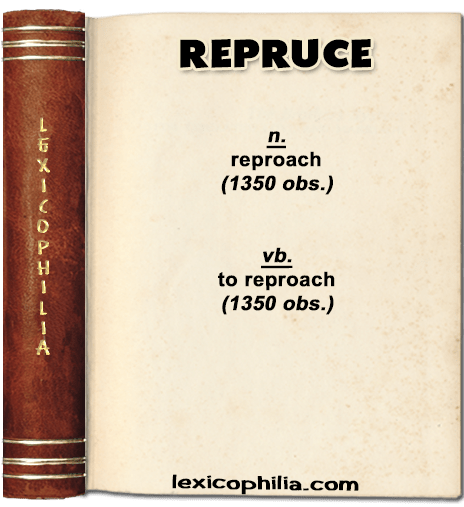
Word of the Day: REPRUCE

ETYMOLOGY
from Anglo-French repruce, variant of reproche (reproach)

EXAMPLE
“… Þou settest us repruse [MS depruse.] to our neȝburs, vndernimyng [Here an e follows, but is dotted out.] and scorne to hem þat ben in our cumpas. …”

From: The Earliest Complete English Prose Psalter, c1350
Preface, introduction, notes, and glossary, by Karl D. Bülbring, 1891

Word of the Day: REPENTINE

ETYMOLOGY
from obsolete French repentin-ine, or from Latin repentinus
from repent-, repens (sudden) + ‑inus (ine)

EXAMPLE
“… Whan thou shalte ought do, of vnexpert or newe
Fyrste ponder in thy mynde, reuoluynge busely
What maner, and how great thynge, may therof ensue
Attempt nothynge weyghty, in haste nor sodaynly
If thynges may byde, tary, begyn thou nat rasshely
For enterpryses rasshe, hasty and
repentyne
Ar chefe thynges bryngynge, great warkes to ruyne
…”

From: Here begynneth a ryght frutefull treatyse, intituled The Myrrour of Good Maners,
By Dominicus Mancinus
Translated by Alexander Barclay, ?1518

PRONUNCIATION
ruh-PEN-tighn

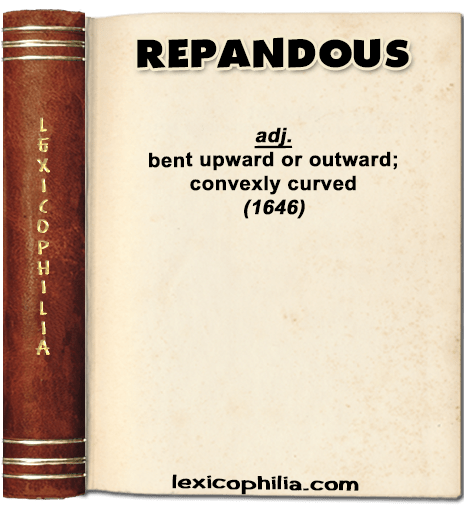
Word of the Day: REPANDOUS

ETYMOLOGY
from Latin repandus (bent backwards, turned up), from re- + pandus (bent)

EXAMPLE
“… And as indeed is deducible from pictures themselves; for though they be drawn repandous, or convexedly crooked in one piece, yet the Dolphin that carrieth Arion is concavously inverted, and hath its spine depressed in another. …”

From: Pseudodoxia Epidemica: 
Or Enquiries Into Very Many Received Tenents and Commonly Presumed Truths
By Thomas Browne, 1646

Word of the Day: REELING-RIPE

ETYMOLOGY
from reeling (moving with a swaying or staggering motion) + ripe (adj.)

EXAMPLE
“…  SEBASTIAN He is drunk now. Where had he wine?
ALONSO And Trinculo is reeling ripe. Where should they
 Find this grand liquor that hath gilded ’em?
 ⌜To Trinculo.⌝ How cam’st thou in this pickle?
TRINCULO  I have been in such a pickle since I saw you
 last that I fear me will never out of my bones. I
 shall not fear flyblowing
. …”

From: The Tempest
By William Shakespeare, a1616

Word of the Day: RAMFEEZLED

ETYMOLOGY
apparently from Scots ram- (used with intensive force before words which generally imply something forcible, vigorous or disorderly) + the second element is obscure;
but perhaps feeze (to beat, to ‘do for’ – Eng dial.) + ‑le ‑ed 

EXAMPLE
“…The tappetless, ramfeezl’d hizzie,
She’s saft at best, an’ something lazy:
Quo’ she, ‘Ye ken we’ve been sae busy
‘This month an’ mair,
That trouth, my head is grown right dizzie,
An’ something sair.’ …”

From: Poems,
By Robert Burns, 1786
Epistle to J. L*****K,
An Old Scottish Bard.
April 21, 1785