ETYMOLOGY
of unknown origin
EXAMPLE
“…A shackazin’ owd tallock…”
From: The Folk-Speech of South Cheshire,
By Thomas Darlington, 1889
ETYMOLOGY
of unknown origin
EXAMPLE
“…A shackazin’ owd tallock…”
From: The Folk-Speech of South Cheshire,
By Thomas Darlington, 1889
ETYMOLOGY
for n.1., apparently a reduplication with vowel variation of trim (adj.);
for n. 2., apparently a whimsical application of n.1.
EXAMPLE
“…Esebon, Marybon, Wheston next Barnet;
A trym tram for an horse myll it were a nyse thyng;
Deyntes for dammoysels, chaffer far fet:
Bo ho doth bark wel, but Hough ho he rulyth the ring…”
From: Speke Parott
By John Skelton, 1523

ETYMOLOGY
from Latin tolūtiloquentia (a talking on a trot, volubility)
EXAMPLE
“…After prolonged study of this pestiferous tolutiloquence I understand and sympathize with the editor’s policy ; nothing useful can or need be done…”
From: The Classical Review
Volume 4, 1954
ETYMOLOGY
from tickle + tongue
EXAMPLE
“…yet notwithstanding he was so crost in the nycke of thys determination, that his hystorie in mitching wyse wandred through sundry hands, and being therwithall in certaine places somewhat tyckle tongued (for M. Campion dyd learne it to speake) and in other places ouer spare, it twitled more tales out of schoole…”
From: Introduction to The firste (laste) volume of the Chronicles of England, Scotlande, and Irelande (Raphael Holinshed, 1577)
– Richard Stanyhurst
ETYMOLOGY
from Greek θερσίτης Thersites (‘the Audacious’), an ill-tongued Greek at the siege of Troy + -ical
EXAMPLE
“…The Genuensians saith he, having received from the Mauritanians their Progenitors this Custome, to compresse the Temples of their Infants as soon as they are Borne, now, without that Compression, are Borne with a Thersiticall Head and Heart…”
From: Anthropometamorphosis: = Man Transform’d: or, The Artificiall Changling
– John Bulwer, 1650
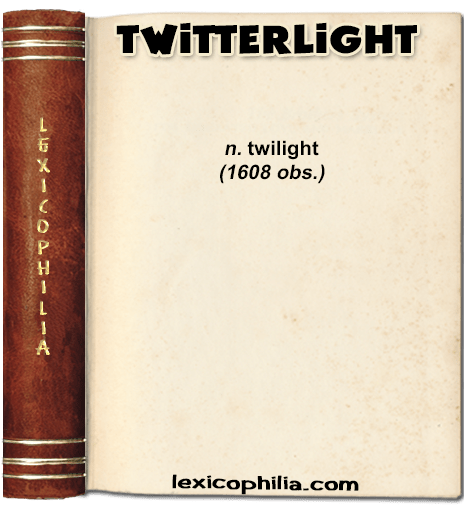
ETYMOLOGY
? alteration of twilight after twitter (vb. to move tremulously, shake, quiver) + light
EXAMPLE
“…You can steale secretly hether, you misticall queane you, at twylight, twitterlights,
You haue a priuiledge from your hat forsooth,
To walke without a man, and suspition,”
But we poore gentlewomen that goe in Tires
Haue no such liberty, we cannot do thus…”
From: Your fiue gallants
As it hath beene often in action at the Black-friers
By Thomas Middleton, 1608

ETYMOLOGY
from Latin tinctus (a dyeing) + mūtāntem (changing)
EXAMPLE
“…The chameleon is the best known of all the tinctumutants (tinctus, color, and mutare, to change), though many other animals possess this faculty in a very marked degree…”
From: The Popular Science Monthly
January, 1895
Animal Tinctumutants
By Dr. James Weir, Jr.
 Lexicophilia