Word of the Day: VICTITATION

ETYMOLOGY
from Latin victitare (to subsist (on something)); from victus (food, sustenance)

EXAMPLE
“… And soe most commonlye the occasione of death commeth throughe the inordinate state of life, in eatinge, and drinckinge vvithout observinge anye rule of
victitation, hauntinge also of vvoemen, and not suffering themselves to be handled, of the handes of the Chyrurgian, as the cause requireth, it be ether in tenting of the vvounde, by inscisione, by cauterisatian, & by keepinge himselfe quiet vvhich all aunciente Chyrurgians so highly and exactlye commande, …”

From: The Frenche Chirurgerye, or All the Manualle Operations of Chirurgerye, with Divers, & Sundrye Figures, and Amongst the Rest, Certayne Nuefownde Instrumentes, Verye Necessarye to All the Operationes of Chirurgerye
By Jacques Guillemeau
Translated by A.M., 1598

Word of the Day: VANQUISSANT

ETYMOLOGY
from obsolete French vainquissant, present participle of vainquir, a rare variant of vaincre (to conquer, overcome)

EXAMPLE
“… Full glad was Eromena to heare of such things, acknowledging her thankes to heaven for doing them in the favour of her girle. Congratulations she received not as a woman in child-bed, but as a Captaine vanquissant of a battel. Many times and often kissed shee her sweet babe, who without either crying or weeping, beheld stedfastly the faire light of the world; by no meanes possible would the sweet little one endure the swathing bands, but would with a lovely fiercenesse push them off her. …”

From: Eromena, or, Love and Revenge
Written originally in the Thoscan tongue, by Cavalier Giovanni Francesco Biondi
Translated by James Hayward, 1632

Word of the Day: VIRIPOTENT

ETYMOLOGY
adj. 1: from Latin viripotent-viripotens, from vir (man, husband) + potens (able)
adj. 2: from Latin viripotent-viripotens, from vires (strength)

EXAMPLE
“… The king thus hauing vanquished and ouercome the Welshmen, placed garisons in sundrie townes & castels, where he thought most necessarie, and then returned to London with great triumph. Thither shortlie after came ambassadours from the emperour, requiring the kings daughter affianced (as before you haue heard) vnto him, and (being now viripotent or mariable) desired that she might be deliuered vnto them. …”

From: The first and second volumes of Chronicles. [vol. 3 (i.e. The Third Volume of Chronicles)] comprising 1 The description and historie of England, 2 The description and historie of Ireland, 3 The description and historie of Scotland:
First collected and published by Raphaell Holinshed, William Harrison, and others: now newlie augmented and continued (with manifold matters of singular note and worthie memorie) to the yeare 1586. by Iohn Hooker aliàs Vowell Gent and others.
Henrie the first, yoongest sonne to William the Conquerour. (Book Henry I)

Word of the Day: VERSIPELLOUS

ETYMOLOGY
from Latin versipellis, from vers-vertere (to turn) + pellis (skin)

EXAMPLE
“… The power, indeed, is in the witch, and not conferred by him; but this versipellous or Protean impostor – these are his words – will not suffer her to know that it is of her own natural endowment, though for the present charmed into somnolent inactivity by the narcotic of primitive sin. …”

From: The House By The Churchyard
By Joseph Sheridan Le Fanu, 1863
Chapter V. How the Royal Irish Artillery Entertained some of the Neighbours at Dinner

Word of the Day: VETERASCENT

ETYMOLOGY
from Latin veterascent-veterascens (present participle of veterascere to grow old),
from veter-vetus (old) + ‑ascere

EXAMPLE
“… This Vestis animae (as Tertullian calls it,) our body, the clothing of our soules, is daily veterascent and mouldring away; notwithstanding all the art wee use to patch up our obsolete faces and withered carkasses. O let our minds, that inward man, as the Eagle, be renewed daily …”

From: Three Sermons preached upon severall publike occasions by John Gauden, 1642

PRONUNCIATION
vet-uh-RASS-uhnt

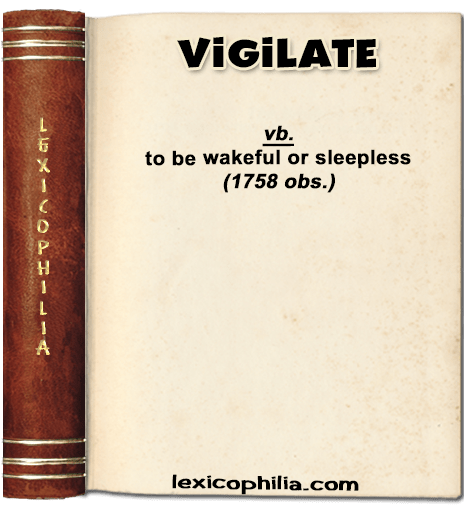
Word of the Day: VIGILATE

ETYMOLOGY
from Latin vigilat-, ppl. stem of vigilare (to remain awake)

EXAMPLE
“… Mountain Hawkweed with long slender stalks and small flowers. The flowers are in their expanded or vigilating state from five or six in the morning till about ten. …”

From: Philosophical Transactions
Volume L. Part II. For the Year 1758
Printed 1759
“Some Observations upon the Sleep of Plants”

Word of the Day: VILIORATE

ETYMOLOGY
from Latin vilior, comparative of vilis (vile) + -ate; after meliorate

EXAMPLE
“…Secondly, that there is a medium in the watery temperature of the earth, either extream of
which
viliorates the juice, where there is not an equal heat of the sun or fatness in the earth to correct the juices of the superluxuriant grass. …”

From: Observations in Husbandry
By Edward Lisle, a1722

Word of the Day: VINOMADEFIED

ETYMOLOGY
from Latin vinum (wine) + madefieri (to be soaked) + -ed

EXAMPLE
“…The Prince unwilling to miss of his mark, and not having in all the quivers of his reason one shaft wherewith to hit it, resolved to interpose some authority with his argumentations, and where the foxes skin could not serve, to make use of the Lyons: to the prosecuting of which intent, he with his vinomadefied retinue, resolved to press in upon the Page, and, maugre his will, to get up staires, and take their fortune in the quest of the Chamber they aimed at: for albeit the stradling as wide as he could, of pretty Pomponacio at the door whereat they made account to force their passage, did for a while retard their designe, …”

From: Εκσκυβαλαυρον, Ekskybalauron: or, The Discovery of a Most Exquisite Jewel, more precious then diamonds inchased in gold, the like whereof was never seen in any age
By Thomas Urquhart, 1652

Word of the Day: VITUPERIOUS

ETYMOLOGY
from Old French vituperieus (implied in the adv. vituperieusement), 
or from late or medieval Latin vituperiōsus from vituperium (vitupery)


EXAMPLE
“…Muse I inuoke the vtmost of thy might,
That with an armed and auspitious wing,
Thou be obsequious in his doubtlesse right
Gainst the vile Athiests vituperious sting:
Where thou that gate industriously mai’st flie,
Which Nature striues but fainedlie to goe,
Borne by a power so eminent and hie,
As in his course leaues reason farre belowe,
To shew how Poesie (simplie hath her praise)
That from full Joue takes her celestiall birth,
And quicke as fire, her glorious selfe can raise
Aboue this base and euitable earth
…”

From: Moyses in a Map of his Miracles
By Michael Drayton, 1604