Word of the Day: NEBUCHADNEZZAR

ETYMOLOGY
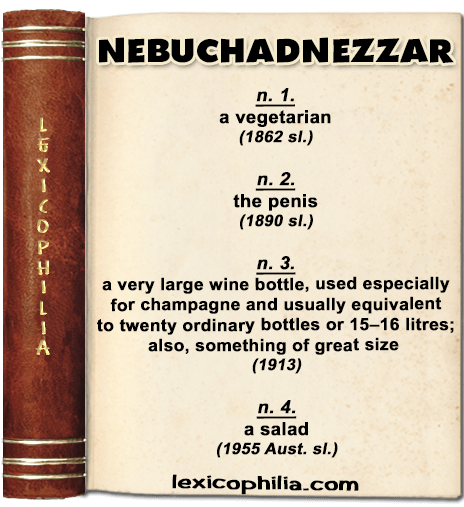
from the name of Nebuchadnezzar (died c562 BC) ruler of the Babylonian empire (604–562 BC), after French nabuchodonosor (large wine bottle used for champagne)

EXAMPLE (for n. 3.)
“… That didn’t prevent me strewing my whole room with little bits of paper, when I undressed that night. Fireworks ensue, then (children dismissed) supper and afterwards, the most magnificent Nebuchadnezzars, and finally a good form of blind-man’s buff, where everyone stands round the room in a circle and the blind man walks up and prods someone, telling him at the same time to make a noise … sch as the sound of rain falling on mud – and the speaker has to be recognised by the sound of his voice. …”

From: Letters of Aldous Huxley
By Aldous Huxley, 1969
Letter to Leonard Huxley, 11 November, 1913

PRONUNCIATION
neb-yuh-kuhd-NEZ-uh
Word of the Day: DAFFYDOWNDILLY


ETYMOLOGY
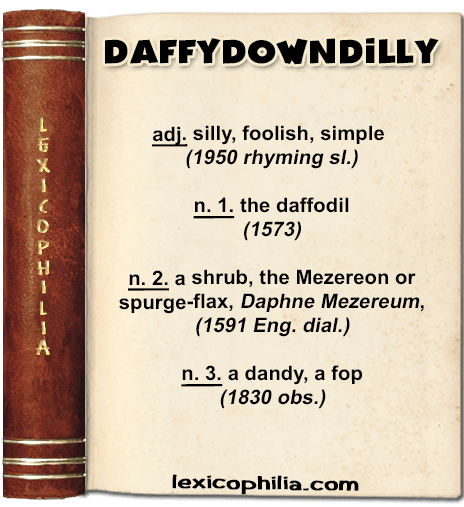
n. 1. a playful expansion of daffodilly. (from daffodil + -y);
n. 2: so called in Yorkshire from the slight similarity of the Greek name Daphne with Daffodil


EXAMPLE

“…Herbes, branchis & flowers for windowes & potts
• 1 Bayes, sowe or set in plants in Ianuarie.
2 Batchelers buttens,
3 Botles, blewe, red & tauney,
4 Collembines.
5 Campions.
6 Daffadondillies.
7 Eglantine, or swete bryer.
8 Fetherfewe.
9 Flower armour, sowe in Maye.
10 Flower deluce,
11 Flower gentil, whight & red.
12 Flower nyce.
13 Gelyflowers, red, whight & carnacions, set in Spring, & Heruest in potts, payles or tubs, or for sommer in bedds.
14 Holiokes, red, whight & carnacions.
15 Indian eye, sowe in Maye, or set in slips in March.
16 Lauender, of al sorts
…”

From: Fiue Hundreth Points of Good Husbandry
By Thomas Tusser, 1573

Word of the Day: WHIZZER


ETYMOLOGY
from whizz (to move swiftly or with such a sound) + -er


EXAMPLE
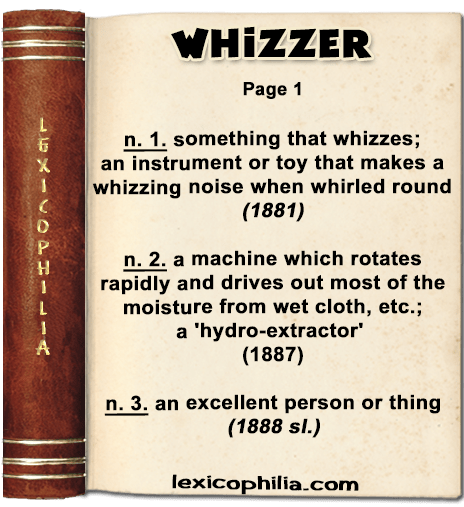
“…The washerwoman finds her occupation almost gone through the introduction of machinery. The larger part of the city of Troy is devoted to the manufacture of engines, whizzers, starchers, and other machines of the steam laundry. The most interesting machine is the whizzer, which dries clothes in 1,000 revolutions a minute…”

From: The Pall Mall Budget, July 1887
Volume 35