Word of the Day

Word of the Day: RASCABILIAN


ETYMOLOGY
derived from rascabilia (rascals collectively)


EXAMPLE
“…Then next, I bequeath to the whole societie of these my carousing companions, as followeth: Namely, drinke, more drinke, a little more drinke, yet more drinke, then a little modicum of Bakers bread: then drinke againe, then more drinke, then yet a little more drinke, and so forth. Item, I appoint Arthur ale-man, the sole and onely Executor of this my last Testament, making Huf-cap the Hunts-man, and Small-braines the Shoomaker, my ioynt superuisers; allowing to euery of them, a full pipe of Tobacco for his paines taken that way. Witnesse hereunto, the whole Rascabilian rabblement of this our damnable Crew…”

From: Tobacco Tortured,
or, The filthie fume of tobacco refined shewing all sorts of subiects, that the inward taking of tobacco fumes, is very pernicious vnto their bodies.
By John Deacon, 1616

Word of the Day: INQUIROUS


ETYMOLOGY
from inquire -ous


EXAMPLE
“…In our sixe dayes toile, traversing this Countrey, wee had many troubles and snarlings from these Savages; who somtimes over-laboured us with Bastinados, and were still inquirous, what I was, and whither I went; yea and enough for the Dragoman to save my life and liberty…”

From: The totall discourse, of the rare adventures, and painefull peregrinations of long nineteene yeares trauayles from Scotland, to the most famous kingdomes in Europe, Asia, and Affrica,
By William Lithgow, 1632

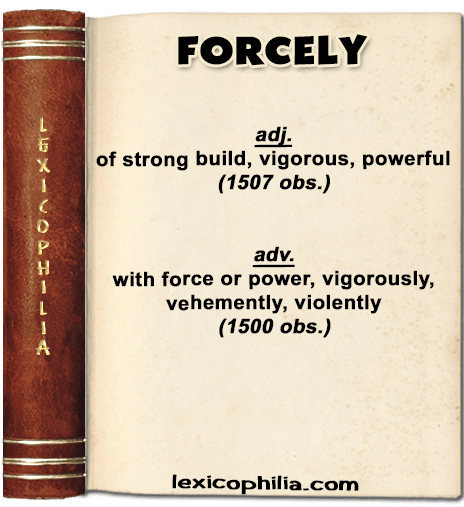
Word of the Day: FORCELY


ETYMOLOGY
from force (n.) + -ly


EXAMPLE (for adv.)
“…Luke we the fische that swimmis in the se,
Luke we in eirth all kynd of bestyall,
The foulis fair sa forcelie thay fle,
Scheddand the air with pennis grit and small;
Syne luke to man that he maid last of all
Lyke to his image and his similitude;
Be thir we knaw that God is fair and gude.
…”

From: The morall fabillis of Esope the Phrygian
Translation by Robert Henryson
The Preiching of the Swallow. a1500

Word of the Day: REMORAL


ETYMOLOGY
from Latin remora (delay) + -al


EXAMPLE
“…Besides great Counsellors have their private, and their publique ends; and their private affections do oftentimes yield to their publique judgements, and make them remoral in their friends suits. And therefore noble natures will be rather thankful for good turns received, than ungrateful, that they enjoy not all their own hearts desire…”

From: Collectanea Curiosa; 
Or Miscellaneous Tracts, 
Relating to the History and Antiquities of England and Ireland,
John Gutch, 1781
An Apology for the late Lord Treasurer Sir Robert Cecill, Earl of Salisbury,
Written by Sir Walter Cope, a1625

Word of the Day: LASCIVIATE


ETYMOLOGY
irregular, from Latin lascivire, after verbs ending in -iate


EXAMPLE 1
“…A kemb’d Oration will cost both sweate, and the rubbing of the braine. And kemb’d I wish it, not frizzled, nor curl’d. Divinity should not lasciuiate, Vn-wormewooded jests I like well; but they are fitter for the Tauerne, then the Majesty of a Temple. Christ taught the People with Authoritie. Gravitie becomes the Pulpit. Demosthenes confest he became an Orator, by spending more Oyle then Wine…”

From: Resolves, a Duple Century
By Owen Felltham, 1628


EXAMPLE 2
“…But by his smile the Prophet means that the people would be reduced to such straits, that they might not lasciviate, as they had done, in their superstitions; for while the Israelites enjoyed prosperity, they thought everything lawful for them; hence their security, and hence their contempt of the word of the Lord…”

From: Commentaries on the Twelve Minor Prophets.
By John Calvin.
Translation from the Original Latin by the Rev. John Owen, 1846

Word of the Day: BABBLATIVE


ETYMOLOGY
from babble (to talk excessively, to chatter excitedly or quickly) + -ative.


EXAMPLE 1
“…Manye of them which lacke good bringing vp and haue not beene trayned in learning and ciuilitie, are of disposition, wauering, vnconstant, captious, deceitfull, falseharted, destrous of alterations and tumultes, babblatiue, and full of muche vaine tattling: in consultacion and counsell so suttle and craftie, that whatsoeuer they once conceyue in mynde or purpose to do, without delay that do they iudge best, forthwith to be enterprysed, & out of hande to be atchieued: and whereunto so euer they addict their mindes, therin proue they right excellente…”

From: The Touchstone of Complexions
By Leuine Lemnie
Translation by Thomas Newton, 1576


EXAMPLE 2
“…He could mesmerize a room full of scientists, an auditorium flush with factory workers, or a parlor pack of literati, including his salon companions Oliver Wendell Holmes, Ralph Waldo Emerson, and Henry Wadsworth Longfellow, the sharpest talkers in a smart and garrulous town. He was one of those brilliant, babblative sorts whose immense skill in their main work is nearly eclipsed by their gift for talk…”

From: Reef Madness: Charles Darwin, Alexander Agassiz, and the Meaning of Coral
By David Dobbs, 2005


PRONUNCIATION
BAB-luh-tiv

Word of the Day: MISEASY


ETYMOLOGY
from Anglo-Norman meseisémiseisémysesé (sick, unhappy, suffering, painful),
from mesaiser (misease, to trouble, to distress)


EXAMPLE 1
“…A lodlich musel he þouȝte al-so : and þe fouleste þat miȝte beo—
A Miseisiore man þane he þouȝte : no man ne miȝte iseo
…”

From:
The early South-English legendary ; or, Lives of Saints
Edited by Carl Horstmann, 1887
Vita sancti Iuliani boni hospitis (The life of St. Julian the Hospitable). c1300


EXAMPLE 2
It had been a long, hard day, and I went to bed that night feeling miseasy and heart-sick.

Word of the Day: BOINARD


ETYMOLOGY
from Old French buisnartbuinard (silly fellow)


EXAMPLE
“…”Wat! nou const þou no god?
Me þinkeþ þat þou art wod:
Ȝeuest þo þe welpe mustard?” 
“Be stille, boinard!
…”

From: Dame Siriz (Dame Sirith),
A late thirteenth-century Middle English poem.

nou const þou no god? = can you do no good?
þinkeþ = thinketh
wod = mad, crazy
Ȝeuest þo þe welpe = give you the whelp
Be stille, boinard = hold your tongue fool

Word of the Day: FIDDLE-FACED


ETYMOLOGY
from fiddle (n.) + faced (adj.)


EXAMPLE
“…And would any but such like, sick-brained, corky-noddled, flea-lugg’d piper framed, fiddle faced, wagtailed fellows, saucy, and idle, lazy, lubbert, leeped, nasty, foul clacking, and a meer outside, a pinned up bacon, a stitched together stand-bra, can scarce put on her own cloaths, and can do nothing else but stand like a statue, with her gogling eyes, and black patches, and when they are off is ashamed to be seen in public, for fear they prove a scare crow…”

From: John Thompson’s Man
Or. A short survey of the difficulties and disturbances That may attend a married Life, c1785

Word of the Day: JIMMYCANE


ETYMOLOGY
probably a jocular variation of hurricane


EXAMPLE
“…”Well, I’ll be everlastin’ly bamboozled! I never seen Doc Barwood melt and’ leak away like that before. I was countin’ on a storm – a reg’lar cyclone an’ jimmycane rolled into one; an’ ther’ wasn’t even a puff o’ wind n’r a clap of thunder...”

From: Ralph Marlowe
A Novel
By James Ball Naylor, 1901