Word of the Day: AMARICATE


ETYMOLOGY
from late Latin amaricat- ppl. stem of amaricare (to make bitter, to irrritate, to anger),
from amarus (bitter) + -icare


EXAMPLE
“…But what vertue so cold I pray you is there in Opium, which shall make me sleep though unwilling, and hot enough? If the coldnesse of the vapours, why do wines after dinner provoke to sleep? whether therefore is there one identity of heat and cold to the procuring of sleep? why therefore is cold singularly attributed to Opium? why are not hot things equally reckon’d narcotick and dormitive? how doth opium amaricate? and amaritude in the schools predominating is accounted hot? Therefore it is of unavoidable necessity, that the schools should chuse one of these; to wit, either that the coldnesse of opium is not exceeding, and by consequence that Opium doth not produce sleep by his cold…”

From: Matæotechnia Medicinæ Praxeōs, The vanity of the craft of physick
By Noah Biggs, 1651

Word of the Day: AURIPOTENT


ETYMOLOGY
from Latin auri- (gold) + potentem (powerful)


EXAMPLE 1
“…For to descriue thair honest Ornament,
Thair riche array, and thair habillement:
My feble wit standis in extasie,
So bene, so big, and so Auripotent,
So ground michtie it was, and precellent:
It dullis far my small capacitie.
Thairfoir I most at this time let it be.
Bot ʒe sall wit thair was na thing absent
Of gold, nor silk, that ganit sic cumpanie
….”

From: Ane treatise callit The Court of Venus deuidit into four buikis,
By John Rolland, 1575


EXAMPLE 2
“…and the vexatious vigilance with which the stern lady-patronesses of the time were wont to sift the merits of candidates, were intended as a protest against the auripotent nabobs and mill-owners who came purse in hand to demand admission…”

From: Belgravia
A London Magazine
Conducted by M.E. Braddon. Vol. IV, May-June, 1871
‘The Season’

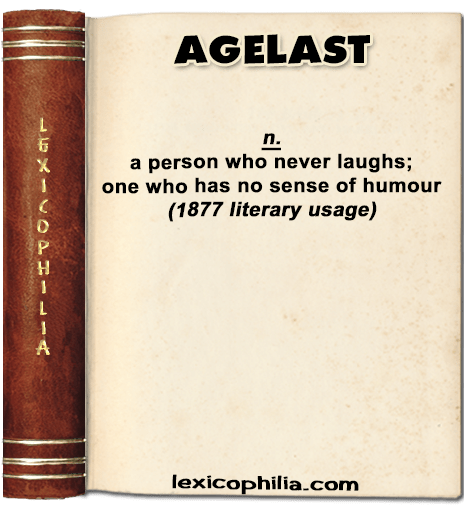
Word of the Day: AGELAST


ETYMOLOGY
from agelaste (person who never laughs),  from Greek ἀγέλαστος (agelastos – not laughing),
from ἀ- (a having sense without) + γελασ-, stem of γελᾶν (to laugh) + ‑τος


EXAMPLE
“…But let us beware lest in our laughter we commit the very sin which raised it, for through all laughter, the most benighted, must arise primarily from an, at least, imagined comic perception, in most the maximum is on the wrong side, Over-laughing, the sin of the ‘hypergelast’ as Mr. Meredith terms him, is even less tolerable to the muse than that of the ‘agelast‘ he who
‘Show his teeth in way of smile
Though Nestor swore the jest be laughable,’
and if we are guilty of it, the muse will but send out another laughter upon ours, which in its turn may need chastening
…”

From: George Meredith: Some Characteristics.
By Richard Le Gallienne, 1890
‘The Comic Muse’


PRONUNCIATION
AJ-uh-lasst

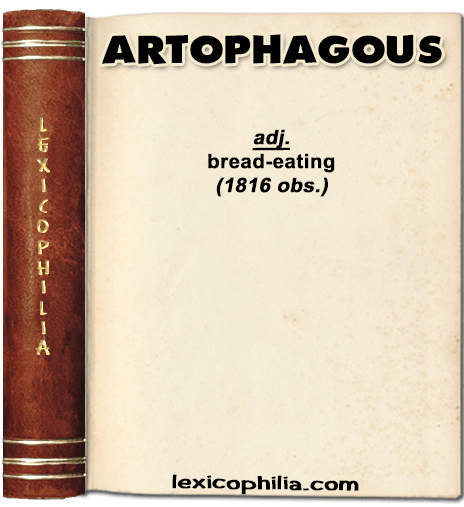
Word of the Day: ARTOPHAGOUS


ETYMOLOGY
from Greek ἀρτοϕάγος (bread-eating) [from ρτο-, combining form of ἄρτος (bread) + ‑ϕάγος (eating)] + -ous


EXAMPLE
“…give him a loaf, Tom] Again! Our old writers are never weary of this jest. In the ‘Rebellion,’ by Rawlins, allusions to this artophagous propensity of the tailors occur in almost every page…”

From: The Works of Ben Jonson
Edited by W. Gifford, Volume the Fifth, 1816
‘The Staple of News’

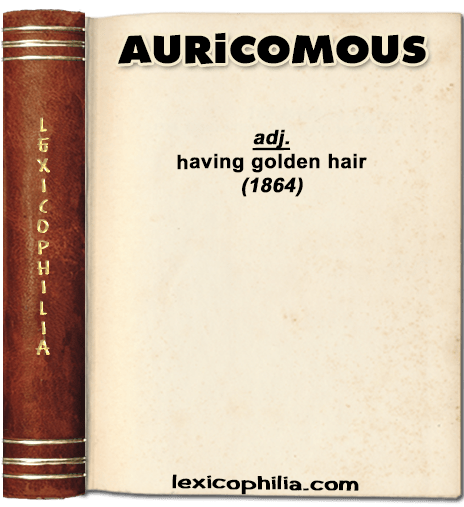
Word of the Day: AURICOMOUS


ETYMOLOGY
from Latin auricomus, from auri-, comb. form of aurum (gold) + coma (hair) + -ous


EXAMPLE
“…Mrs. Poignarde, who was walking beside Saltasche, raised her eyelashes, and timidly looked for a recognition. Mrs. Hepenstall, a very frisky matron, and her friend of the auricomous hair, looked blankest forgetfulness…”

From: Hogan, M.P.: A Novel
By May Laffan Hartley, 1881

Word of the Day: ACERVATE


ETYMOLOGY
from Latin acervāt- past participial stem of acervare (to make into heaps, to pile up),
from acervus (a heap)


EXAMPLE
“…The mass of burning embers, by which the oven had been heated, was not, as he pretended, fairly swept out. Those that were well ignited were acervated (heaped up) into one corner; and the steak, so far from being left to the action of the heated air of the oven, was put between two tin dishes, and was embedded in the mass of the burning embers in the corners. …”

From: Arcana of Science and Art
Or, An Annual Register of Popular Inventions and Improvements
Printed by John Limbird, 1830
‘Chemical Science. The Fire King’

Word of the Day: ACYROLOGICAL


ETYMOLOGY
from Greek ἀκυρολόγος (akyrologos) (incorrect in speech);
from ἀ (not) + κῦρος (authority) + λόγος (speech) + -ical


EXAMPLE
for adverb form – (‘acyrologically – incorrectly as regards the use of words’)

“…He saith, (but Magisterially without the least proof) that the Apostle speaks Acurologically and abusively; and by sanctified, means quasi, as if they were sanctified…”

From: Plain Scripture Proof of Infants Church-Membership and Baptism
By Richard Baxter, 1651

Word of the Day: AUTEXOUSIOUS


ETYMOLOGY
from Greek αὐτεξούσιος (free will) + -ous


EXAMPLE
“…For First, as to Moral Evils, (which are the Chiefest) there is a Necessity that there should be Higher and Lower Inclinations in all Rational Beings Vitally United to Bodies, and that as Autexousious or Free-willed, they should have a Power of determining themselves more or less, either way…”

From: The True Intellectual System of the Universe
By Ralph Cudworth, 1678

Word of the Day: AGUERRIED


ETYMOLOGY
from French aguerri, (to accustom to war) + -ed


EXAMPLE
“…But, said he, we have an army to defend us in case of an invasion; an army maintain’d in time of peace, and the best aguerried of any troops in Europe that have never seen an enemy…”

From: Letters from a Persian in England to his Friend at Ispahan
By George Lyttelton, 1735

Word of the Day: ANCIPITOUS


ETYMOLOGY
from Latin anceps-cipitis (two-edged or double)


EXAMPLE
“…of Planets amicall, benevolous, auspicious, fortunate; and inimicall, maleficall, unfortunate, exitiall; as also ancipitous, and indifferent to both (and all these sometimes roborated, and holpen; sometimes infirmed, and hindred one by another)…”

From: Πῦς-μαντία. (Pus-mantia) The Mag-Astro-Mancer, 
Or The Magicall-Astrologicall-Diviner posed, and puzzled,
By John Gaule, 1652