Word of the Day: AURICOMOUS


ETYMOLOGY
from Latin auricomus, from auri-, comb. form of aurum (gold) + coma (hair) + -ous


EXAMPLE
“…Mrs. Poignarde, who was walking beside Saltasche, raised her eyelashes, and timidly looked for a recognition. Mrs. Hepenstall, a very frisky matron, and her friend of the auricomous hair, looked blankest forgetfulness…”

From: Hogan, M.P.: A Novel
By May Laffan Hartley, 1881
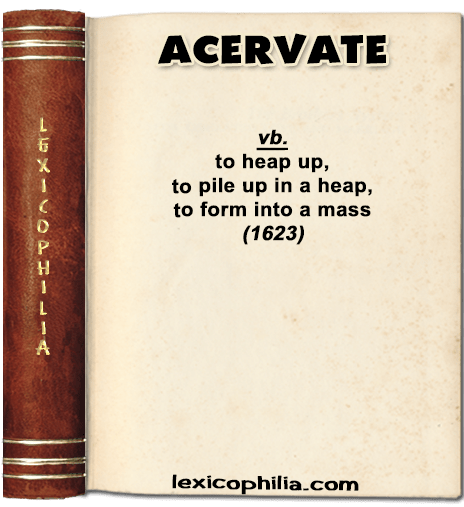
Word of the Day: ACERVATE


ETYMOLOGY
from Latin acervāt- past participial stem of acervare (to make into heaps, to pile up),
from acervus (a heap)


EXAMPLE
“…The mass of burning embers, by which the oven had been heated, was not, as he pretended, fairly swept out. Those that were well ignited were acervated (heaped up) into one corner; and the steak, so far from being left to the action of the heated air of the oven, was put between two tin dishes, and was embedded in the mass of the burning embers in the corners. …”

From: Arcana of Science and Art
Or, An Annual Register of Popular Inventions and Improvements
Printed by John Limbird, 1830
‘Chemical Science. The Fire King’

Word of the Day: ACYROLOGICAL


ETYMOLOGY
from Greek ἀκυρολόγος (akyrologos) (incorrect in speech);
from ἀ (not) + κῦρος (authority) + λόγος (speech) + -ical


EXAMPLE
for adverb form – (‘acyrologically – incorrectly as regards the use of words’)

“…He saith, (but Magisterially without the least proof) that the Apostle speaks Acurologically and abusively; and by sanctified, means quasi, as if they were sanctified…”

From: Plain Scripture Proof of Infants Church-Membership and Baptism
By Richard Baxter, 1651

Word of the Day: AUTEXOUSIOUS


ETYMOLOGY
from Greek αὐτεξούσιος (free will) + -ous


EXAMPLE
“…For First, as to Moral Evils, (which are the Chiefest) there is a Necessity that there should be Higher and Lower Inclinations in all Rational Beings Vitally United to Bodies, and that as Autexousious or Free-willed, they should have a Power of determining themselves more or less, either way…”

From: The True Intellectual System of the Universe
By Ralph Cudworth, 1678

Word of the Day: AGUERRIED


ETYMOLOGY
from French aguerri, (to accustom to war) + -ed


EXAMPLE
“…But, said he, we have an army to defend us in case of an invasion; an army maintain’d in time of peace, and the best aguerried of any troops in Europe that have never seen an enemy…”

From: Letters from a Persian in England to his Friend at Ispahan
By George Lyttelton, 1735

Word of the Day: ANCIPITOUS


ETYMOLOGY
from Latin anceps-cipitis (two-edged or double)


EXAMPLE
“…of Planets amicall, benevolous, auspicious, fortunate; and inimicall, maleficall, unfortunate, exitiall; as also ancipitous, and indifferent to both (and all these sometimes roborated, and holpen; sometimes infirmed, and hindred one by another)…”

From: Πῦς-μαντία. (Pus-mantia) The Mag-Astro-Mancer, 
Or The Magicall-Astrologicall-Diviner posed, and puzzled,
By John Gaule, 1652

Word of the Day: AROMATOUS


ETYMOLOGY
from Latin aromata or French aromat, as if adapted from Latin aromatosus or French aromateux


EXAMPLE
“…And thenne it hath vertue tascende by the lightnes of the fume and to comforte by his qualite and to conioyne by the gumme and to conferme by that it is aromatous or wel smellyng. And all in lyke wyse i the orison or prayer whiche ascendeth to the mynde of god. It conforteth the soule as to the synne passed in axyng medecyne…”

From: Legenda Aurea/The Golden Legend
By Jacobus de Voragine
Translated by William Caxton, 1483

Word of the Day: ACCIDIOUS


ETYMOLOGY
from medieval Latin accidiosus (listless, slothful),
from accidia (slothfulness, apathy, lethargy) + Latin -osus (-ous)


PRONUNCIATION
uhk-SID-ee-uhss


EXAMPLE
“…Þe accidious man haþ ydilnesse, sleuþe, & sleep for his god…”

From: The Pore Caitif, edited from MS. Harley, a1400
(a late fourteenth-century Middle English manual of religious instruction intended for the use of the laity)

Word of the Day: AUXILIATE


ETYMOLOGY
from Latin auxiliat- ppl. stem of auxiliari (to help, to assist)


EXAMPLE
“…of which are some Plants, or parts thereof, and some Minerals, which being absolutely described, put the Apothecary upon doubts, who is ignorant of the genuine dilucidation: whose tenuity, that we may auxiliate, we will give him the names of the five opening roots; and they are the roots of Smallage, Sperage, Parsley, Fennel, and Butchers-broom. Besides which, other five are much celebrated, to wit, the roots of Grass, the greater Madder, Oenone, Ca∣pers, and Eryngium…”

From: A Medical Dispensatory
Containing the Whole Body of Physick
Composed by the Illustrious Renodaeus,
Englished and Revised by Richard Tomlinson, 1657
The Fourth Book Of Roots

Word of the Day: ASTRAPHOBIA


ETYMOLOGY
from Greek ἀστραπή (astrape lightning) + phobos (fear)


EXAMPLE
“…These nervous perturbations, in their various degrees, have seemed to me to be sufficiently frequent and distinctive to entitle them to be regarded as a separate disease. To this disease I have given the name Astraphobia…”

From: Te Popular Science Monthly
Conducted by E. L. Youmans, Vol. IV. February 1874
Atmospheric Electricity and Ozone