Word of the Day: ASTRAPHOBIA


ETYMOLOGY
from Greek ἀστραπή (astrape lightning) + phobos (fear)


EXAMPLE
“…These nervous perturbations, in their various degrees, have seemed to me to be sufficiently frequent and distinctive to entitle them to be regarded as a separate disease. To this disease I have given the name Astraphobia…”

From: Te Popular Science Monthly
Conducted by E. L. Youmans, Vol. IV. February 1874
Atmospheric Electricity and Ozone
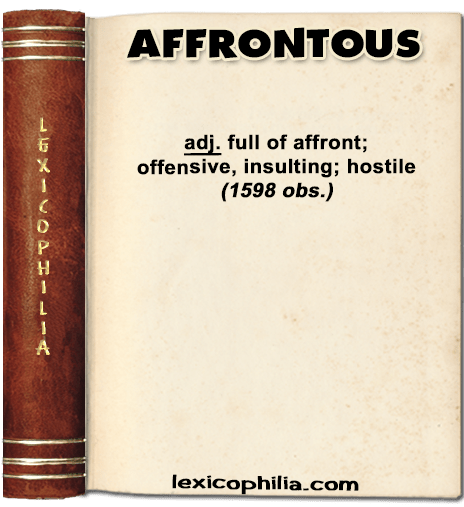
Word of the Day: AFFRONTOUS


ETYMOLOGY
 either from affront (n.) or affront (vb.) + -ous,
perhaps after Middle French affronteur (opposing, attacking)


EXAMPLE
“…for those Counsels are sufficient honourable, which render securitie vnto doubtfull affaires. And on the contrary, those are most affrontous, & miserable; when being enterprised with temeritie, onely to shew a vaine presumption, and rigorous boldnesse of minde, they are wont to disturbe the good courses of the honorable enterprises, and of the victories whereof great hope is to be had…”

From: The Theorike and Practike of Moderne Warres
By Robert Barret, 1598

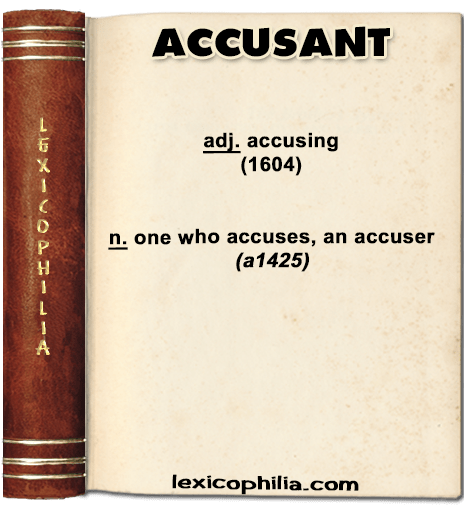
Word of the Day: ACCUSANT


ETYMOLOGY
from French accusant (n. person who accuses), (adj. that accuses)


PRONUNCIATION
uh-KYOO-zuhnt


EXAMPLE
“…The whole Councell beeing afterward called together, they gaue them-selues to the vnderstanding of the matter. As for the crime and the punishment, was of the accusant called vpon in these wordes: The Iudgement of death is due to this man, because hee hath done this or that. But the Defendant repelled it, with these wordes. The Iudgement of death is not due this man, because hee hath not done it, or because hee hath doone it righteously …”

From: A Defence of the Government Established in the Church of Englande
By John Bridges, 1587

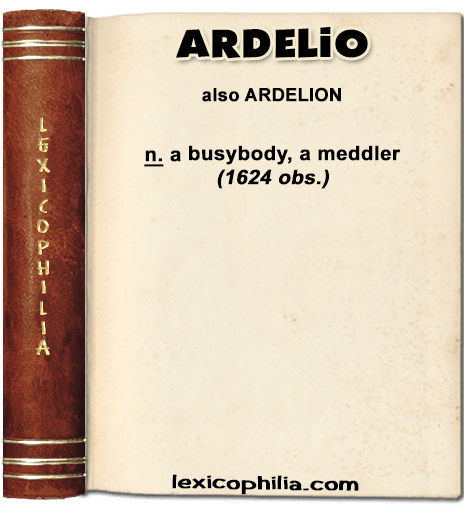
Word of the Day: ARDELIO


ETYMOLOGY
from Latin ardelio, from ardere (to burn, be eager or zealous)


EXAMPLE
“…we run, ride, take indefatigable pains, all up early, down late, striving to get that which we had better be without, (Ardelion’s busybodies as we are) it were much fitter for us to be quiet, sit still, and take our ease…”

From: The Anatomy of Melancholy
By Robert Burton, 1624

Word of the Day: ARGUITIVE


ETYMOLOGY
from Latin arguit- ppl. stem of arguere + -ive, as if from Latin arguitivus (attacking or accusing)


EXAMPLE
“…But, as it is, the only knowledge of God to which the mind of man can naturally attain, is arguitive, being deduced from his cognitions of the creature; and therefore in the enunciation of the Thesis, the direct measure of the human intellect is restricted to finite Being…”

From: The Metaphysics of the School
By Thomas Harper, 1879

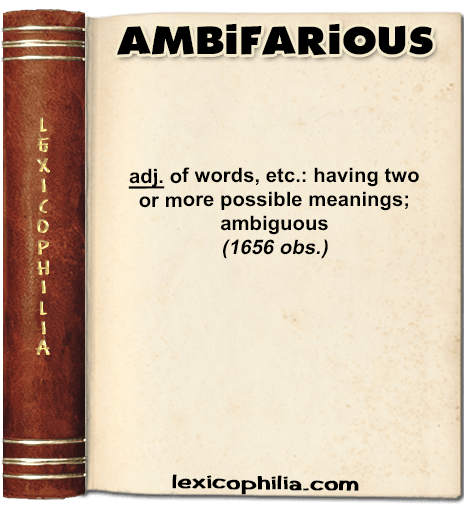
Word of the Day: AMBIFARIOUS


ETYMOLOGY
from Latin ambifarius two-sided, of double meaning + -ous


EXAMPLE
“…The Bridegroom, with his Bride is brought,
To Bed with various Turn of Thought;
By Ruth, with ambifarious Jest:
To please them both, she thinks it best
…”

From: Poems on Various Subjects,
By Thomas Sadler, 1766
The Unfortunate Batchelor, Or Wife’s Resentment

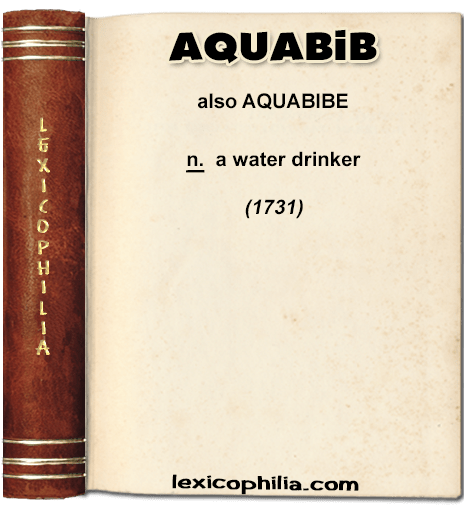
Word of the Day: AQUABIB


ETYMOLOGY
from Latin aqua (water) + bibere (to drink)


EXAMPLE
“…To call a man a total abstainer would imply that he abstained from everything; to call him a temperance man is absurd, because from time immemorial men have drunk, as they still drink, wine temperately. Aquabib and hydropot may mean one who drinks water, but most men do that. I drink it always to quench thirst, but then I drink also a moderate quantity of wine…”

From: The Medical Times and Gazette,
A Journal of Medical Science, Literature, Criticism, and News
Volume I for 1883
“Temperance Appellations”

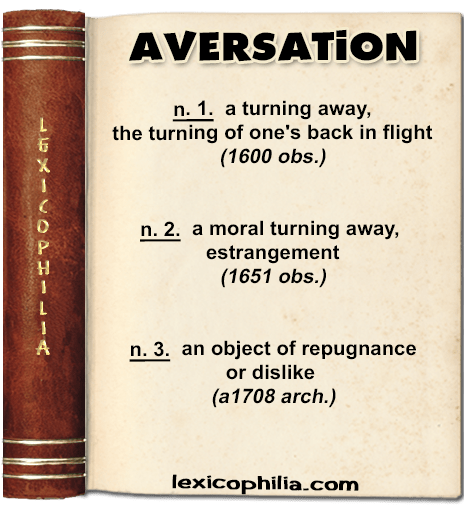
Word of the Day: AVERSATION


ETYMOLOGY
rom Latin aversationem, noun of action from aversat-


EXAMPLE
“…He can bear glory to their fleet, or shut up all their toils In his one suff’rance on thy lance.” With this deceit she led, And, both come near, thus Hector spake: “Thrice have I compassed This great town, Peleus’ son, in flight, with aversation That out of fate put off my steps; but now all flight is flown, The short course set up, death or life. Our resolutions yet Must shun all rudeness, and the Gods before our valour set For use of victory;…”

From: The Whole Works of Homer in his Iliads and Odysses
Translated by George Chapman, 1616