Word of the Day: AROMATOUS


ETYMOLOGY
from Latin aromata or French aromat, as if adapted from Latin aromatosus or French aromateux


EXAMPLE
“…And thenne it hath vertue tascende by the lightnes of the fume and to comforte by his qualite and to conioyne by the gumme and to conferme by that it is aromatous or wel smellyng. And all in lyke wyse i the orison or prayer whiche ascendeth to the mynde of god. It conforteth the soule as to the synne passed in axyng medecyne…”

From: Legenda Aurea/The Golden Legend
By Jacobus de Voragine
Translated by William Caxton, 1483

Word of the Day: ACCIDIOUS


ETYMOLOGY
from medieval Latin accidiosus (listless, slothful),
from accidia (slothfulness, apathy, lethargy) + Latin -osus (-ous)


PRONUNCIATION
uhk-SID-ee-uhss


EXAMPLE
“…Þe accidious man haþ ydilnesse, sleuþe, & sleep for his god…”

From: The Pore Caitif, edited from MS. Harley, a1400
(a late fourteenth-century Middle English manual of religious instruction intended for the use of the laity)

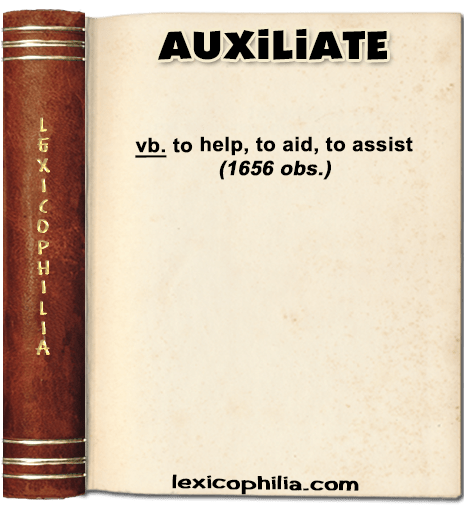
Word of the Day: AUXILIATE


ETYMOLOGY
from Latin auxiliat- ppl. stem of auxiliari (to help, to assist)


EXAMPLE
“…of which are some Plants, or parts thereof, and some Minerals, which being absolutely described, put the Apothecary upon doubts, who is ignorant of the genuine dilucidation: whose tenuity, that we may auxiliate, we will give him the names of the five opening roots; and they are the roots of Smallage, Sperage, Parsley, Fennel, and Butchers-broom. Besides which, other five are much celebrated, to wit, the roots of Grass, the greater Madder, Oenone, Ca∣pers, and Eryngium…”

From: A Medical Dispensatory
Containing the Whole Body of Physick
Composed by the Illustrious Renodaeus,
Englished and Revised by Richard Tomlinson, 1657
The Fourth Book Of Roots

Word of the Day: ASTRAPHOBIA


ETYMOLOGY
from Greek ἀστραπή (astrape lightning) + phobos (fear)


EXAMPLE
“…These nervous perturbations, in their various degrees, have seemed to me to be sufficiently frequent and distinctive to entitle them to be regarded as a separate disease. To this disease I have given the name Astraphobia…”

From: Te Popular Science Monthly
Conducted by E. L. Youmans, Vol. IV. February 1874
Atmospheric Electricity and Ozone

Word of the Day: AFFRONTOUS


ETYMOLOGY
 either from affront (n.) or affront (vb.) + -ous,
perhaps after Middle French affronteur (opposing, attacking)


EXAMPLE
“…for those Counsels are sufficient honourable, which render securitie vnto doubtfull affaires. And on the contrary, those are most affrontous, & miserable; when being enterprised with temeritie, onely to shew a vaine presumption, and rigorous boldnesse of minde, they are wont to disturbe the good courses of the honorable enterprises, and of the victories whereof great hope is to be had…”

From: The Theorike and Practike of Moderne Warres
By Robert Barret, 1598

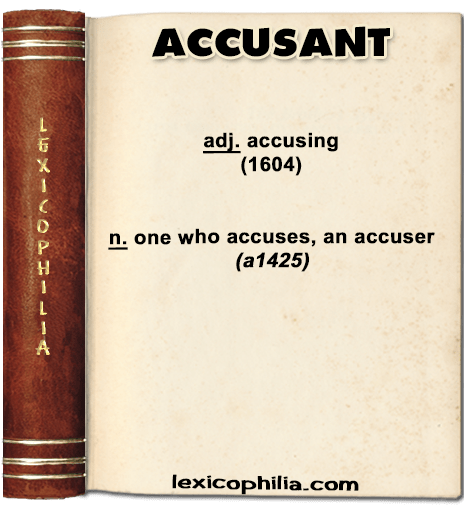
Word of the Day: ACCUSANT


ETYMOLOGY
from French accusant (n. person who accuses), (adj. that accuses)


PRONUNCIATION
uh-KYOO-zuhnt


EXAMPLE
“…The whole Councell beeing afterward called together, they gaue them-selues to the vnderstanding of the matter. As for the crime and the punishment, was of the accusant called vpon in these wordes: The Iudgement of death is due to this man, because hee hath done this or that. But the Defendant repelled it, with these wordes. The Iudgement of death is not due this man, because hee hath not done it, or because hee hath doone it righteously …”

From: A Defence of the Government Established in the Church of Englande
By John Bridges, 1587

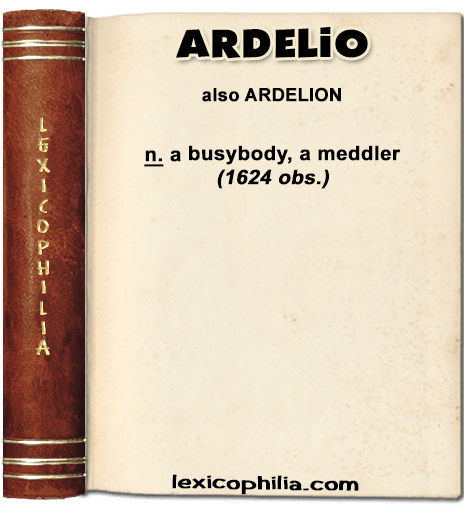
Word of the Day: ARDELIO


ETYMOLOGY
from Latin ardelio, from ardere (to burn, be eager or zealous)


EXAMPLE
“…we run, ride, take indefatigable pains, all up early, down late, striving to get that which we had better be without, (Ardelion’s busybodies as we are) it were much fitter for us to be quiet, sit still, and take our ease…”

From: The Anatomy of Melancholy
By Robert Burton, 1624

Word of the Day: ARGUITIVE


ETYMOLOGY
from Latin arguit- ppl. stem of arguere + -ive, as if from Latin arguitivus (attacking or accusing)


EXAMPLE
“…But, as it is, the only knowledge of God to which the mind of man can naturally attain, is arguitive, being deduced from his cognitions of the creature; and therefore in the enunciation of the Thesis, the direct measure of the human intellect is restricted to finite Being…”

From: The Metaphysics of the School
By Thomas Harper, 1879